
Close Menu
Arunangshu Das Blog
  • SaaS Tools
    • Business Operations SaaS
    • Marketing & Sales SaaS
    • Collaboration & Productivity SaaS
    • Financial & Accounting SaaS
  • Web Hosting
    • Types of Hosting
    • Domain & DNS Management
    • Server Management Tools
    • Website Security & Backup Services
  • Cybersecurity
    • Network Security
    • Endpoint Security
    • Application Security
    • Cloud Security
  • IoT
    • Smart Home & Consumer IoT
    • Industrial IoT
    • Healthcare IoT
    • Agricultural IoT
  • Software Development
    • Frontend Development
    • Backend Development
    • DevOps
    • Adaptive Software Development
    • Expert Interviews
      • Software Developer Interview Questions
      • Devops Interview Questions
    • Industry Insights
      • Case Studies
      • Trends and News
      • Future Technology
  • AI
    • Machine Learning
    • Deep Learning
    • NLP
    • LLM
    • AI Interview Questions
    • All about AI Agent
  • Startup

Subscribe to Updates

Subscribe to our newsletter for updates, insights, tips, and exclusive content!

What's Hot

How AI Agents Are Improving Paid Advertising Campaign Performance

June 26, 2026

Optimizing Real-Time Applications in Node.js with WebSockets and GraphQL

December 23, 2024

How AI Is Transforming Medical Imaging and Diagnostics

November 27, 2025
X (Twitter) Instagram LinkedIn
Arunangshu Das Blog Monday, August 17
  • Write For Us
  • Blog
  • Stories
  • Gallery
  • Contact Me
  • Newsletter
Facebook X (Twitter) Instagram LinkedIn RSS
Subscribe
  • SaaS Tools
    • Business Operations SaaS
    • Marketing & Sales SaaS
    • Collaboration & Productivity SaaS
    • Financial & Accounting SaaS
  • Web Hosting
    • Types of Hosting
    • Domain & DNS Management
    • Server Management Tools
    • Website Security & Backup Services
  • Cybersecurity
    • Network Security
    • Endpoint Security
    • Application Security
    • Cloud Security
  • IoT
    • Smart Home & Consumer IoT
    • Industrial IoT
    • Healthcare IoT
    • Agricultural IoT
  • Software Development
    • Frontend Development
    • Backend Development
    • DevOps
    • Adaptive Software Development
    • Expert Interviews
      • Software Developer Interview Questions
      • Devops Interview Questions
    • Industry Insights
      • Case Studies
      • Trends and News
      • Future Technology
  • AI
    • Machine Learning
    • Deep Learning
    • NLP
    • LLM
    • AI Interview Questions
    • All about AI Agent
  • Startup
Arunangshu Das Blog
  • Write For Us
  • Blog
  • Stories
  • Gallery
  • Contact Me
  • Newsletter
Home » Artificial Intelligence » Machine Learning » Master the Z-Score in Statistics: Formula, Interpretation, and Real-World Applications
Machine Learning

Master the Z-Score in Statistics: Formula, Interpretation, and Real-World Applications

Arunangshu DasBy Arunangshu DasApril 6, 2024Updated:August 12, 2026No Comments5 Mins Read
Facebook Twitter Pinterest Telegram LinkedIn Tumblr Copy Link Email Reddit Threads WhatsApp
Follow Us
Facebook X (Twitter) LinkedIn Instagram
Share
Facebook Twitter LinkedIn Pinterest Email Copy Link Reddit WhatsApp Threads
Master the Z Score in Statistics Formula Interpretation and Real World Applications

In data analytics and statistics, standardizing raw data is often the first step toward drawing meaningful insights. The Z-score (or standard score) is a core statistical metric that measures how many standard deviations a specific data point lies away from the dataset’s mean.

Whether you are building machine learning models, conducting academic research, or analyzing business performance, understanding Z-scores enables you to evaluate individual values relative to an entire population, detect anomalies, and compare datasets across completely different scales.
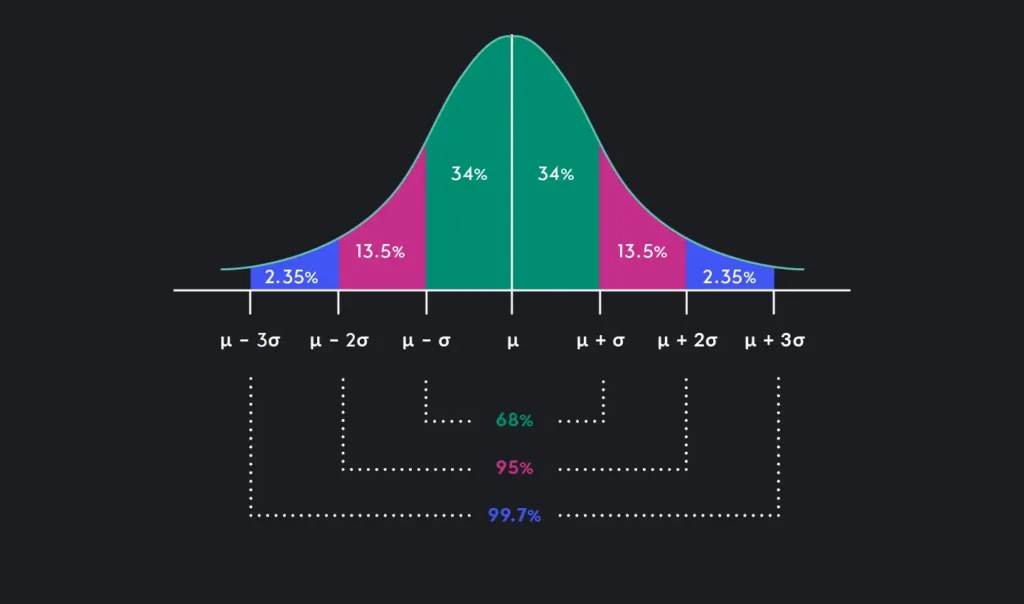
image 6
credits

What Is a Z-Score?

A Z-score standardizes individual values within a distribution by shifting the mean to $0$ and setting the standard deviation to $1$. This process creates a Standard Normal Distribution, allowing for direct comparisons between datasets that originally used different units or measurement scales.

  • Positive Z-score: Indicates a value above the mean.
  • Negative Z-score: Indicates a value below the mean.
  • Z-score of 0: Indicates a value exactly equal to the mean.

Read more blog : Beyond the Bell Curve: A Deep Dive into the Central Limit Theorem

The Basic Z-Score Formula

To calculate the Z-score for an individual observation ($X$) in a dataset with mean $\mu$ and standard deviation $\sigma$:
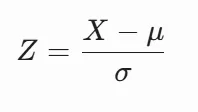
image 4

Where:

  • $Z$ = Z-score (Standard Score)
  • $X$ = Individual raw data point
  • $\mu$ = Population mean
  • $\sigma$ = Population standard deviation

Z-Score in Hypothesis Testing

When conducting hypothesis tests or building confidence intervals for a population mean ($\mu$) using a sample mean ($\bar{x}$), the Z-score calculation accounts for sample size ($n$).

Z-Score Formula for Sample Means
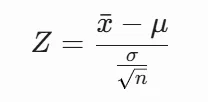
image 5

Where:

  • $\bar{x}$ = Sample mean
  • $\mu$ = Hypothesized population mean
  • $\sigma$ = Population standard deviation
  • $n$ = Sample size
  • $\frac{\sigma}{\sqrt{n}}$ = Standard Error of the Mean (SEM)

The Standard Error of the Mean quantifies expected sampling variability. As sample size ($n$) increases, standard error decreases, making the Z-test more sensitive to minor deviations from the null hypothesis.

Standard Normal Distribution Interpretation

Understanding standard deviation coverage helps quickly classify data points based on their Z-scores in a normal bell curve.

Z-Score RangePercentile / Population CoveredStatistical Interpretation
$-1.00$ to $+1.00$~68.27% of total dataTypical / Expected observation range
$-2.00$ to $+2.00$~95.45% of total dataModerate variation from average
$-3.00$ to $+3.00$~99.73% of total dataExtreme threshold (Empirical 68-95-99.7 Rule)
Beyond $\pm 3.00$$< 0.27\%$ of total dataStatistical Outlier requiring further analysis

Read more blog: 5 Key Principles of Database Normalization

Key Benefits of Using Z-Scores

  1. Data Normalization: Converts continuous variables with different scales (e.g., income in dollars vs. age in years) into dimensionless units suitable for machine learning algorithms like k-NN or Principal Component Analysis (PCA).
  2. Outlier Detection: Provides an objective, mathematical threshold (typically $\vert{}Z\vert{} > 3$) to identify data anomalies, fraud, or measuring errors.
  3. Probability & Percentile Mapping: Pairs directly with Z-tables or statistical algorithms to determine exact percentiles and tail probabilities.
  4. Standardized Benchmarking: Facilitates cross-industry performance metrics, such as comparing standardized test scores across different test versions or years.

Practical Applications Across Industries

  • Finance & Risk Management: Altman’s Z-Score model evaluates financial metrics (liquidity, profitability, leverage) to predict corporate bankruptcy risk.
  • Healthcare & Pediatrics: World Health Organization (WHO) growth charts use Z-scores to track infant height, weight, and nutritional development relative to global benchmarks.
  • Quality Control & Manufacturing: Six Sigma protocols track process deviations in Z-scores to limit production defects to under 3.4 per million opportunities.
  • Digital Marketing & UX Testing: Evaluates conversion rate changes across split tests (A/B testing) to confirm statistical significance over baseline noise.

Level Up Your Statistical Analysis

Conclusion

In conclusion, the Z-score is a versatile and indispensable tool in the realm of statistics. Its ability to standardize data, identify outliers, and facilitate probabilistic calculations makes it invaluable for researchers, analysts, and decision-makers across various domains. By understanding and leveraging the power of Z-scores, one can gain deeper insights into datasets, make informed decisions, and drive meaningful outcomes in both research and practical applications. So, the next time you encounter a dataset, remember the mighty Z-score and its role in unlocking the secrets hidden within the numbers.

Frequently Asked Questions (FAQs)

1. What is the difference between a Z-score and a T-score?

A Z-score is used when the population standard deviation ($\sigma$) is known or when the sample size is large ($n \ge 30$). A T-score is used when the population standard deviation is unknown and the sample size is small ($n < 30$), relying instead on the sample standard deviation ($s$).

2. Can a Z-score be negative?

Yes. A negative Z-score simply means the data point falls below the population mean. For instance, a Z-score of $-1.5$ indicates the value is 1.5 standard deviations lower than average.

3. What does a Z-score of 0 mean?

A Z-score of 0 means the observed data point is equal to the population mean.

4. How do you find the probability corresponding to a Z-score?

You can look up the Z-score value in a standard normal distribution table (Z-table) or use statistical computing functions (e.g., norm.cdf() in Python or NORM.S.DIST() in Excel) to retrieve the cumulative probability.

5. Why is a Z-score threshold of $\pm 3$ commonly used for outliers?

Under a standard normal distribution, approximately 99.73% of all observations lie within 3 standard deviations of the mean. Values exceeding $\pm 3$ occur less than 0.27% of the time by random chance, making them strong candidates for outliers.

Artificial Intelligence Machine Learning
Follow on Facebook Follow on X (Twitter) Follow on LinkedIn Follow on Instagram
Share. Facebook Twitter Pinterest LinkedIn Telegram Email Copy Link Reddit WhatsApp Threads
Previous ArticleNormal Distribution: Comprehensive Guide 2026
Next Article Beyond the Bell Curve: A Deep Dive into the Central Limit Theorem
Arunangshu Das
  • Website
  • Facebook
  • X (Twitter)

Trust me, I'm a software developer—debugging by day, chilling by night.

Related Posts

AI Workflows You Can Build Without Coding

August 16, 2026

CRM for Startups: Why It Matters from Day One in 2026

July 23, 2026

Future of Cloud Hosting: Trends Businesses Should Watch in 2026

July 20, 2026
Add A Comment
Leave A Reply Cancel Reply

You must be logged in to post a comment.

Top Posts

Technical Interview Questions for Software Developers (Complete Guide)

May 21, 2026

What is Cybersecurity? An Amazing Beginner’s Introduction

May 28, 2025

IoT Solutions for Smart Offices and Enterprise Efficiency: Transforming the Modern Workplace

February 26, 2025

Cybersecurity Challenges in the Era of 5G

November 11, 2025
Don't Miss

How Natural Language Processing Works in Artificial Intelligence?

January 8, 20267 Mins Read

At the intersection of linguistics, computer science, and artificial intelligence lies a transformative field: Natural…

Top 7 Affordable Web Hosting Plans Perfect for Small Businesses

December 8, 2025

Going Beyond Scrum: Exploring Various Agile Software Development Approaches

June 12, 2025

Cloud Computing Boom: What AWS, Azure, and Google Cloud Mean for Investors in 2026

September 1, 2025
Stay In Touch
  • Facebook
  • Twitter
  • Pinterest
  • Instagram
  • LinkedIn

Subscribe to Updates

Subscribe to our newsletter for updates, insights, and exclusive content every week!

About Us

I am Arunangshu Das, a Software Developer passionate about creating efficient, scalable applications. With expertise in various programming languages and frameworks, I enjoy solving complex problems, optimizing performance, and contributing to innovative projects that drive technological advancement.

Facebook X (Twitter) Instagram LinkedIn RSS
Don't Miss

NLP: Fine-Tuning Pre-trained Models for Maximum Performance

May 16, 2024

How to Protect Your E-Commerce Website from Online Fraud?

November 11, 2025

Fraud Prevention with Financial SaaS: How AI Flags Risk in Real Time in 2025

November 11, 2025
Most Popular

Top 50 Software Developer Interview Questions and Answers (2026 Guide)

May 18, 2026

VGG and LeNet-5 Architectures: Key Differences and Real-World Applications

December 31, 2024

The Risks of IoT Device Firmware Vulnerabilities and How to Fix Them

November 11, 2025
Arunangshu Das Blog
  • About Us
  • Contact Us
  • Write for Us
  • Advertise With Us
  • Privacy Policy
  • Terms & Conditions
  • Disclaimer
  • Article
  • Blog
  • Newsletter
  • Media House
© 2026 Arunangshu Das. Designed by Arunangshu Das.

Type above and press Enter to search. Press Esc to cancel.

Ad Blocker Enabled!
Ad Blocker Enabled!
Our website is made possible by displaying online advertisements to our visitors. Please support us by disabling your Ad Blocker.