



Artificial intelligence is entering a new technological phase where systems do more than predict or generate content- they act. This evolution has given rise to AI agents.
Traditional machine learning models typically respond to isolated inputs. An AI model might classify images, predict demand, or generate text based on prompts.
AI agents, however, operate differently. They follow a structured decision-making loop where they observe their environment, reason about the objective, plan the next step, and take action. This continuous loop allows them to complete complex, multi-step tasks.
Because of this capability, organizations are exploring agent-based automation for functions such as software debugging, data analysis, cybersecurity monitoring, and customer service orchestration.
For developers and technology leaders, it is important to understand how AI agents work and how to build an AI agent from scratch as a foundational skill in modern software architecture.
Also Read: How to Train an AI Agent Using Your Company Data: An Enterprise Guide
What are AI Agents
An AI agent is a goal-oriented software system that interacts with its environment to accomplish tasks autonomously. Unlike rule-based automation scripts, agents can evaluate the situation and decide what action to perform next.
Most AI agents follow a decision loop often described as:
Observe → Reason → Plan → Act
This loop enables the agent to continuously adapt its behavior while progressing toward the target objective.
A modern AI agent architecture typically consists of several interconnected modules:
- Perception Layer
- Reasoning Engine
- Planning Module
- Memory System
- Tool Integration Layer
- Feedback and Evaluation Loop
Each component plays a distinct role in enabling the agent to operate autonomously.
Also Read: Tool Calling for Agents Using JSON Schemas & Error Handling
Perception Layer- Understanding the Environment
The perception layer in AI agents acts as the system’s input interface. It gathers information from various sources such as APIs, databases, user inputs, or sensors.
For text-based tasks, inputs are often converted into vector embeddings using models such as OpenAI’s embedding models or Cohere’s embedding APIs. These embeddings transform text into numerical vectors, allowing the agent to perform semantic similarity searches.
In enterprise environments, this perception layer often connects with:
- Enterprise databases
- Cloud data warehouses such as Snowflake or BigQuery
- ERP systems like SAP or Dynamics 365
- External APIs and monitoring tools
Through these integrations, AI agents for enterprise automation can interpret real-time operational data.
Reasoning Engine: The Cognitive Core
The reasoning layer is typically powered by a Large Language Model (LLM) such as GPT-4, Claude, Gemini, or LLaMA.
These models rely on the transformer architecture, which enables attention-based reasoning across large context windows.
Within an AI agent reasoning loop, the model typically performs four steps:
- Interpret the current task or state
- Break the objective into subtasks
- Evaluate possible actions
- Select the most effective action
Advanced orchestration frameworks such as LangGraph, AutoGen, and CrewAI enable developers to build multi-agent systems, where multiple AI agents collaborate to complete complex workflows.
Planning Mechanisms: Turning Thought into Action
While reasoning generates ideas, planning mechanisms organize those ideas into executable steps.
Without planning, an AI model may generate responses but cannot reliably execute complex workflows. To address this challenge, modern agent frameworks incorporate structured reasoning strategies.
- Chain-of-Thought (CoT): Encourages explicit step-by-step reasoning, improving performance on logical tasks.
- ReAct (Reason + Act): Alternates between reasoning and external tool execution, forming a self-feedback loop.
- Tree-of-Thought (ToT): Expands on CoT by exploring multiple reasoning branches simultaneously, pruning low-confidence paths through scoring heuristics.
Memory Systems: Maintaining Context
To operate across long workflows, AI agents require persistent memory. Without memory, the system would lose context after every interaction.
Most architectures include two types of memory:
- Short-term memory: This stores the immediate context of a task, such as the current conversation or execution state.
- Long-term memory: This stores knowledge accumulated across interactions.
Long-term memory is often implemented using vector databases. These databases store embeddings of documents, previous conversations, or knowledge sources. When the agent encounters a new query, it retrieves semantically similar information through vector similarity search.
Tool Integration: Enabling Real-World Actions
An AI agent becomes truly useful when it can interact with external systems. Through tool integration layers, agents can execute API calls, run scripts, or trigger workflows.
For example, an infrastructure monitoring agent might:
- retrieve system metrics
- analyze log data
- trigger automated recovery processes
- generate performance reports
Frameworks such as LangChain, Semantic Kernel, and CrewAI provide standardized interfaces that allow agents to connect with external tools safely and efficiently.
Building an agent involves combining these modules into a continuous reasoning-execution loop.
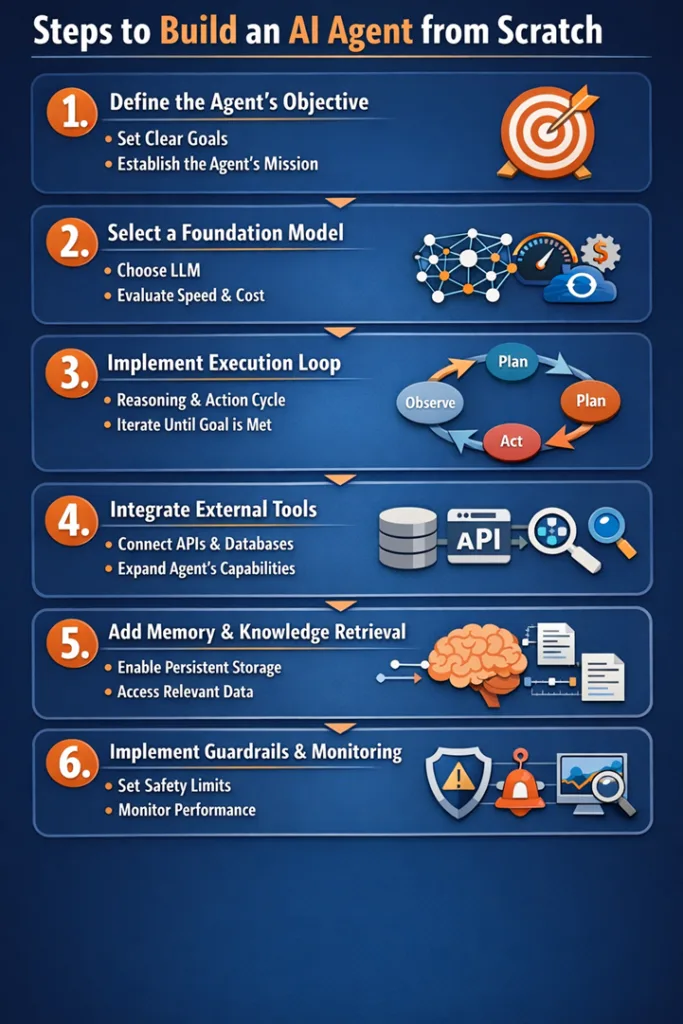
Step 1: Define the Agent’s Objective
Every agent must operate around a clearly defined goal. Without a goal-oriented design, the system cannot evaluate success or failure.
For example, a research agent may be tasked with gathering information from multiple sources and generating a summary report.
Step 2: Select a Foundation Model
The next step is selecting a suitable LLM. This choice depends on latency requirements, cost constraints, reasoning capability, and context window size.
Enterprise systems often benchmark models based on:
- inference speed
- token cost
- reasoning accuracy
- tool integration capability
Step 3: Implement the Agent Execution Loop
The agent must operate within a continuous reasoning loop that evaluates progress and determines the next action.
The basic loop generally follows the sequence:
Observe the environment-> reason about the goal-> generate an execution plan -> perform an action-> store results in memory -> evaluate whether the goal has been achieved
This loop repeats until the objective is completed.
Step 4: Integrate External Tools
Agents become significantly more powerful when connected to external tools. Developers often integrate APIs, databases, search engines, and automation platforms to expand the agent’s capabilities.
Step 5: Add Memory and Knowledge Retrieval
Persistent knowledge storage is essential for long-running tasks. Implementing vector search and RAG pipelines enables agents to access contextual information during reasoning.
Step 6: Implement Guardrails and Monitoring
Autonomous systems must be controlled through guardrails. Developers often impose limits on tool usage, reasoning depth, iteration cycles, and token consumption.
Production deployments also require monitoring systems that track latency, cost, and task completion accuracy.

The Future of Agent-Based AI Systems
The next stage of AI development will likely involve multi-agent ecosystems, where specialized agents collaborate to solve complex problems. One agent may handle research, another may perform planning, while a third verifies results. This distributed architecture significantly expands the capabilities of automated systems.
As reasoning models improve and orchestration frameworks evolve, AI agents are expected to become a core component of modern software infrastructure, functioning as intelligent digital collaborators across industries.
Stay tuned for more such informative blogs.
FAQs
1. What programming languages are best for building AI agents?
Python is the most widely used language due to its strong ecosystem of AI libraries (such as TensorFlow, PyTorch, and LangChain). However, JavaScript (Node.js) is also gaining traction for building real-time, web-integrated agents.
2. How much does it cost to build and run an AI agent?
The cost depends on factors such as the choice of LLM, API usage, infrastructure, and frequency of execution. Token-based pricing for LLMs, vector database storage, and cloud compute costs are the primary contributors.
3. Can AI agents work offline or do they always require cloud access?
AI agents can run offline if deployed with local models (like LLaMA or other open-source LLMs). However, many enterprise-grade agents rely on cloud services for scalability, real-time data access, and advanced reasoning capabilities.
4. What are the biggest challenges when deploying AI agents in production?
Common challenges include managing hallucinations, ensuring data security, handling latency, maintaining cost efficiency, and implementing strong guardrails to prevent unintended actions.
