

In the modern search landscape, creating high-quality content is only half the battle. The other half is ensuring that content is meticulously structured and optimized to satisfy both user intent and search engine algorithms. This is where specialized content optimization tools for SEO become indispensable.
Moving beyond basic keyword research, these advanced platforms analyze top-performing pages to provide data-driven guidelines for creating content that ranks. Among the many options available, Surfer SEO, Clearscope, and Frase have emerged as leaders.
This article will delve into these three powerful content optimization tools, comparing their unique approaches, strengths, and ideal use cases to help you determine which is the best fit for your SEO strategy.
Table of Contents
What Are Content Optimization Tools and Why Do They Matter?
Content optimization tools for SEO are software platforms designed to bridge the gap between a content creator’s intent and what search engines deem authoritative for a given query. They work by conducting a deep analysis of the current search engine results page (SERP) for a target keyword. By processing the top 10-20 ranking pages, these tools extract actionable insights on factors like:
- Semantic Keywords: Related terms, entities, and questions that top pages include.
- Content Structure: Optimal word count, heading (H1-H4) distribution, and paragraph length.
- Readability: Target reading ease scores and sentence complexity.
- Technical Factors: Image usage, meta tag recommendations, and internal linking cues.
The core value proposition is clear: they remove guesswork. Instead of wondering what a “comprehensive” article looks like for “best hiking boots,” these tools provide a concrete blueprint based on empirical data, significantly increasing the probability of your content gaining visibility.
In-Depth Review: Top Content Optimization Tools
1. Surfer SEO: The Data-Driven Architecture Powerhouse
Surfer SEO operates on the principle of “SERP DNA.” It scans the top-ranking pages for your focus keyword and generates a detailed, real-time checklist of on-page elements required to compete.
Key Features:
- Content Editor: Its flagship feature. You write directly in the editor (or use its AI writer) while it provides live feedback on a “Content Score” out of 100, tracking your use of recommended keywords, headings, and structure.
- Audit Tool: Analyze existing pages against competitors to uncover precise gaps.
- Keyword Research & Graph: Identifies a core cluster of semantically related terms and visualizes their connection.
- Strength: Unmatched depth in structural analysis (word count, keyword density, heading structure). It’s essentially an engineering tool for content.
Best For: SEOs, agencies, and content teams who want granular, quantitative control over on-page optimization and thrive on a structured, checklist-driven approach.
2. Clearscope: The Enterprise-Grade Authority and Readability Leader
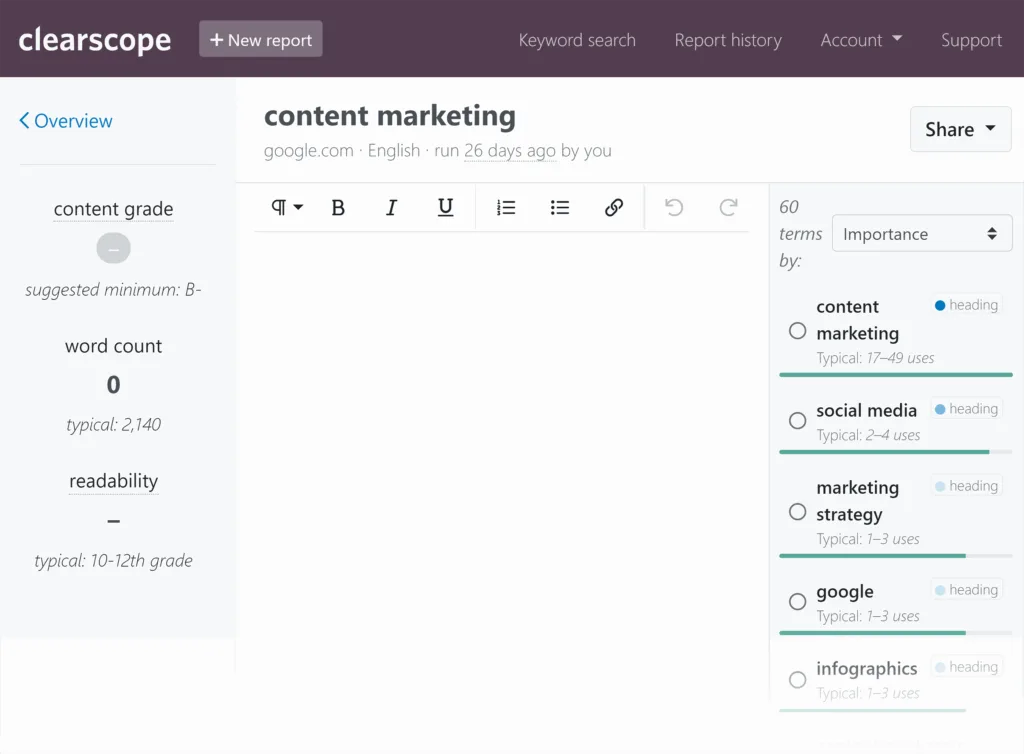
Clearscope emphasizes content clarity and topical authority, with a strong focus on readability and integration into professional editorial workflows.
Key Features:
- Reports: Generates a clear, prioritized list of key terms (from “most important” to “helpful”) derived from top SERP content and relevant databases.
- Content Editor: Similar live-editing environment with a readability focus and an “Optimize” button that suggests specific places to add terms.
- Workspace & Workflows: Excellent for team collaboration, allowing editors to assign, brief, and review content with SEO guidelines attached.
- Strength: Produces clean, highly readable, and authoritative content that aligns with Google’s E-E-A-T (Experience, Expertise, Authoritativeness, Trustworthiness) principles. Its reporting is exceptionally user-friendly.
Best For: Larger content teams, enterprise marketers, and publishers who prioritize editorial quality, seamless collaboration, and content authority alongside SEO.
3. Frase: The All-in-One Research, Optimization, and AI Content Suite
Frase positions itself as an end-to-end content creation hub, combining powerful optimization with integrated AI writing and research capabilities.
Key Features:
- SERP Analysis & Content Briefs: Automatically creates comprehensive content briefs by summarizing top competitors, extracting questions, and outlining topics.
- AI Writer: A robust built-in AI assistant that can help draft sections or entire articles based on your optimization targets.
- Optimization Dashboard: Provides a score and recommendations, though its visual dashboard is distinct from a live editor.
- Question Research: Excellent at mining “People also ask” and forum data to uncover user intent.
- Strength: Unifies the entire content workflow—from research and briefing to writing, optimization, and even answering customer queries via its chatbot feature.
Best For: Content managers, solo marketers, and teams looking for a single platform to handle the entire content lifecycle, especially those who want to leverage AI writing assistance ethically.
Integrating Tools into Your Content Creation Process
To maximize ROI, embed your chosen tool into a consistent workflow:
- Keyword & Briefing: Start with a primary keyword. Use the tool to generate a content brief and analyze SERP competitors.
- Outline & Structure: Build your outline based on the recommended headings and topical clusters provided.
- Write & Optimize: Draft your content within the tool’s editor (if available) or use its dashboard as a reference to ensure coverage of key terms while maintaining a natural flow.
- Final Audit & Publish: Before publishing, run a final audit to check your score, then make minor tweaks if necessary. Remember, a score in the “green” is sufficient; perfect 100s are not required.
- Monitor & Update: Use the tool’s audit feature periodically to re-analyze older content against new SERP changes to identify update opportunities.
Conclusion
Investing in the best content optimization tools for SEO—like Surfer, Clearscope, and Frase—is an investment in precision and efficiency. Surfer offers architectural precision, Clearscope delivers editorial authority, and Frase provides a unified creation suite. The common thread is their ability to translate SERP data into actionable writing guidelines, dramatically improving your content’s relevance and competitive edge.
By selecting the platform that aligns with your team’s workflow and content philosophy, you can systematically produce content that is engineered to rank and crafted to resonate.
Frequently Asked Questions (FAQs)
Q1: Are these content optimization tools a replacement for a human writer?
Absolutely not. These are tools to augment human skill, not replace it. They provide the data and structural framework, but a skilled writer is essential to interpret these insights, craft compelling narratives, and ensure the content genuinely engages and adds unique value to the reader.
Q2: Which tool is best for a beginner or solo blogger?
Frase is often the most beginner-friendly due to its all-in-one nature, combining research, briefing, and AI writing help. It streamlines the entire process for a solo operator. Surfer can have a steeper learning curve due to its data density.
Q3: Is it possible to over-optimize content using these tools?
Yes, it is a common pitfall. Chasing a perfect “score” can lead to keyword stuffing and unnatural, robotic content. The key is to use the recommendations as a guide. Aim to cover topics comprehensively and use semantically related terms naturally, but always write for the human reader first. Google’s algorithms are increasingly sophisticated at rewarding user satisfaction.
Q4: Do I still need a separate keyword research tool if I use one of these?
While all three offer basic keyword research features, they are primarily focused on optimization for a single primary term and its direct semantic field. For broader keyword discovery, strategy, and tracking, you will still benefit from a dedicated keyword research tool (like Ahrefs or SEMrush) in conjunction with your chosen content optimization tool.
