


Marketing automation tools for startups are critical force multipliers, enabling small teams to execute sophisticated campaigns, nurture leads with precision, and drive scalable growth. In the 2026 landscape, these platforms are defined by increased AI integration, a focus on unified customer data, and flexible pricing models that align with a startup’s evolution.
Choosing the right tool is a strategic decision that directly impacts your ability to compete and retain customers efficiently. This guide explores the leading platforms that deliver the essential power and flexibility for ambitious startup teams. Along with marketing automation, startups often rely on CRM tools for early-stage startups to manage leads and customer data efficiently.
Table of Contents
Essential Features in a Modern Startup Marketing Automation Platform
Before evaluating specific tools, understand the non-negotiable capabilities. An effective startup marketing automation platform must handle Multi-Channel Campaign Automation (email, SMS, in-app), Behavioral Triggering (actions dictate communications), Lead Management & Segmentation (organizing and prioritizing prospects), Robust Analytics (clear attribution and ROI tracking), and Deep Integration with your CRM, website, and product.
The Top Marketing Automation Platforms for Startups in 2026
1. HubSpot Marketing Hub
Brief Overview: The cornerstone of the HubSpot ecosystem, offering deeply integrated marketing, sales, and service tools. Its strength lies in creating a unified customer profile that fuels highly personalized automation.
Best for: Startups committed to inbound methodology or those already using other HubSpot products (CRM, Sales Hub).
Pricing: A powerful, feature-rich free plan. Paid marketing automation plans start at $20/month (annual billing).
Pros: Seamless CRM integration; industry-leading educational content and support; intuitive visual workflow builder.
Cons: Costs can scale significantly with contact database growth and advanced feature needs.
2. ActiveCampaign
Brief Overview: A powerhouse known for its exceptionally deep automation builder and robust built-in CRM. It excels at creating complex, conditional customer journeys based on every contact interaction.
Best for: Startups that prioritize sophisticated, behavior-triggered automation sequences from the outset.
Pricing: Scales based on contacts and features. The “Plus” plan (including automation & CRM) starts at $49/month.
Pros: Unmatched automation flexibility; strong segmentation and machine learning features; excellent email marketing capabilities.
Cons: Interface can present a steeper initial learning curve.
3. Brevo (formerly Sendinblue)
Brief Overview: A formidable all-in-one platform combining email, SMS, marketing automation, and a CRM suite. It stands out for delivering high-value multi-channel functionality at a competitive price.
Best for: Startups seeking the best cost-to-feature ratio, especially those leveraging SMS marketing.
Pricing: Free plan with unlimited contacts (daily send limits). Paid automation plans start at $65/month.
Pros: Outstanding affordability; strong transactional email capabilities; user-friendly interface.
Cons: The built-in CRM, while capable, may lack the depth of dedicated platforms for complex sales cycles.
4. Mailchimp
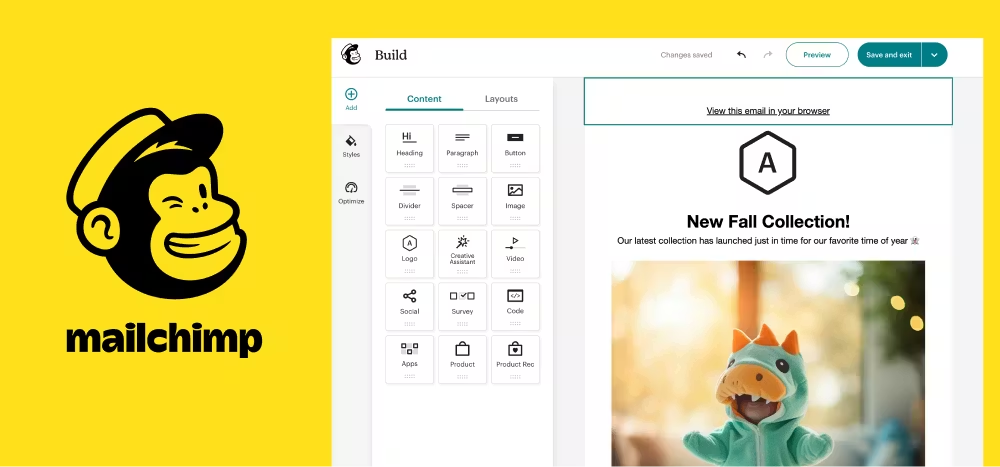
Brief Overview: Having evolved from an email leader, Mailchimp now offers a full-scale marketing automation and CRM platform designed with small business usability at its core.
Best for: Early-stage startups and solopreneurs who value an exceptionally user-friendly starting point.
Pricing: A free plan is available (with branding). The “Essentials” automation plan starts at $13/month.
Pros: Legendary ease of use; excellent design tools and templates; reliable delivery infrastructure.
Cons: Advanced automation logic and segmentation can be limited on lower-tier plans.
5. Customer.io
Brief Overview: A data-centric platform engineered for sending targeted, behavior-based messages across email, push, and SMS. It thrives on leveraging detailed user event data from your product.
Best for: SaaS and product-led startups that need to trigger communications based on specific in-app user behavior.
Pricing: No permanent free plan, but a free trial. Pricing is based on the number of tracked profiles.
Pros: Unrivaled for behavioral targeting and event-driven messaging; powerful data integration capabilities.
Cons: Requires technical setup for event tracking; higher entry price point.
6. ConvertKit
Brief Overview: Built specifically for creators, bloggers, and online businesses. It focuses on visual automation, powerful subscriber tagging, and tools to monetize an audience directly.
Best for: Content-driven startups, solo founders, and creator-led businesses building a dedicated community.
Pricing: Free plan for up to 1,000 subscribers. Paid plans start at $15/month.
Pros: Creator-first features (commerce, digital products); intuitive visual automation builder; excellent email deliverability.
Cons: Less optimized for traditional B2B lead scoring and complex sales pipelines.
7. Drip
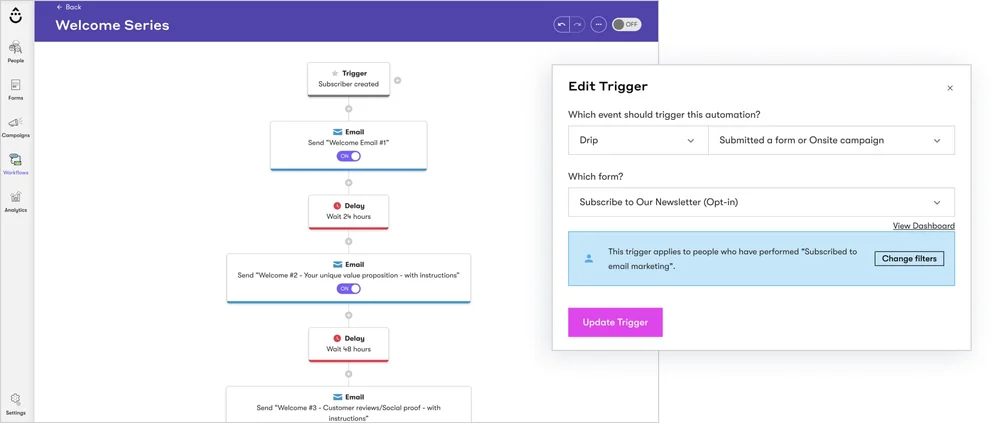
Brief Overview: An ecommerce-focused automation platform built to maximize customer lifetime value through personalized post-purchase journeys and robust product-based segmentation.
Best for: Ecommerce and direct-to-consumer brands needing deep integration with platforms like Shopify.
Pricing: Starts at $39/month. A 14-day free trial is available.
Pros: Excellent pre-built ecommerce workflows; strong product and customer data syncing.
Cons: Less ideal for B2B or service-based startup models.
8. User.com
Brief Overview: A unified customer platform that combines marketing automation, live chat, helpdesk, and CRM in a single interface, focusing on a 360-degree view of the user.
Best for: Startups wanting to tightly align marketing automation with real-time customer support and communication.
Pricing: The “Pro” automation plan starts at $49/month. A free trial is offered.
Pros: Reduces tool sprawl with an all-in-one approach; unified user timeline across all interactions.
Cons: May not have best-in-class depth in every single category compared to specialized tools.
9. Marketo Engage (by Adobe)
Brief Overview: An enterprise-grade leader now offering scaled-down “Spark” packages, providing immense power for account-based marketing (ABM) and complex, multi-touch campaigns.
Best for: Fast-scaling, venture-backed B2B startups with a dedicated marketing team ready for sophisticated demand generation.
Pricing: Custom “Spark” pricing aimed at the mid-market. Requires a demo.
Pros: Unmatched depth for B2B marketing strategies; powerful lead management and ABM tools.
Cons: Significant learning curve and typically a higher cost of entry.
How We Selected the Top Marketing Automation Tools for Startups
Our evaluation focused on the practical realities of startup growth. We prioritized platforms based on Core Feature Density for Growth: essential capabilities like email sequencing, lead scoring, and CRM sync; Startup-Friendly Pricing: transparent costs, generous free tiers or trials, and scalable plans; Ease of Adoption: a manageable learning curve for fast-moving teams; AI & Automation Sophistication: intelligent features that provide a competitive edge; and Ecosystem Connectivity: seamless integration with the other critical components of your essential SaaS stack.
Navigating Your 2026 Choice
The best startup marketing automation platform for you depends on your primary channel, business model, and technical readiness. For a broad-based approach, HubSpot and Brevo offer incredible foundational value. For depth in behavioral automation, evaluate ActiveCampaign or Customer.io. Begin by leveraging free trials to test the workflow builder and key integrations with your existing tools, ensuring it fits seamlessly into your operational processes.
Frequently Asked Questions (FAQ)
Q1: When is the right time for a startup to invest in marketing automation?
A: The ideal time is when you have a defined lead generation process and find yourself manually sending follow-up emails or losing track of prospect interactions. Implementing automation early establishes scalable systems for nurturing leads and onboarding customers, which pays dividends as you grow. It’s a key component of a mature startup marketing automation strategy.
Q2: How do we avoid overwhelming our team with a complex new tool?
A: Start with a single, high-impact use case. Automate your welcome email series for new sign-ups or a basic lead nurturing sequence. Master that first campaign. This builds confidence and demonstrates value. Choose a platform known for its usability and provide focused training on that specific workflow before expanding.
Q3: What role should AI play in our choice of a 2026 platform?
A: Look for practical, built-in AI that saves time and improves results. This includes AI for subject line optimization, send time prediction, content suggestions, and basic predictive lead scoring. These features help small teams work smarter. Avoid platforms where advanced AI is merely a future promise or a costly add-on; it should be a core utility.
Q4: Can these tools integrate with our other critical business software?
A: Seamless integration is non-negotiable. Your marketing automation platform must connect deeply with your CRM, website analytics, and product data. Siloed data cripples personalization. Before committing, verify native integrations or easy API/Zapier connections to the other tools in your essential SaaS stack to ensure a unified view of the customer.
