


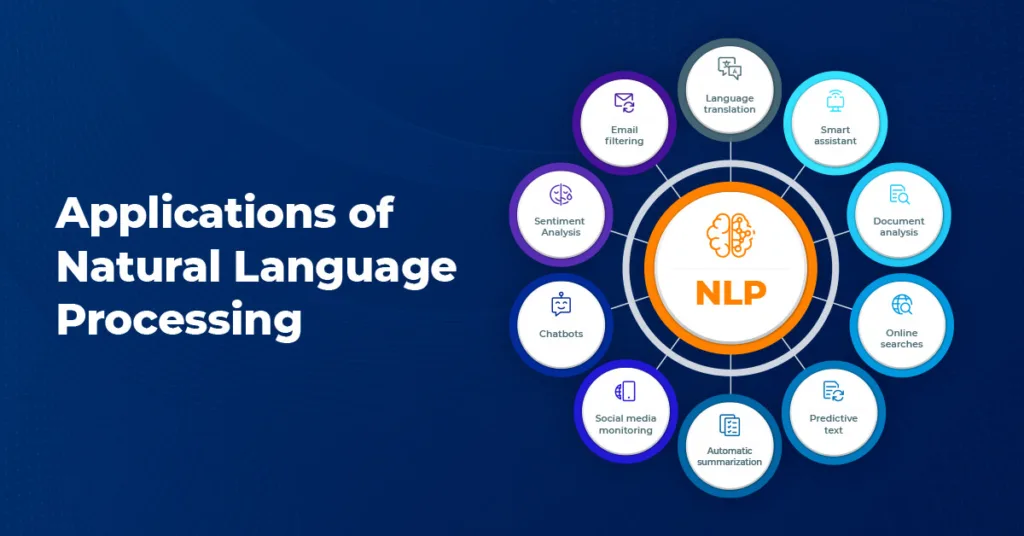
The transformative power of Natural Language Processing (NLP) is no longer confined to research labs; it’s actively reshaping core business functions and customer experiences across the global economy. By enabling machines to understand, interpret, and generate human language, NLP applications are solving critical challenges in data-heavy industries.
From diagnosing diseases to detecting fraudulent transactions and personalizing shopping journeys, NLP is turning unstructured text—the world’s largest data reservoir—into actionable intelligence. This article explores the most impactful and practical NLP applications within three pivotal sectors: healthcare, finance, and e-commerce.
Table of Contents
The Foundational Role of NLP Across Industries
Before delving into sector-specific uses, it’s important to understand why NLP applications are so revolutionary. An estimated 80% of enterprise data is unstructured—clinical notes, customer emails, legal contracts, social media posts, and product reviews. Traditional data analysis tools cannot parse this information.
NLP bridges this gap by using techniques like named entity recognition (NER), sentiment analysis, and text classification to extract meaning, patterns, and insights. This capability allows organizations to automate complex tasks, gain unprecedented insights, and make data-driven decisions at scale. The following exploration of NLP in healthcare, finance, and ecommerce demonstrates this universal principle in action.
Revolutionizing Patient Care: NLP in Healthcare
The healthcare industry is inundated with unstructured text data, making it a prime candidate for NLP-driven transformation. NLP in healthcare is improving patient outcomes, accelerating research, and reducing administrative burdens.
- Clinical Documentation and EHR Management: A major source of clinician burnout is manual data entry into Electronic Health Records (EHRs). NLP applications can automatically transcribe doctor-patient conversations, extract key medical concepts (symptoms, diagnoses, medications, dosages), and populate structured fields in the EHR. This not only saves hours of administrative work but also creates more accurate and searchable patient records.
- Drug Discovery and Clinical Trial Matching: NLP in healthcare accelerates pharmaceutical research by mining millions of scientific papers, clinical trial reports, and patient forums. It can identify potential drug candidates, uncover adverse effect patterns, and match eligible patients to clinical trials based on the nuanced criteria in their medical histories, dramatically speeding up recruitment.
- Intelligent Triage and Patient Monitoring: Chatbots powered by NLP can perform initial patient intake, ask symptom-based questions, and provide triage recommendations. Furthermore, NLP can analyze patient-generated text from portals or wearable apps to monitor mental health status (via sentiment analysis) or flag worsening chronic conditions based on described symptoms, enabling proactive care.
Securing and Optimizing Markets: NLP in Finance
In the high-stakes world of finance, speed, accuracy, and risk management are paramount. NLP in finance provides a critical edge by analyzing news, reports, and communications that move markets.
- Fraud Detection and Anti-Money Laundering (AML): Beyond rule-based systems, NLP models analyze the language in transaction descriptions, customer service emails, and underwriter notes to detect subtle, fraudulent patterns. They can identify suspicious narratives or attempts to obfuscate the true nature of a transaction, making AML processes more efficient and effective.
- Algorithmic Trading and Market Sentiment Analysis: Trading algorithms now incorporate NLP applications that analyze real-time news feeds, earnings call transcripts, and social media sentiment. By gauging market mood and extracting actionable signals from unstructured text, these systems can execute trades based on qualitative insights, not just quantitative data.
- Contract Analysis and Regulatory Compliance: Financial institutions handle thousands of complex legal documents. NLP can review loan agreements, derivative contracts, and regulatory filings (like 10-K reports) in seconds to extract key clauses, assess risk, and ensure compliance. This automates a traditionally manual, expensive, and error-prone process.
Personalizing the Digital Marketplace: NLP in Ecommerce
The e-commerce sector thrives on understanding and influencing customer behavior. NLP in ecommerce is the engine behind hyper-personalization, efficient customer service, and robust brand management.
- Enhanced Search and Product Discovery: Modern search bars use semantic search powered by NLP. They understand user intent, synonyms, and context. A search for “a formal shirt for a summer wedding” understands concepts of occasion, seasonality, and style, returning relevant results even if those exact keywords aren’t in the product description.
- Sentiment Analysis and Review Intelligence: NLP applications automatically analyze thousands of product reviews to provide summarized insights. They can identify which features customers love (“battery life”) or hate (“zipper quality”), track sentiment trends over time, and alert merchants to emerging issues. This turns qualitative feedback into quantitative product development data.
- Intelligent Customer Service and Chatbots: NLP-driven chatbots handle a vast majority of routine customer inquiries about order status, returns, and product specifications. They provide instant, 24/7 support, resolve issues faster, and seamlessly escalate complex cases to human agents, all while maintaining a conversational, natural dialogue.
- Personalized Marketing and Content Generation: NLP can analyze a customer’s browsing history, past purchases, and reviewed items to generate personalized product descriptions, email content, and targeted ad copy. It helps create a unique shopping experience for each user, increasing engagement and conversion rates.
Comparative Impact and Future Trajectory
While the NLP applications in each sector differ, their impact shares common themes: automation of manual tasks, extraction of latent insights, and enhancement of decision-making. NLP in healthcare is often life-critical and focused on precision. NLP in finance is geared toward risk mitigation and exploiting market inefficiencies. NLP in ecommerce is centered on optimizing the customer experience for conversion and loyalty.
The future trajectory points toward more integrated, multimodal, and predictive systems. In healthcare, NLP will combine with genomic data. In finance, it will fuse with real-time global event data. In e-commerce, it will merge with visual search. The core challenge remains consistent across all three: ensuring models are unbiased, transparent, and built on high-quality, secure data.
Conclusion
The exploration of NLP applications across healthcare, finance, and e-commerce reveals a technology that is both versatile and profoundly transformative. NLP in healthcare is making care more proactive and efficient. NLP in finance is safeguarding assets and uncovering opportunities. NLP in ecommerce is creating deeply personalized and responsive shopping experiences.
As NLP models grow more sophisticated, their capacity to understand the nuance of human language will continue to drive innovation, proving that the most valuable insights are often hidden in plain text, waiting to be unlocked.
Frequently Asked Questions (FAQs)
1. How does NLP handle sensitive data in industries like healthcare and finance?
Responsible NLP applications in sensitive fields are built with privacy-by-design principles. This often involves techniques like data anonymization (removing personally identifiable information before processing), training models on secure, on-premise servers or private clouds, and using federated learning where the model learns from data without it ever leaving its original secure location. Compliance with regulations like HIPAA (healthcare) and GDPR or SOX (finance) is a fundamental requirement for any deployed system.
2. What’s the difference between a simple chatbot and an NLP-powered chatbot in e-commerce?
A simple, rule-based chatbot follows a rigid “if-then” script. If a user’s query doesn’t match a predefined keyword path, it fails. An NLP-powered chatbot, a key application in ecommerce, uses machine learning to understand the user’s intent and the meaning behind their words. It can handle varied phrasing, ask clarifying questions, manage context throughout a conversation, and provide accurate answers for complex queries like “Show me dresses like the one I returned last week,” making interactions far more natural and effective.
3. Do companies need massive amounts of data to implement these NLP applications?
It depends on the application. For general tasks like sentiment analysis or standard chatbot intents, companies can leverage pre-trained NLP models available through cloud APIs (from Google, AWS, Azure) that require minimal custom data. However, for highly specialized NLP in healthcare (e.g., parsing radiology reports) or NLP in finance (e.g., analyzing specific loan contract jargon), domain-specific models are necessary. These require fine-tuning with a significant volume of high-quality, labeled data from the specific field to achieve accuracy and reliability.
