


SaaS platforms for education have emerged as a cornerstone of modern teaching and learning, fundamentally reshaping how knowledge is imparted and acquired. The seismic shift towards remote and hybrid learning models, accelerated by global events, highlighted the limitations of traditional educational frameworks. In this new landscape, the need for dynamic, accessible, and collaborative tools became paramount.
This is where Software-as-a-Service (SaaS) solutions stepped in, offering a powerful answer to the challenges of distance and disconnection. By leveraging the cloud, these platforms provide educational institutions with scalable, cost-effective, and feature-rich environments that transcend physical classrooms, ensuring continuity and enriching the learning journey for students and educators alike.
How SaaS Platforms for Education Are Transforming Classrooms?
The traditional model of education, heavily reliant on physical presence and paper-based resources, was severely disrupted. Schools and universities scrambled to find solutions that could replicate, or even improve upon, the classroom experience virtually.
Early attempts often involved a patchwork of disconnected tools—email for communication, file-sharing links for assignments, and video conferencing for lectures. This fragmented approach led to confusion, student disengagement, and immense administrative overhead for teachers.
The integration of SaaS platforms for education offered a unified solution. Unlike traditional software that requires complex installation and maintenance on individual devices, SaaS applications are hosted in the cloud and accessed via a web browser.
This model offers several inherent advantages: automatic updates, accessibility from any internet-connected device, and a subscription-based pricing structure that is often more affordable for institutions than large, upfront software licenses. This shift has democratized access to powerful educational technology, allowing schools of all sizes to deploy enterprise-level tools.
Read more blog : SaaS Companies to Watch: Trading Opportunities in Software as a Service
Key Features of SaaS Platforms for Remote Learning
What makes these platforms so effective for remote learning? It’s the combination of several core features designed to create a seamless and interactive virtual classroom.
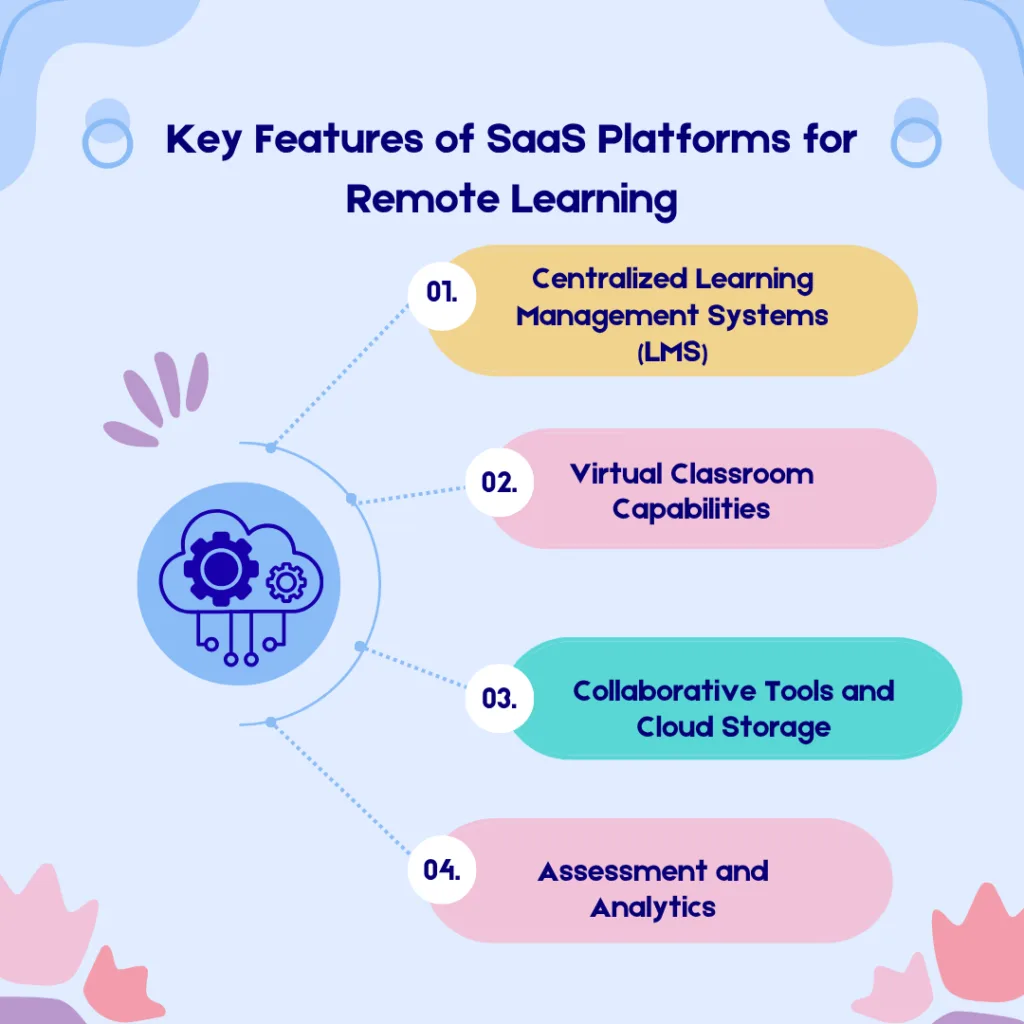
- Centralized Learning Management Systems (LMS): At the heart of most educational SaaS ecosystems is an LMS like Canvas, Moodle Cloud, or Blackboard. These systems act as a digital hub where instructors can post syllabi, create and grade assignments, host discussion forums, and manage grades. Students have a single, organized destination for all their course materials, reducing cognitive load and improving organization.
- Virtual Classroom Capabilities: Platforms like Zoom for Education and Google Classroom integrate video conferencing directly into the learning flow. These are not just simple video calls; they are enhanced with features like digital whiteboards, breakout rooms for small group collaboration, hand-raising functions, live polls, and Q&A sessions. This interactivity is crucial for maintaining student engagement and replicating the collaborative aspects of a physical classroom.
- Collaborative Tools and Cloud Storage: SaaS platforms often embed real-time collaboration tools. Google Workspace for Education and Microsoft 365 for Education allow students to work simultaneously on documents, spreadsheets, and presentations, providing feedback and co-creating content from different locations. Integrated cloud storage ensures that all work is automatically saved and accessible, eliminating the “I lost my homework” excuse.
- Assessment and Analytics: These platforms provide robust tools for creating quizzes, tests, and interactive assessments. More importantly, they generate valuable data analytics. Educators can track student progress, identify areas where the class is struggling, and offer targeted support early on. This data-driven approach enables personalized learning pathways, a significant advantage over the one-size-fits-all model.
Benefits of SaaS Platforms for Students and Educators
The adoption of sophisticated SaaS platforms for education yields significant benefits for every stakeholder in the educational process.
- For Students: The experience becomes more flexible and accessible. Students can learn at their own pace, revisit recorded lectures, and access materials anytime. The variety of interactive and multimedia tools caters to different learning styles, making education more inclusive. The centralized nature of these platforms also fosters a stronger sense of community and connection with peers, combating the isolation often associated with remote learning.
- For Educators: Teachers transition from being mere dispensers of information to facilitators of learning. Automated grading for certain assignment types, streamlined communication, and easy distribution of materials free up valuable time. This allows educators to focus on what they do best: providing individualized attention, crafting engaging lesson content, and mentoring students.
- For Administrators and Institutions: SaaS solutions offer scalability and cost predictability. Schools can easily add or remove user licenses as needed without investing in new hardware or IT infrastructure. The centralized management console simplifies user administration, security policy enforcement, and compliance reporting. Furthermore, a robust technological infrastructure becomes a key differentiator, helping institutions attract and retain both students and faculty.

Looking Ahead: The Future of SaaS in Education
The role of SaaS platforms for education is set to grow even more profound. The future points towards deeper integration of Artificial Intelligence (AI) and Machine Learning to offer hyper-personalized learning experiences, adaptive testing, and automated tutoring systems. We can also expect a greater emphasis on immersive technologies like Virtual and Augmented Reality (VR/AR) within these platforms, creating simulated lab environments and historical explorations that were previously impossible.
As the boundaries between physical and digital learning continue to blur, the SaaS model provides the necessary agility and innovation to support this evolution. By continuously integrating new technologies and pedagogies, these platforms are not just a temporary fix for a remote learning crisis but a permanent and progressive upgrade to the global educational infrastructure.
Frequently Asked Questions (FAQs)
1. What is the difference between a SaaS platform and traditional educational software?
Traditional educational software is often installed locally on specific computers, requires manual updates, and has limited accessibility. A SaaS (Software-as-a-Service) platform is cloud-based, accessed through a web browser, automatically updated by the provider, and can be used from any device with an internet connection, offering greater flexibility and lower maintenance.
2. Are SaaS platforms for education secure and compliant with privacy laws?
Reputable SaaS providers for education, such as Google and Microsoft, prioritize security and are compliant with stringent regulations like FERPA (Family Educational Rights and Privacy Act) in the U.S. and GDPR in Europe. They employ robust encryption, secure data centers, and provide administrators with tools to control data privacy. However, it is always the responsibility of the institution to configure these settings correctly.
3. Can these platforms be used effectively for younger students, like those in elementary school?
Yes, many SaaS platforms offer simplified interfaces or dedicated versions for younger learners. For example, Google Classroom and Seesaw are designed with intuitive icons and simple workflows that even young children can navigate with minimal supervision. Teachers can use these platforms to assign digital activities, share videos, and communicate with parents effectively.
