


What are Bio Compute Platforms?
Bio compute platforms are advanced technological ecosystems that merge biological data with high-performance computing, AI, and machine learning. These platforms allow scientists to simulate complex biological processes in silico (on a computer), significantly accelerating research in areas like drug discovery, genomics, and synthetic biology by reducing the need for years of physical lab experiments.
Bioinformatics Platforms: The Rise of AI Biotech Stealth Startups
The convergence of biology and computing has birthed a new generation of innovators: AI biotech platforms. While many tech companies thrive on public hype, a significant number of leaders in this space operate as stealth startups. These companies work in secret to protect high-value intellectual property and develop revolutionary AI models for drug discovery before revealing their breakthroughs to the world.
These platforms are becoming the bedrock of modern medicine. By using AI in drug discovery, these startups can decipher sophisticated biological information, automate laboratory functions, and augment human decision-making with unprecedented accuracy.
Top AI Biotech & Bioinformatics Startups
The following companies represent the cutting edge of how bio compute platforms are being used today:
- Recursion Pharmaceuticals: Uses automated biology and AI to map human cellular biology to find new treatments.
- Insilico Medicine: A leader in using generative AI to identify drug targets and design entirely new molecules.
- Schrödinger: Combines physics-based methods and machine learning to accelerate the discovery of novel molecules.
- Exscientia: The first company to advance an AI-designed drug into clinical trials.
- Isomorphic Labs: A subsidiary of Alphabet (DeepMind) focused on using “AlphaFold” technology to reimagining the drug discovery process.
- EvolutionaryScale: A rising “stealth-like” startup focusing on large language models (LLMs) for biological structures.
Bio Compute vs. Traditional Biotech
The shift from traditional “wet lab” biology to computational platforms is a massive leap in efficiency.
| Feature | Traditional Biotech | Bio Compute Platforms |
| Data Source | Physical samples & manual trials | Genomic, molecular, and cellular big data |
| Primary Goal | Manual drug synthesis | Biological simulation & AI-driven discovery |
| Speed | Slow (years of trial and error) | Rapid (months of digital modeling) |
| Experimentation | Physical laboratory testing | In-silico (Computational) modeling |
| Key Output | Generic blockbusters | Personalized medicine & synthetic biology |
The possibilities of these platforms are endless, and that is why stealth startups are investing so much money in this area.
Also Read – Top 10 Questions in Software Development Interviews and How to Answer Them
Why Stealth Startups Rule Bio Compute Platforms
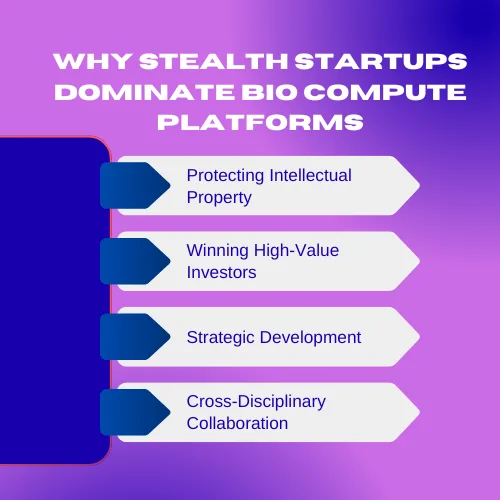
The AI biotech industry is high-stakes and heavily dependent on patents. Stealth mode—where a company operates privately without a public website or PR—is a strategic choice for several reasons:
- Protecting Algorithms: In bioinformatics platforms, a single proprietary algorithm for protein folding can be worth billions. Stealth keeps these secrets safe from competitors.
- Attracting Tier-1 Investors: Sophisticated venture capitalists often prefer “quiet” companies that focus entirely on R&D rather than marketing “hype.”
- Focus on Product-Market Fit: Without the pressure of public updates, these startups can refine their AI models and validate their biological findings in private.
Challenges in the Industry
Despite the potential, these startups face unique hurdles:
- Regulatory Compliance: Navigating FDA and international healthcare laws is complex for digital-first platforms.
- Data Privacy: Handling sensitive genetic information requires elite-level cybersecurity.
- High R&D Costs: Building high-performance computing clusters and hiring AI talent is incredibly expensive.
Scaling Success in AI Biotech & Science
Navigating the intersection of biology and high-performance computing requires more than just scientific knowledge; it requires a strategic roadmap. This is where Arunangshu Das bridges the gap between complex innovation and commercial viability. With over a decade of experience in bioinformatics platforms and business strategy, he assists stealth startups in scaling from concept to breakthrough.
- Strategic Growth Roadmaps: Tailored guidance for AI biotech startups to navigate venture capital, scalability, and long-term market entry.
- Specialized Infrastructure: Expert advice on building the secure, high-performance computational environments required for massive biological datasets.
- Precision Stakeholder Engagement: Developing high-impact, confidential communication strategies to connect with key investors and research partners while maintaining stealth.
- Biotech Data Integration: Optimizing the flow of real-world biological data into AI models to improve the accuracy of AI in drug discovery.
By merging technical precision with business intelligence, organizations can protect their intellectual property while accelerating their path to clinical and commercial success.

Conclusion
The rise of bioinformatics platforms and stealth startups marks a definitive shift in how we approach human health and environmental sustainability. By integrating AI in drug discovery, these innovators are moving past the limitations of traditional trial-and-error biology, replacing slow physical experiments with high-speed digital simulations.
While the “stealth” nature of these companies keeps much of their work behind closed doors, their impact is already being felt through faster clinical trials and the development of highly personalized medical treatments. As AI biotech platforms continue to mature, they will not only accelerate the pace of scientific discovery but fundamentally redefine the boundaries of what is possible in modern medicine.
Frequently Asked Questions (FAQs)
What is the role of AI in drug discovery?
AI identifies patterns in massive biological datasets to predict how different chemicals will interact with the human body. This allows researchers to skip thousands of “failed” experiments and focus only on the most promising drug candidates.
How do bioinformatics platforms help patients?
These platforms enable personalized medicine. By analyzing a patient’s specific genetic code, doctors can choose the exact treatment that will work for them, rather than relying on a one-size-fits-all approach.
Why are “stealth” startups so common in biotech?
Stealth mode allows companies to develop unique AI models and file for patents without alerting competitors. It ensures that when they finally launch, they have a significant technological lead.
Are bio compute platforms used outside of healthcare?
Yes. These platforms are also used in Agritech to create climate-resilient crops and in Synthetic Biology to develop microbes that can create sustainable biofuels or break down plastics.
