


Understanding Paid Marketing Basics
1. What is a Paid Marketing Campaign?
When you start to launch your first paid marketing campaign checklist, it can be like jumping into a new realm of online growth. Put simply, paid marketing involves paying for promotion of your product or service on a digital platform such as, search engines, social media, or display advertising. Rather than waiting for customers to find you, you are “putting your message out there”. It’s like paying for a billboard, only better, more refined and more immediate.
In the digital world, setting up online marketing campaigns is crucial for businesses to get instant exposure. Whether you’re advertising on search engines or scrolling applications, paid campaigns are a way to skip the long game of organic growth. But the magic is in the data – each click, view and conversion provides insights about your audience.
2. Why Start with Paid Advertising?
Why Moves the Crowd to Paid? Because speed matters. Advertisements have a faster return on investment compared to organic search results that take months. When launching a new product or experimenting with a new business strategy, this approach is a short cut.
Another advantage is scalability. After that, you can boost your budget that will help you take over at speed. When used correctly, this combined with Conversion Rate Optimization (CRO) for Startup means that every click means you make a customer, making investment in online advertising more valuable.
Setting Clear Campaign Goals
1. Define KPIs and Metrics
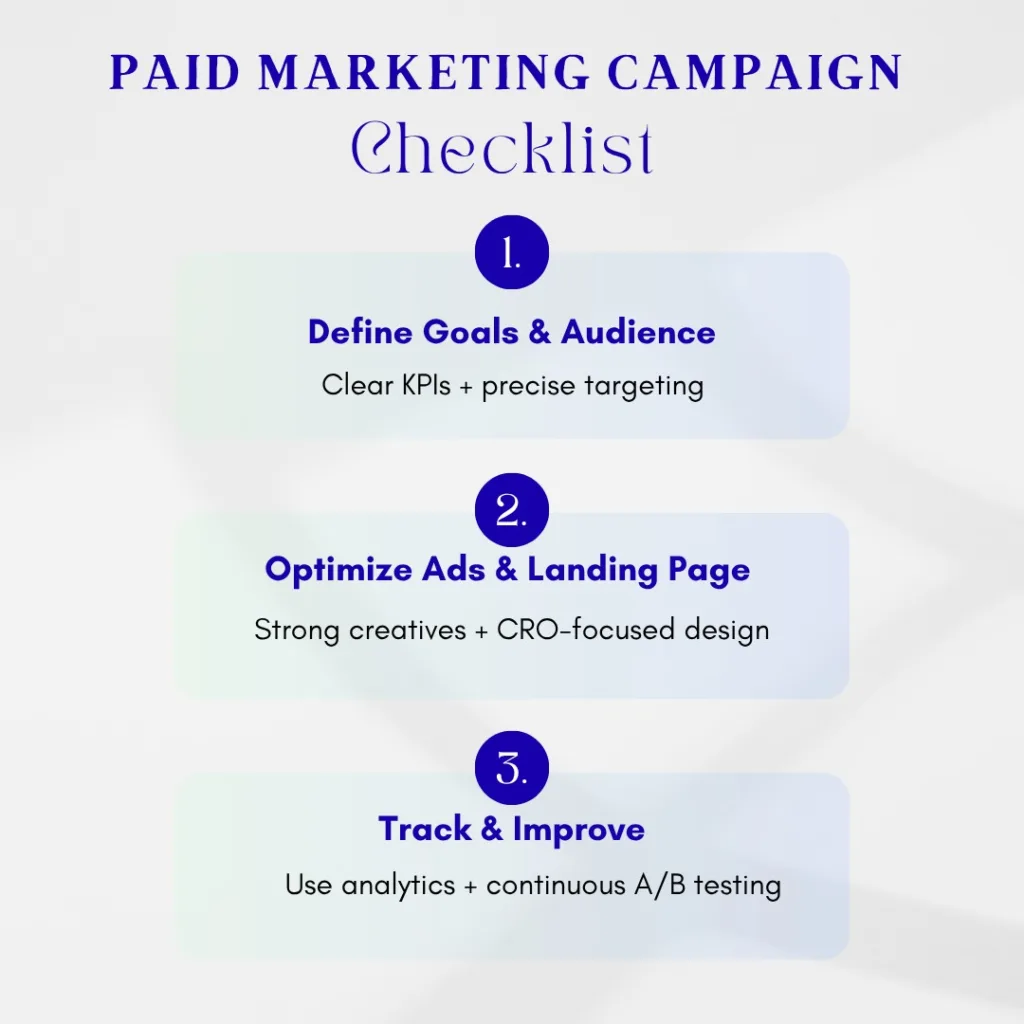
Before you invest your rupee, be clear. What will be considered a success? Leads, sales, app downloads, brand awareness? Without key performance indicators (KPIs), you’re shooting in the dark.
Click-through rate (CTR), cost per acquisition (CPA) and return on ad spend (ROAS) are important metrics. That’s where conversion rate optimization comes in handy – it assists in increasing the number of users who take a desired action when they click on your ad.
2. Align Goals with Business Objectives
Your campaign goals should align with your business goals. If introducing new products, prioritise visibility and engagement. If you’re growing, go for conversions and revenue.
An effective campaign planning checklist ensures goals are purposeful, trackable and integrated with growth plans. Otherwise, excellent ads won’t help you much.
Audience Research and Targeting
1. Identifying Your Ideal Customer
There’s no point selling down jackets in the tropics. So understanding your target audience is essential. Consider basic info such as age, region and income, but also dig into interests, behaviour and the challenges facing your audience.
Personas help bring your audience to life The more targeted, the more effective your advertising.
2. Using Data for Smarter Targeting
New platforms leverage AI and NLP Improves Search Engines to target. Advertising platforms examine how users search, their intentions, and their interests to present your ads to the right audience.
This shifts your digital advertising checklist from “hope and prayer” to a science that puts your advertising dollars to work.
Choosing the Right Platform
1. Google Ads vs Social Media Ads
The platform you choose will impact your campaign. Search ads ride on intent – users searching for solutions to their problems – whereas social media ads create need through attention.
A well-optimised Google Ads campaign is perfect for intent-based targeting. Meanwhile, visuals-based Instagram and Facebook are ideal for storytelling and branding purposes.
2. Platform Selection Based on Goals
For instant sales, use search marketing. If you want to boost brand recognition, use social media. Tailoring medium to aims is a vital part of setting up any online marketing plan.
Budget Planning and Allocation
1. Setting a Realistic Budget
Don’t focus on the size of the budget – instead set the budget at what you can afford to lose. Test, test, test – then scale.
Allocate your budget to test, optimise and scale. This prevents you from spending big without learning.
2. Cost-per-click and ROI Considerations
Knowing CPC (the cost to click) gives you an idea of your budget’s reach. This, along with conversion rates, helps estimate ROI.
Experts use Tools for Marketing to monitor budget and ROI, so no rupee goes to waste.
Crafting High-Converting Ads
1. Writing Compelling Ad Copy
Ad copy is your first impression. Make it simple, compelling and problem-solving. Employ urgency, emotional appeal and benefits.
Rather than “Buy,” go for “Solve.” Subtle changes make a big difference.
2. Designing Visuals That Convert
Images are incredibly important. Professional pictures or videos enhance engagement and brand trust. Ensure your images or videos match your brand and campaign.
Ad and landing page consistency boosts trust, a critical conversion rate optimization factor.
Landing Page Optimization
1. Importance of Conversion Rate Optimization
You can’t neglect traffic. If your landing page is not converting, you will not succeed. This is where conversion rate optimization comes in.
This can lead to higher conversions without raising costs through optimising headlines, CTAs and page load times among other things.
2. Elements of a High-Converting Landing Page
A strong landing page includes:
- Clear headline
- Strong CTA
- Social proof
- Fast loading speed
- Mobile responsiveness
These factors tick off all the items on your digital marketing to-do list.
Campaign Setup Process
1. Step-by-Step Google Ads Campaign Setup
When setting up a Google Ad campaign you need to:
- Choosing campaign type
- Setting budget
- Defining audience
- Creating ads
- Setting bids
Every step is crucial so you don’t end up wasting money.
2. Tracking and Analytics Integration
If you don’t track, you don’t know. Software such as Google Analytics provides data on performance and behavior.
Using analytics in the setup of your online marketing campaigns provides valuable data for analysis and improvements.
Testing and Optimization
1. A/B Testing Strategies
Testing is the key to success. Test different versions of ads to see which perform best. Try different headlines, images and CTAs.
This can add up to large gains when scaled up.
2. Continuous Performance Monitoring
It’s never “set and forget”. This allows for issues and opportunities to be detected.
You can set up reporting and real-time campaign optimisation with powerful Tools for Marketing.
Final Campaign Planning Checklist
The first campaign is much easier when you take the time to prepare your paid campaign marketing:
| Table | Status |
| Define goals | ✔ |
| Identify audience | ✔ |
| Choose platform | ✔ |
| Set budget | ✔ |
| Create ads | ✔ |
| Optimize landing page | ✔ |
| Track performance | ✔ |
| Test and improve | ✔ |
Expert Guidance: How Arunangshudas Helps
For successfully executing paid campaigns, expert advice helps. Arunangshudas offers strategies, tools and frameworks to make the complex world of online marketing less daunting. With a proven process for creating a campaign planning list to complex conversion rate optimization solution, he emphasises on delivering results. Through his advice, beginners and experienced marketers alike can circumvent pitfalls and expedite their progress on their campaign building journey.
Conclusion
Starting your first paid campaign needn’t be a daunting task. By following the digital advertising checklist, setting your objectives and focusing on the conversion rate, you will be on the road to success. It’s a journey of discovery and learning as each campaign is a different experiment. Consistency, testing and data are key to this process.
FAQs
1. What’s the first step for a paid marketing campaign?
Setting a campaign objective and KPIs for success is critical.
2. What is the minimum starting budget?
Start small, experiment and upscale based on results and return on investment (ROI).
3. What is the significance of conversion rate?
It helps you turn visitors into customers, increasing ROI.
4. Which platform is best for beginners?
SEM (Google) is good for urgency, social media is good for awareness.
5. How often should I optimize my campaigns?
It’s best to monitor campaigns and make weekly adjustments.
