


Java full stack development is a popular career path for developers who want to work on both the frontend and backend of web applications. It combines Java-based backend technologies with frontend tools such as HTML, CSS, JavaScript, React, or Angular to create complete and scalable applications.
As businesses continue to invest in web applications, ecommerce platforms, enterprise software, and digital services, professionals with full stack skills can find opportunities across multiple industries. However, becoming a full stack developer requires more than learning Java. You need to understand databases, APIs, frontend development, testing, version control, deployment, and modern development practices.
This guide explores the essential tools and technologies used in Java full stack development and explains the career opportunities available to developers who build expertise in this field.
Table of Contents
What Is Java Full Stack Development?
Java full stack development involves building both the frontend and backend components of a web application, with Java commonly used for backend programming.
The frontend is the part users interact with, including pages, buttons, forms, menus, and dashboards. Technologies such as HTML, CSS, JavaScript, React, and Angular are commonly used to build these interfaces.
The backend handles business logic, authentication, data processing, APIs, and communication with databases. Java and frameworks such as Spring Boot are widely used for this layer.
A full stack developer understands how these components communicate and can contribute to multiple stages of application development.
For example, an online shopping platform might use React for the user interface, Spring Boot for backend services, MySQL for data storage, and REST APIs to connect the frontend with the backend.
Java Full Stack Development: Essential Tools and Technologies

1. Java
Java is the foundation of this technology stack.
Developers should have a strong understanding of Core Java concepts such as:
- Object-oriented programming
- Classes and objects
- Inheritance
- Polymorphism
- Encapsulation
- Abstraction
- Collections
- Exception handling
- Generics
- Multithreading
- Lambda expressions
- Stream API
Strong Java fundamentals make it easier to understand frameworks and build reliable backend applications.
2. Spring Boot
Spring Boot is one of the most important backend technologies for modern Java applications.
It simplifies application development by providing configuration and development features that reduce boilerplate code.
Developers commonly use Spring Boot to build REST APIs and backend services.
Important concepts include dependency injection, controllers, services, repositories, validation, exception handling, configuration, and security.
Spring Boot is particularly common in enterprise environments, making it a valuable skill for developers pursuing Java full stack careers.
3. HTML and CSS
HTML and CSS are essential frontend technologies.
HTML defines the structure of webpages, while CSS controls their visual presentation.
A full stack developer should understand semantic HTML, forms, tables, responsive layouts, Flexbox, CSS Grid, and basic accessibility principles.
You do not need to become a professional designer, but you should be able to build and modify functional interfaces.
4. JavaScript
JavaScript adds functionality and interactivity to websites.
Important JavaScript concepts include:
- Variables and data types
- Functions
- Arrays and objects
- Events
- DOM manipulation
- Modules
- Promises
- Async/await
- Fetch API
- JSON
Understanding asynchronous programming is particularly important because modern frontend applications frequently communicate with backend APIs.
5. React or Angular
Modern Java applications often use a separate frontend framework.
React and Angular are two common choices.
React provides a component-based approach to building user interfaces, while Angular is a structured framework designed for building web applications.
A developer should understand components, routing, forms, state management, API communication, authentication, and error handling.
You do not need to master both immediately. Choose one and develop strong practical skills before exploring another framework.
6. Databases
Databases store the information used by applications.
Relational databases such as MySQL and PostgreSQL are common choices for Java applications.
You should understand:
- Tables
- Primary keys
- Foreign keys
- SQL queries
- Joins
- Indexes
- Transactions
- Database relationships
- CRUD operations
Java developers should also understand technologies such as JPA and Hibernate for interacting with relational databases.
Learning a NoSQL database such as MongoDB can provide additional flexibility and knowledge.
7. REST APIs
REST APIs connect the frontend to backend services.
For example, when a user logs into a website, the frontend can send their credentials to a backend API. The Java application validates the information and returns an appropriate response.
Developers should understand HTTP methods such as GET, POST, PUT, PATCH, and DELETE.
Other important concepts include JSON, HTTP status codes, authentication, authorization, request parameters, headers, and error handling.
8. Git and GitHub
Version control is essential for professional development teams.
Git allows developers to track changes, create branches, collaborate with other developers, and manage different versions of a project.
Important commands include:
git clonegit addgit commitgit pushgit pullgit branchgit merge
GitHub and similar platforms can also be used to store repositories and collaborate on projects.
9. Testing Tools
Testing helps ensure applications work correctly.
Java developers should understand unit and integration testing.
Common technologies include JUnit and Mockito.
Testing allows developers to identify bugs early and reduce the risk of breaking existing functionality when new code is introduced.
A good full stack developer should understand testing as part of the development lifecycle rather than treating it as a final step.
10. Docker and Cloud Technologies
Modern applications are frequently deployed using cloud infrastructure and containers.
Docker allows applications and their dependencies to be packaged into containers, making development and deployment more consistent.
You should also understand basic concepts related to cloud platforms such as AWS, Microsoft Azure, or Google Cloud.
You do not need to become a cloud engineer immediately. Basic knowledge of servers, containers, environment variables, logging, deployment, and CI/CD can provide a useful advantage.
Java Full Stack Developer Career Opportunities

Learning Java full stack development can open several career paths.
Java Full Stack Developer
A Java full stack developer works on both frontend and backend components of web applications.
Responsibilities can include developing interfaces, creating APIs, managing databases, writing backend logic, testing applications, and fixing bugs.
Java Backend Developer
Some developers choose to specialize in backend development.
Backend developers primarily work with Java, Spring Boot, databases, APIs, security, and business logic.
Software Engineer
Full stack skills can also lead to broader software engineering roles.
Software engineers may work on application architecture, development, testing, performance, and system design.
Web Application Developer
Web application developers build and maintain applications that run through web browsers.
They may work across frontend and backend technologies depending on the company and project.
Technical Lead
After gaining significant professional experience, developers may move into technical leadership.
Technical leads help make architecture decisions, review code, mentor developers, and coordinate technical implementation.
Skills Beyond Programming
Technical knowledge is important, but successful developers also need soft skills.
Problem-Solving
Developers frequently encounter unexpected bugs and technical problems. Being able to investigate issues and find logical solutions is essential.
Communication
Full stack developers work with designers, testers, product managers, and other engineers. Clear communication helps teams understand requirements and technical decisions.
Teamwork
Modern software development is usually collaborative. Developers should be comfortable participating in code reviews, meetings, planning sessions, and shared projects.
Continuous Learning
Technology changes quickly. Developers need to keep improving their skills and learning new tools when they become relevant.
How to Start a Career in Java Full Stack Development?
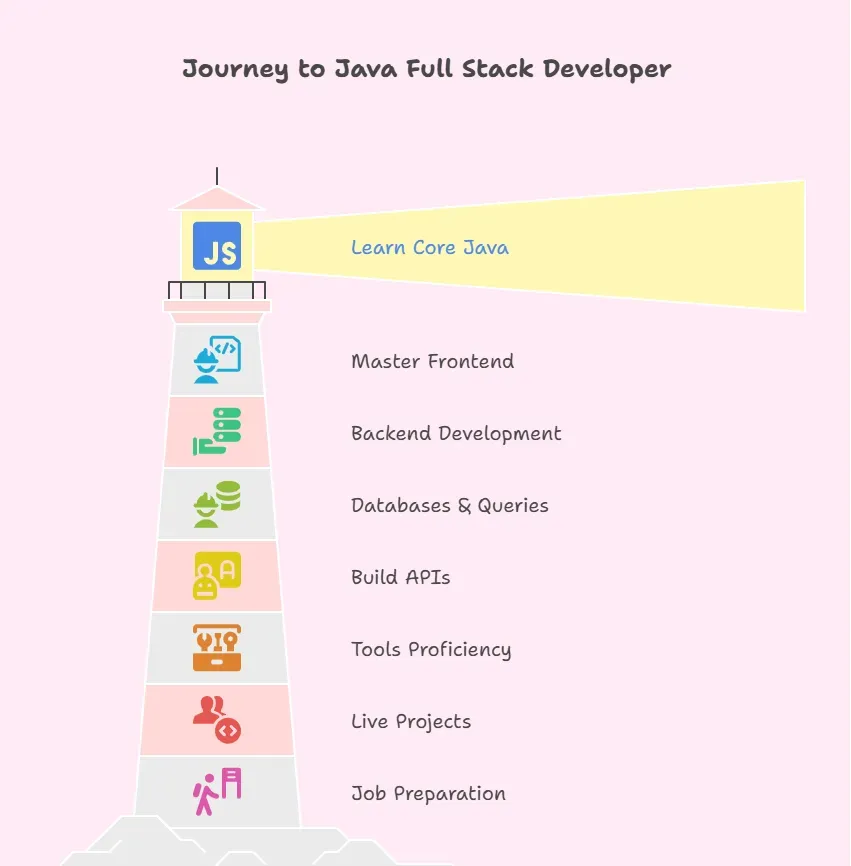
If you are a beginner, avoid trying to learn every technology at once.
Start with Core Java and object-oriented programming. Then learn HTML, CSS, and JavaScript.
After building a foundation in frontend development, learn React or Angular. Next, study SQL, databases, Spring Boot, and REST APIs.
Once you understand the fundamentals, combine everything into complete projects.
Good project ideas include:
- Ecommerce website
- Employee management system
- Online booking platform
- Banking application
- Task management system
- Blog platform
Your projects should demonstrate that you can connect a frontend to a Java backend, communicate through APIs, store data in a database, and implement features such as authentication.
Why Choose Java Full Stack Development?
One of the biggest advantages of Java full stack development is versatility.
Instead of understanding only one part of an application, you can work across multiple layers.
Java also has a mature ecosystem and is widely used in enterprise environments. Learning Spring Boot, databases, APIs, and modern frontend technologies can give developers a broad technical foundation.
However, full stack development can be challenging because there are many technologies to learn. The key is to build your skills gradually rather than trying to master everything simultaneously.
Final Thoughts
Java full stack development combines Java backend programming with frontend technologies, databases, APIs, testing, version control, and deployment tools.
The core technology stack can include Java, Spring Boot, HTML, CSS, JavaScript, React or Angular, MySQL or PostgreSQL, REST APIs, Git, Docker, and cloud platforms.
The career opportunities can range from Java backend developer and full stack developer to software engineer and technical lead.
If you want to pursue this career, focus on strong fundamentals and practical projects. Build applications that demonstrate how different technologies work together, publish your work on GitHub, and continue learning as the industry evolves.
With consistent practice and real-world experience, Java full stack development can provide a strong foundation for a long-term software development career.
Frequently Asked Questions
1. What is Java full stack development?
Java full stack development involves building both the frontend and backend of web applications. Java and Spring Boot are commonly used for backend development, while HTML, CSS, JavaScript, React, or Angular can be used for the frontend.
2. What technologies should I learn for Java full stack development?
Important technologies include Core Java, Spring Boot, HTML, CSS, JavaScript, React or Angular, SQL, databases, REST APIs, Git, testing tools, Docker, and basic cloud technologies.
3. Is Java full stack development a good career?
Yes. It can provide opportunities in software engineering, backend development, web application development, and full stack development. Java’s established ecosystem also makes it relevant for many enterprise applications.
4. How long does it take to learn Java full stack development?
The time varies depending on your programming experience and study schedule. A beginner may need several months to learn the fundamentals and additional time to become comfortable building complete real-world applications.
