


The debate around Edge Computing vs Cloud Computing has become increasingly critical as organizations adopt modern technologies to process and manage data efficiently. Both paradigms play vital roles in digital transformation, yet they differ radically in architecture, performance, scalability, security, and real-time processing capabilities.
Understanding these differences helps businesses select the optimal infrastructure for applications spanning IoT, artificial intelligence, autonomous systems, healthcare, and enterprise software. This guide breaks down the core technical distinctions, use cases, costs, and strategic considerations.
Read more blog : Can Edge Computing do Real-Time Data Processing for Faster, Smarter Applications?
What is Edge Computing?
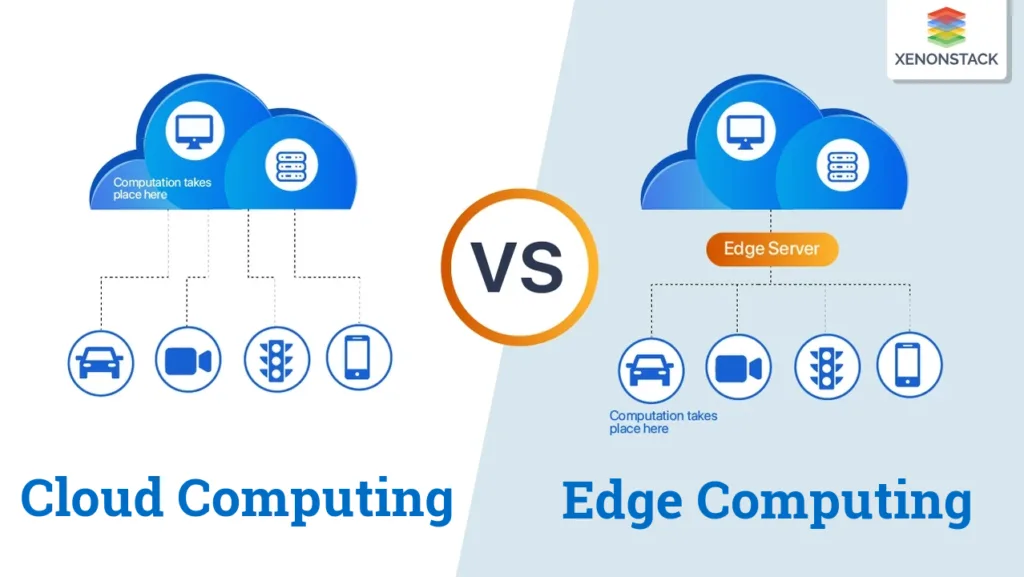
Edge computing is a distributed IT architecture where data processing occurs at the “edge” of the network—near the physical location of the data source (such as IoT devices, localized micro-gateways, or smart sensors)—rather than in a distant central server.
- Localized Processing: Reduces latency by analyzing critical data on-site before transmitting filtered metrics upstream.
- Offline Functionality: Capable of continuous operational performance even during intermittent or completely severed internet connectivity.
- Bandwidth Optimization: Minimizes network congestion by preventing continuous streams of raw data from traversing public or private networks.
- Core Limitation: Individual edge devices feature constrained memory, compute capacity, and thermal tolerances compared to enterprise cloud hardware.
What is Cloud Computing?
Cloud computing is a centralized model that delivers computing services—including servers, storage, databases, networking, and software—over the internet (“the cloud”) from hyper-scale data centers managed by providers like AWS, Microsoft Azure, and Google Cloud.
- Massive Compute & Storage: Provides enterprise-grade processing capabilities and virtually infinite elastic storage capacity.
- Flexibility & On-Demand Access: Resources can be allocated or decommissioned dynamically using pay-as-you-go pricing models.
- Centralized Data Management: Simplifies global data aggregation, multi-user collaboration, and large-scale analytical workflows.
- Core Limitation: High dependency on persistent high-speed internet connectivity and inherently higher network latency due to physical data travel distances.
Key Differences at a Glance
| Feature / Dimension | Edge Computing | Cloud Computing |
| Architecture | Decentralized, distributed local nodes | Centralized, hyper-scale data centers |
| Latency | Near-zero / Ultra-low (sub-millisecond to low ms) | Moderate to high (50ms – 200ms+) |
| Data Processing | On-site / Near data source | Remote centralized servers |
| Internet Dependency | Works offline or with intermittent connectivity | Requires continuous high-speed internet |
| Bandwidth Usage | Low (filters raw data locally) | High (transfers high volumes of raw data) |
| Compute Power | Limited by localized hardware physical size | Virtually unlimited high-performance compute |
| Cost Model | Higher initial CAPEX (local hardware deployment) | Operational OPEX model (pay-as-you-go) |
| Primary Security Focus | Physical security & physical device endpoint management | Centralized cloud infrastructure & network transit encryption |
Key Technical Comparisons
1. Architecture and Latency
- Edge Computing: Pushes computation to localized devices. By eliminating the round-trip journey to a remote server, response times stay within sub-millisecond ranges—making it essential for split-second decisions.
- Cloud Computing: Relies on hyper-scale server clusters. While capable of executing complex processing tasks, network routing introduces latency delays that make pure cloud models unsuitable for time-critical safety applications.
2. Cost and Scalability
- Edge Computing: Scaling involves purchasing and deploying additional physical hardware (edge servers or gateway nodes) across sites, increasing initial Capital Expenditure (CAPEX). However, it drastically lowers ongoing network bandwidth costs over time.
- Cloud Computing: Offers virtually infinite on-demand scalability without capital investments. Operating Expenses (OPEX) stay predictable initially, though high-volume data ingress/egress can lead to escalating cloud bills.
3. Security and Compliance
- Edge Computing: Enhances privacy and regulatory compliance (e.g., GDPR, HIPAA) by processing sensitive raw data on-site without broadcasting across public networks. The primary vulnerability lies in securing thousands of physical endpoint devices.
- Cloud Computing: Protected by enterprise-grade security controls, automated patching, and dedicated security teams. However, centralized databases represent high-value targets for cyberattacks and present risks during network data transit.
Industry Use Cases
Best Use Cases for Edge Computing
- Autonomous Vehicles: Onboard sensors, cameras, and LiDAR require sub-millisecond local evaluation for braking and navigation safety without depending on cell coverage.
- Industrial Automation & Smart Manufacturing: Real-time machine monitoring, automated assembly lines, and predictive maintenance trigger immediate safety shut-offs on local plant floors.
- Healthcare & Remote Monitoring: Wearable medical monitors analyze vital signs in real time to alert staff immediately, continuing uninterrupted during network blackouts.
- Smart Retail: Point-of-Sale (POS) systems and smart inventory tags process local transactions efficiently even during localized internet outages.
Best Use Cases for Cloud Computing
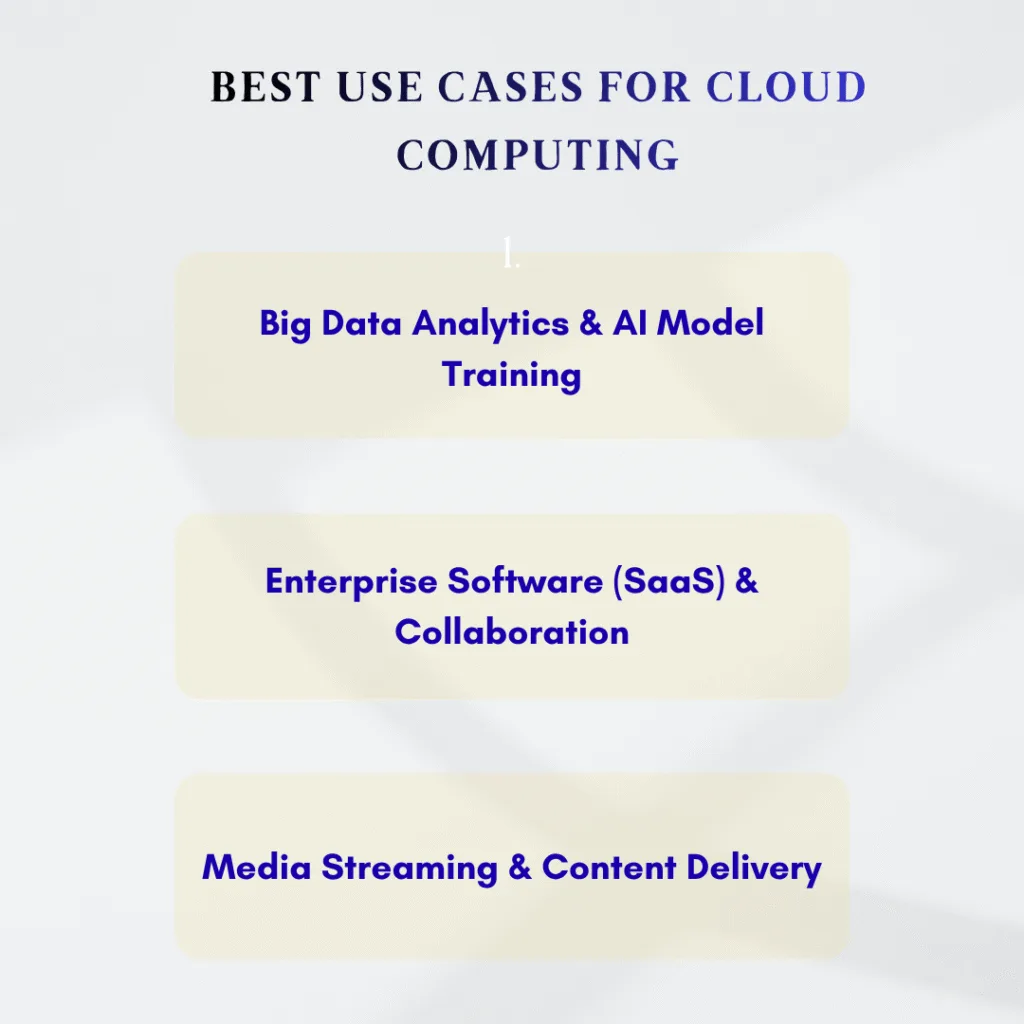
- Big Data Analytics & AI Model Training: Massive parallel computing resources needed to train deep learning models and run enterprise-wide trend analytics.
- Enterprise Software (SaaS) & Collaboration: Platforms like Google Workspace, Microsoft 365, and CRM systems benefit from centralized file access and unified data stores.
- Media Streaming & Content Delivery: Global distribution networks (e.g., Netflix, Spotify) rely on massive cloud storage and regional CDNs to serve high-volume content.
Hybrid Approach: Integrating Edge and Cloud
Choosing between edge and cloud computing is rarely an “either/or” decision. Modern digital architectures increasingly adopt a Hybrid Edge-Cloud Strategy:
- Continuous Synergy: Re-deploy updated, optimized AI models from the cloud back down to edge nodes for smarter localized inference over time.erprise resource management, where flexibility and virtually unlimited computing resources are essential.
- Edge Handles Real-Time Tasks: Process time-sensitive operations, immediate feedback loops, and local data filtering directly on edge devices.
- Cloud Handles Core Intelligence: Aggregate non-urgent, summarized data from all edge nodes into the central cloud for long-term storage, deep analytics, and AI model training.
Conclusion
Choosing between Edge Computing and Cloud Computing isn’t about selecting a single “winner”—it’s about matching the right architecture to your specific performance, bandwidth, and operational requirements.
- Choose Edge Computing when your priority is ultra-low latency, real-time decision-making, offline reliability, or strict data localization (e.g., autonomous systems, industrial automation, or remote medical monitoring).
- Choose Cloud Computing when you need massive compute capacity, centralized data management, virtually limitless elasticity, or complex analytics (e.g., enterprise software, big data processing, or AI model training).
For most modern digital enterprises, the optimal path forward is a Hybrid Edge-Cloud Strategy. By placing instantaneous, time-critical processing at the edge while leveraging the raw power and elastic storage of the cloud at the core, organizations achieve the ideal balance of speed, scalability, efficiency, and cost-effectiveness.
Read more blog : Edge Computing vs Cloud Computing for SaaS Applications in 2025
Frequently Ask Questions-
What is the main difference between Edge Computing vs Cloud Computing?
The main difference is where data is processed. Edge computing processes data near the source, while cloud computing processes data in centralized remote data centers.
Which is faster: Edge Computing or Cloud Computing?
Edge computing is faster for real-time applications because it reduces latency, whereas cloud computing is better for large-scale data processing.
Can Edge Computing and Cloud Computing work together?
Yes. Many businesses use a hybrid approach that combines edge computing for real-time processing and cloud computing for storage, analytics, and scalability.
Which industries benefit most from Edge Computing?
Edge computing offers lower latency, faster response times, reduced bandwidth usage, improved privacy, and reliable performance even in environments with limited internet connectivity.
Which industries use Edge Computing and Cloud Computing?
Industries such as healthcare, manufacturing, retail, transportation, finance, and smart cities use both edge computing and cloud computing to improve efficiency, enhance security, and support real-time decision-making.
