



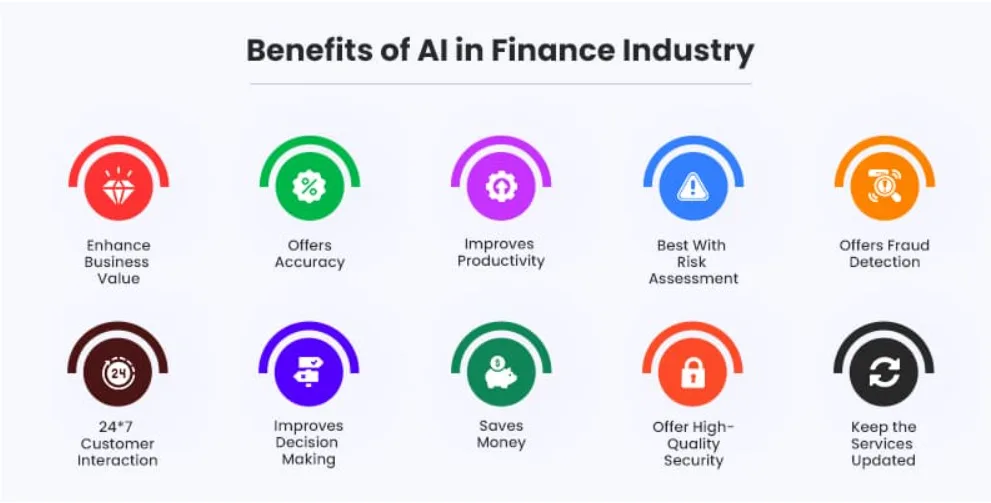
Artificial Intelligence (AI) has revolutionized the finance industry, changing how banks, investors, and businesses manage money. From fraud detection to automated trading, AI-powered solutions are making financial systems more efficient, secure, and accessible. If you’re still wondering whether AI is just a buzzword in finance, here are ten game-changing benefits proving otherwise.
What is AI Finance?
AI in Finance refers to the integration of advanced technologies like Machine Learning (ML), Natural Language Processing (NLP), and Deep Learning into the financial ecosystem to automate tasks, analyze massive datasets, and make high-speed decisions.
In 2026, AI is no longer just a “helper” tool; it has evolved into an execution layer where autonomous AI agents can manage workflows, predict market shifts, and protect assets with minimal human intervention.
The 3 Pillars of AI Technology in Finance
1. Machine Learning (The Brain)
Machine Learning algorithms digest millions of data points to find patterns. In finance, this is used for:
- Credit Scoring: Evaluating “thin-file” borrowers who don’t have a traditional credit history by looking at utility bills or shopping patterns.
- Predictive Analytics: Forecasting cash flow for businesses and predicting stock price movements for investors.
2. Natural Language Processing (The Communicator)
NLP allows machines to “read” and “understand” human language.
- Sentiment Analysis: Scanning news headlines and social media to see how the public feels about a stock.
- Smart Chatbots: Virtual assistants like Bank of America’s Erica that can resolve complex banking issues via voice or text.
3. Computer Vision (The Observer)
- Insurance Claims: AI can “see” photos of a car accident and instantly estimate repair costs.
- KYC (Know Your Customer): Automatically verifying your ID or passport during digital onboarding to prevent identity theft.
Key Use Cases in 2026
| Use Case | How it Works | Impact |
| Algorithmic Trading | AI executes trades based on market signals in milliseconds. | Higher liquidity and faster market response. |
| Hyper-Personalization | AI predicts your next financial need (like a home loan) before you ask. | 200% increase in customer engagement. |
| RegTech | AI monitors transactions to ensure they follow global laws. | Significant reduction in regulatory fines and manual audits. |
| Agentic AI | Independent AI “agents” that can negotiate loan terms or manage budgets. | Shifts AI from “assisting” humans to “executing” for them |
Benefits of AI in Finance Industry
1. Fraud Detection and Prevention
Fraudsters are getting smarter, but AI is one step ahead. Machine learning models analyze vast amounts of transactions in real-time, identifying suspicious activities and stopping fraud before it happens. AI-powered fraud detection adapts to new threats faster than traditional rule-based systems, making financial transactions safer for everyone.
2. Automated Trading for Smarter Investments
AI-driven trading algorithms process market data, identify patterns, and execute trades within milliseconds—far beyond human capability. High-frequency trading firms and hedge funds leverage AI to optimize their strategies, minimizing risks and maximizing profits. The result? More efficient markets and improved decision-making for investors.
3. Personalized Financial Services
Ever noticed how your banking app suggests financial products tailored just for you? AI analyzes customer spending habits, credit history, and risk tolerance to offer personalized advice. Robo-advisors like Betterment and Wealthfront provide AI-powered investment strategies without the need for human financial advisors, making wealth management more accessible.
4. Enhanced Customer Support with AI Chatbots
Forget waiting on hold for customer service—AI-powered chatbots can answer financial queries 24/7. Virtual assistants like Erica (Bank of America) and Eno (Capital One) help users check balances, detect unusual transactions, and even provide financial insights, improving the customer experience.
5. Better Risk Assessment and Credit Scoring
Traditional credit scoring methods rely on limited data, but AI considers alternative data points like social media activity, online behavior, and transaction history. This allows financial institutions to assess creditworthiness more accurately, providing loans to a broader audience, including those with little to no credit history.
6. Predictive Analytics for Market Trends
AI doesn’t just analyze past data—it predicts the future. Financial firms use AI-powered predictive analytics to forecast market trends, helping investors make informed decisions. AI models detect economic shifts, interest rate movements, and stock price fluctuations, reducing uncertainty in financial planning.
7. Cost Reduction and Operational Efficiency
By automating repetitive tasks like data entry, document verification, and transaction processing, AI reduces operational costs for banks and financial institutions. This leads to lower fees for consumers and a more efficient financial ecosystem. AI also minimizes human errors, further enhancing accuracy.
8. Regulatory Compliance and Reporting
Compliance with financial regulations is a major challenge, but AI simplifies the process. AI-powered RegTech solutions monitor transactions, generate compliance reports, and flag suspicious activities. This reduces the risk of regulatory fines and ensures financial institutions adhere to strict legal requirements.
9. AI-Driven Loan and Mortgage Approvals
AI speeds up the loan approval process by quickly analyzing an applicant’s financial data and creditworthiness. Automated underwriting models assess risk more accurately than traditional methods, leading to faster approvals and better loan terms for borrowers. AI also helps reduce biases in lending decisions.
10. Improved Financial Decision-Making
AI provides data-driven insights that empower individuals and businesses to make smarter financial decisions. Whether it’s budgeting apps analyzing spending habits or AI-powered portfolio management tools optimizing investments, AI enhances financial literacy and decision-making across all levels.
AI in Finance at a Glance
| Benefit | Core Technology | Key Impact |
| Fraud Prevention | Machine Learning | Stops theft in real-time. |
| Trading | High-Frequency Algorithms | Faster, data-driven investments. |
| Customer Support | NLP & Chatbots | Instant, 24/7 assistance. |
| Credit Scoring | Big Data Analytics | Fairer, faster loan approvals. |
| Compliance | RegTech | Automated reporting & fewer fines. |
How Arunangshudas Helps You Master AI Finance
Navigating the intersection of finance and technology can be overwhelming. Arunangshudas simplifies this journey by providing:
- Strategic Implementation: Helping businesses integrate AI tools to reduce costs and improve efficiency.
- Data-Driven Insights: Breaking down complex market trends into actionable financial advice.
With a focus on transparency and innovation, Arunangshudas ensures that you don’t just use AI—you use it to build lasting wealth and security.

Conclusion
AI is no longer a futuristic concept; it is the current reality of the financial world. By embracing these ten benefits, businesses and individuals can move toward a future that is more secure, inclusive, and profitable. As technology evolves, those who leverage AI will lead the next era of global finance.
With a focus on transparency and innovation, Arunangshudas ensures that you don’t just use AI—you use it to build lasting wealth and security.
You may also like:
1) How AI is Transforming the Software Development Industry
2) 8 Key Concepts in Neural Networks Explained
3) Top 5 Essential Deep Learning Tools You Might Not Know
4) 10 Common Mistakes in AI Model Development
5) 6 Types of Neural Networks You Should Know
6) The Science Behind Fine-Tuning AI Models: How Machines Learn to Adapt
7) 7 Essential Tips for Fine-Tuning AI Models
Read more blogs from Here
Share your experiences in the comments, and let’s discuss how to tackle them!
Follow me on Linkedin
Frequently Asked Questions (FAQs)
1. Is AI in finance safe?
Yes. In fact, AI makes finance safer by providing advanced encryption and real-time fraud monitoring that human teams cannot match.
2. Will AI replace human financial advisors?
While “Robo-advisors” handle many tasks, human advisors are shifting toward complex strategy and emotional coaching. AI is a tool that enhances their capabilities, not a total replacement.
3. How does AI help in getting a loan?
AI analyzes a wider range of data (like utility bills or consistent rent payments) to prove your creditworthiness, even if you don’t have a long credit history.
4. What is ‘RegTech’?
RegTech stands for Regulatory Technology. It uses AI to help banks follow government rules and laws automatically.
5. Can AI predict stock market crashes?
While no tool is 100% certain, AI is significantly better at spotting patterns and “red flags” in the market that precede a crash.
