


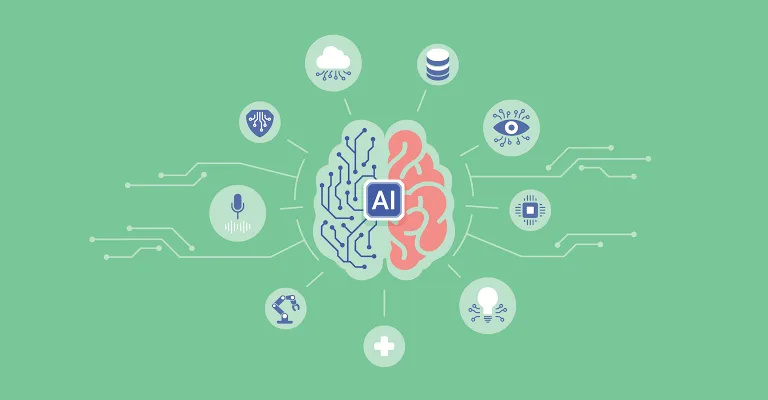
How does AI work? Artificial intelligence (AI) works by using computer systems to process information, identify patterns, learn from data, and produce predictions, recommendations, or decisions. Although AI can sometimes appear intelligent, it does not think exactly like a human. Instead, different AI systems use algorithms, statistical methods, and trained models to perform specific tasks.
From voice assistants and recommendation systems to chatbots and self-driving technologies, AI is becoming part of everyday life. Understanding how artificial intelligence works can help beginners understand why these systems are useful, what their limitations are, and how technologies such as machine learning and generative AI operate.
This guide explains the basic concepts behind AI in simple terms, including data, algorithms, machine learning, neural networks, deep learning, and generative AI.
Table of Contents
What Is Artificial Intelligence?

Artificial intelligence refers to computer systems designed to perform tasks that typically require some form of human intelligence.
These tasks can include:
- Understanding language
- Recognizing images
- Identifying patterns
- Making predictions
- Recommending products
- Translating languages
- Generating text or images
- Analyzing large amounts of information
Traditional software generally follows explicitly programmed instructions. AI systems can instead learn patterns from examples and use those patterns to produce outputs.
For example, a traditional program might identify whether a number is greater than 10 using a rule written by a developer. A machine learning system could be trained using thousands of examples to recognize patterns associated with a particular category.
How Does AI Work? Understanding the Basics
So, how does AI work at a basic level?
Most AI systems involve several important components: data, algorithms, a model, training, and inference.
1. Data
Data is one of the most important ingredients in modern AI.
AI systems can learn from many forms of data, including text, images, audio, video, numerical information, and user interactions.
For example, an image-recognition system may be trained using thousands or millions of labeled images. A language model can be trained using large collections of text.
The quality and relevance of the data can significantly affect the performance of an AI system.
2. Algorithms
An algorithm is a set of computational methods used to process information and solve a problem.
Machine learning algorithms allow computers to identify patterns in data and adjust their internal parameters during training.
Different problems require different approaches. Some systems use decision trees, while others use neural networks or other statistical techniques.
3. Models
A machine learning model is a trained computational system that has learned patterns from data.
During training, the model processes examples and adjusts its parameters to improve its results.
Once training is complete, the model can analyze new information and generate an output.
For example, an email spam detection model may learn patterns associated with spam messages. When a new email arrives, the model analyzes it and predicts whether it is likely to be spam.
What Is Machine Learning?
Machine learning is a major branch of artificial intelligence.
Instead of programming every rule manually, developers provide algorithms with data and allow the system to learn patterns from that data.
There are several major types of machine learning.
Supervised Learning
In supervised learning, a model learns from labeled examples.
For instance, developers could provide thousands of emails labeled as “spam” or “not spam.” The model learns patterns associated with each category and uses them when analyzing new emails.
Unsupervised Learning
Unsupervised learning works with data that does not have predefined labels.
The system attempts to identify patterns, groups, or relationships within the data.
For example, an online retailer might use unsupervised learning to identify groups of customers with similar purchasing behavior.
Reinforcement Learning
Reinforcement learning involves an agent learning through interaction with an environment.
The system receives rewards or penalties based on its actions and gradually learns strategies that improve its performance.
This approach has been used in areas such as robotics, games, and optimization.
How Do Neural Networks Work?
Neural networks are computational models inspired loosely by the structure of biological brains.
A neural network contains interconnected computational units commonly organized into layers.
A basic network can include:
- Input layer
- Hidden layers
- Output layer
The input layer receives information. Hidden layers process that information through mathematical operations, and the output layer produces a result.
During training, the network adjusts its parameters to reduce errors.
For example, an image-recognition neural network may receive an image as input and eventually learn patterns associated with objects such as cars, dogs, or buildings.
Modern neural networks can contain many layers and millions or billions of parameters.
What Is Deep Learning?
Deep learning is a type of machine learning that uses neural networks with multiple layers.
It has become particularly important for processing complex information such as images, audio, and natural language.
Deep learning systems can automatically learn increasingly complex representations from data.
For example, an image model might learn simple visual patterns in early layers and progressively combine them into more complex representations.
Deep learning has contributed significantly to advances in speech recognition, computer vision, recommendation systems, and language technologies.
How Does Generative AI Work?
Generative AI refers to AI systems that can create new content based on patterns learned during training.
These systems can generate:
- Text
- Images
- Audio
- Video
- Computer code
Large language models are a major example of generative AI.
A language model processes text and learns statistical relationships between words, phrases, and broader patterns in language. When given a prompt, it generates an output based on those learned patterns.
Image-generation models work differently depending on their architecture, but they similarly learn patterns from large collections of visual data and use those learned representations to generate new images.
Generative AI does not simply retrieve a complete answer from a database every time. It uses its learned model to produce an output based on the input it receives.
How Does AI Learn?
One important question beginners often ask is whether AI learns in the same way humans do.
The answer is no.
During machine learning training, a model processes examples and makes predictions. The system compares its predictions with the desired outcomes when applicable and calculates an error.
An optimization process then adjusts the model’s parameters to reduce that error.
This process may happen repeatedly across huge datasets.
Once the model has been trained, it can process new information. This stage is commonly called inference.
For example:
Training: Show a model many examples of cats and dogs.
Learning: The model adjusts its parameters to recognize patterns associated with each category.
Inference: Give the model a new image and ask it to predict whether it contains a cat or dog.
How Does AI Process Natural Language?
Natural language processing (NLP) allows computers to work with human language.
AI language systems break text into smaller units called tokens. These tokens are converted into numerical representations that the model can process.
Modern language models use sophisticated neural-network architectures to identify relationships between tokens and generate or analyze language.
For example, when you ask an AI chatbot a question, the system processes your input, analyzes relationships within the text, and generates a response based on its learned model and the instructions or context available to it.
This technology powers applications such as chatbots, translation systems, writing assistants, search tools, and automated customer support.
How AI Makes Predictions and Decisions
AI can use learned patterns to make predictions or classifications.
Consider an online shopping platform. An AI recommendation system may analyze information such as previous purchases, browsing behavior, product characteristics, and interactions.
It can then estimate which products a customer might find relevant.
Similarly, financial institutions can use machine learning systems to identify unusual transaction patterns, while healthcare organizations can use AI-based tools to assist with certain types of data analysis.
However, AI predictions are not automatically correct. The quality of the data, model design, assumptions, and real-world conditions can all affect results.
Advantages of Artificial Intelligence
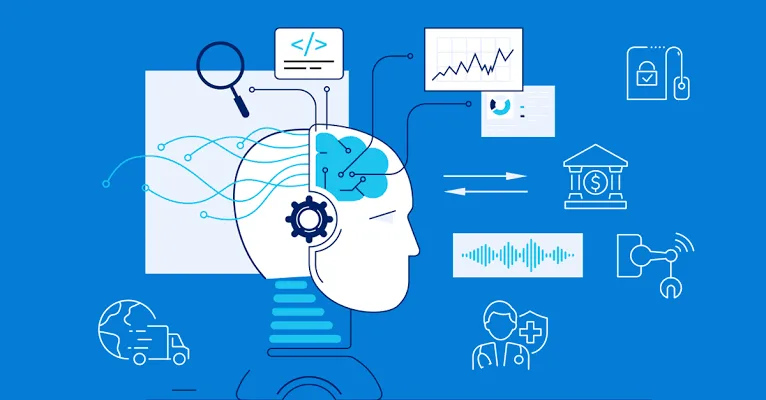
AI can provide several important benefits.
Automation
AI can automate repetitive tasks and reduce the amount of manual work required for certain processes.
Speed
Computers can process large amounts of information much faster than humans in many situations.
Pattern Recognition
AI can identify patterns in large datasets that may be difficult for people to detect manually.
Personalization
Recommendation systems can use AI to provide personalized content, products, or experiences.
Productivity
AI tools can assist people with tasks such as drafting content, analyzing information, writing code, and summarizing documents.
Limitations and Risks of AI
Understanding how artificial intelligence works also means understanding its limitations.
AI systems can produce incorrect information, particularly when the model lacks sufficient context or encounters unfamiliar situations.
Training data can also contain biases, which may affect model outputs.
Privacy and security are additional concerns, especially when AI systems process sensitive information.
Generative AI can also produce convincing but inaccurate content. Therefore, important AI-generated information should be reviewed and verified rather than accepted automatically.
AI is best viewed as a tool that can support human decision-making rather than an infallible replacement for human judgment.
Where Is AI Used?
AI is already used across many industries.
Common applications include:
- Healthcare
- Banking
- Ecommerce
- Manufacturing
- Transportation
- Education
- Cybersecurity
- Marketing
- Customer service
- Software development
- Entertainment
For example, businesses use AI-powered chatbots to answer customer questions, ecommerce platforms use recommendation systems to personalize shopping experiences, and developers use AI tools to assist with programming tasks.
The Future of AI
AI technology is developing rapidly, and its applications are likely to continue expanding.
Future AI systems may become more capable of working with multiple types of information, including text, images, audio, and video. AI assistants may also become more integrated into software, workplaces, and everyday devices.
At the same time, responsible development will remain important. Businesses and governments will need to consider issues involving privacy, security, reliability, transparency, employment, and the appropriate use of AI.
The goal should not simply be to make AI more powerful but also to make it more useful, reliable, secure, and responsible.
Final Thoughts
So, how does AI work?
At its core, AI uses data, algorithms, and trained models to identify patterns and produce useful outputs. Machine learning allows systems to learn patterns from examples, while neural networks and deep learning enable more sophisticated processing of complex information. Generative AI takes these capabilities further by producing new content such as text, images, audio, and code.
For beginners, the most important concept to remember is that AI is not a single technology. It is a broad field containing many techniques and applications.
Understanding the basics of data, training, models, inference, and machine learning provides a strong foundation for learning about more advanced AI technologies.
Frequently Asked Questions
1. How does AI work in simple terms?
AI works by processing data with algorithms and trained models to identify patterns and produce outputs such as predictions, classifications, recommendations, or generated content.
2. How does AI learn from data?
AI models learn by processing examples during training and adjusting internal parameters to improve their results. After training, the model can use the patterns it learned to process new information.
3. What is the difference between AI and machine learning?
Artificial intelligence is the broader field of creating systems capable of performing tasks associated with intelligence. Machine learning is a branch of AI that allows systems to learn patterns from data rather than relying entirely on manually programmed rules.
4. Can AI think like a human?
AI can perform tasks that appear intelligent, but it does not necessarily think or understand the world in the same way humans do. Its capabilities depend on the model, training data, algorithms, and context in which it is used.
