


Investment banking is no longer driven solely by spreadsheets, manual research, and endless hours of financial analysis. Artificial intelligence has become a critical part of modern banking operations, enabling firms to process vast amounts of financial data, identify opportunities faster, and improve decision-making. From mergers and acquisitions to portfolio analysis and compliance, AI agents are transforming how investment professionals work every day.
Organizations adopting investment banking AI are seeing improvements in operational efficiency, research quality, and deal execution. Intelligent automation allows bankers to spend less time on repetitive administrative tasks and more time building client relationships and creating strategic financial solutions.
Modern financial institutions are also integrating AI Agents in Wealth Management to personalize investment strategies and automate portfolio monitoring. At the same time, Financial Services firms are embracing AI-powered technologies to streamline compliance, improve customer experiences, and strengthen risk management capabilities.
Beyond client-facing services, investment banks are increasingly implementing AI Agents for Fraud Detection to identify suspicious transactions, monitor unusual financial activities, and reduce operational risks before they impact business performance.
Why Investment Banking Needs AI Agents
Investment banking involves processing enormous volumes of structured and unstructured financial data. Analysts spend significant time gathering market information, reviewing company reports, creating valuation models, and preparing presentations.
AI agents automate many of these activities by continuously collecting, organizing, and analyzing information from multiple trusted sources. Rather than replacing investment professionals, AI enhances their capabilities and accelerates decision-making.
Some major challenges AI addresses include:
- Manual financial research
- Lengthy due diligence processes
- Slow document analysis
- Repetitive financial modeling
- Compliance monitoring
- Market trend analysis
- Client reporting
These improvements allow investment teams to focus on strategic decision-making instead of repetitive administrative work.
What Are AI Agents in Investment Banking?
AI agents are intelligent software systems capable of performing complex financial tasks with minimal human intervention. Unlike traditional automation, AI agents understand context, learn from historical data, and continuously improve recommendations.
These systems can:
- Analyze earnings reports
- Monitor market news
- Evaluate financial statements
- Detect investment opportunities
- Prepare valuation summaries
- Generate financial reports
- Assist in regulatory compliance
Instead of working as standalone tools, AI agents collaborate with analysts throughout the investment lifecycle.
Key Areas Where AI Agents Are Transforming Investment Banking
1. Faster Deal Sourcing
Investment bankers continuously search for acquisition opportunities and strategic partnerships.
AI agents monitor:
- Company growth
- Market trends
- Industry reports
- Funding announcements
- Executive changes
This creates highly targeted deal pipelines while reducing manual research efforts.
2. Intelligent M&A Support
Modern M&A automation enables banks to evaluate acquisition targets much faster than traditional methods.
AI can compare hundreds of companies based on:
- Revenue growth
- EBITDA
- Market position
- Competitive landscape
- Financial health
- Risk indicators
Instead of spending weeks reviewing data, bankers receive prioritized recommendations within hours.
Traditional Investment Banking vs AI-Powered Operations
| Banking Activity | Traditional Process | AI-Powered Process | Business Benefit |
| Market Research | Manual reports | Automated data collection | Faster insights |
| Financial Analysis | Spreadsheet-driven | AI-driven analytics | Better accuracy |
| Due Diligence | Weeks of review | Intelligent document analysis | Reduced timelines |
| Deal Screening | Human evaluation | AI recommendations | Better opportunity identification |
| Compliance | Manual checks | Continuous monitoring | Lower operational risk |
AI-Driven Deal Intelligence
Banks increasingly rely on deal intelligence systems to monitor industries, competitors, and market movements.
These platforms automatically gather information from:
- Financial statements
- SEC filings
- Earnings transcripts
- Industry news
- Credit reports
- Market databases
AI organizes the information into actionable insights, helping investment teams identify promising opportunities quickly.
Transaction Analysis with AI
One of the biggest innovations is transaction analysis AI.
AI evaluates historical transactions to identify:
- Comparable acquisitions
- Market valuation trends
- Buyer behavior
- Industry benchmarks
- Risk patterns
Analysts receive recommendations supported by historical evidence rather than relying only on manual research.
AI Applications Across Investment Banking
| Department | AI Capability | Primary Outcome |
| M&A Advisory | Deal screening | Faster acquisitions |
| Equity Research | Automated analysis | Better reports |
| Capital Markets | Market forecasting | Improved pricing |
| Risk Management | Predictive monitoring | Reduced financial risk |
| Compliance | Regulatory monitoring | Better governance |
Improving Banker Productivity
Investment bankers often spend countless hours formatting presentations, preparing financial models, and organizing research.
Modern banker productivity tools automate repetitive activities such as:
- Report creation
- PowerPoint drafting
- Financial summaries
- Data extraction
- Client documentation
- Meeting preparation
Instead of replacing professionals, AI allows bankers to dedicate more time to strategic advisory work.
AI-Powered Financial Operations
Financial institutions are rapidly adopting AI-powered financial operations to optimize internal processes.
Examples include:
- Automated reconciliations
- Financial reporting
- Regulatory documentation
- Cash flow analysis
- Expense monitoring
- Audit preparation
These improvements increase operational accuracy while reducing manual workloads.
Smarter Investment Workflows
Banks now deploy investment workflows AI to coordinate multiple processes across departments.
AI agents can:
- Trigger approvals
- Route documents
- Schedule compliance reviews
- Generate financial reports
- Monitor deadlines
This creates seamless collaboration between analysts, associates, vice presidents, and managing directors.
Benefits of AI Agents in Investment Banking
| Benefit | Impact |
| Faster Research | Reduced manual work |
| Better Decision Making | Data-driven recommendations |
| Improved Compliance | Continuous monitoring |
| Lower Costs | Reduced operational expenses |
| Higher Accuracy | Fewer human errors |
| Better Client Service | Faster turnaround time |
Automating Financial Processes
Banks increasingly use finance process automation to eliminate repetitive operational tasks.
Automated workflows include:
- Invoice processing
- Expense approvals
- Financial reconciliations
- Client onboarding
- Document verification
- Regulatory reporting
Automation improves consistency while allowing finance teams to focus on higher-value activities.
Enterprise AI in Banking
Large institutions deploy enterprise banking AI across multiple departments.
Common enterprise applications include:
- Corporate banking
- Investment banking
- Treasury management
- Risk analysis
- Customer support
- Regulatory compliance
Enterprise-wide AI creates a connected ecosystem where information flows efficiently between teams.
Autonomous Deal Execution
The next evolution involves autonomous deal systems capable of supporting complex transactions with minimal manual intervention.
These systems can:
- Track acquisition milestones
- Monitor regulatory approvals
- Coordinate documentation
- Identify transaction risks
- Generate progress reports
Human bankers remain responsible for strategic decisions while AI handles operational coordination.
Financial Research Workflows Become Smarter
Investment analysts traditionally spend days collecting information before beginning financial analysis.
Modern Financial Research Workflows automate:
- Market research
- Earnings analysis
- Company comparisons
- Industry benchmarking
- News monitoring
Analysts receive organized research packages that significantly reduce preparation time.
AI in Private Equity Due Diligence
Private equity firms increasingly use Private Equity Due Diligence solutions powered by AI.
AI accelerates due diligence by reviewing:
- Financial statements
- Legal contracts
- Customer concentration
- Operational risks
- Historical performance
- Market positioning
This enables faster investment decisions with deeper analytical insights.
Autonomous AI Agents for Financial Teams
The emergence of Autonomous AI Agents is changing how investment banks manage daily operations.
These intelligent systems continuously:
- Monitor financial markets
- Analyze investment opportunities
- Generate alerts
- Prepare reports
- Track compliance
- Support analysts
Autonomous agents operate around the clock, providing continuous decision support.
AI-Assisted Financial Modeling
Creating valuation models is one of the most time-consuming tasks in investment banking.
Modern AI simplifies Financial Modeling for Analysts by:
- Importing financial statements
- Forecasting revenue
- Running scenario analysis
- Performing sensitivity testing
- Updating assumptions automatically
Analysts can validate AI-generated models instead of building every spreadsheet manually.
Future Trends in AI-Powered Investment Banking
| Emerging Trend | Expected Business Impact |
| Autonomous AI Agents | Continuous decision support |
| Real-Time Risk Analysis | Faster risk mitigation |
| Intelligent Financial Modeling | Improved forecasting |
| AI Deal Intelligence | Better acquisition targeting |
| Predictive Compliance | Lower regulatory penalties |
Benefits of AI Agents for Investment Banks
Organizations implementing AI agents experience numerous advantages:
- Faster deal execution
- Improved research quality
- Better compliance monitoring
- Reduced operational costs
- Higher analyst productivity
- Enhanced client experience
- More accurate financial forecasting
- Stronger risk management
- Better investment recommendations
- Continuous operational intelligence
Challenges of AI Adoption
Although AI delivers major benefits, investment banks must address several challenges.
These include:
- Data privacy concerns
- Regulatory compliance
- AI transparency
- Integration with legacy systems
- Data quality issues
- Cybersecurity risks
- Human oversight requirements
- Ethical AI governance
Successful implementation requires balancing automation with experienced financial professionals.
The Future of AI in Investment Banking
AI agents will become increasingly integrated into every stage of the investment banking lifecycle. Rather than replacing analysts, associates, or managing directors, intelligent systems will augment their expertise by automating repetitive work and delivering deeper financial insights.
Future investment banks will rely on AI for continuous market monitoring, predictive financial analysis, intelligent document processing, autonomous workflow management, and real-time risk assessment. Firms that successfully combine human expertise with AI-powered intelligence will be better positioned to compete in an increasingly data-driven financial industry.

Conclusion
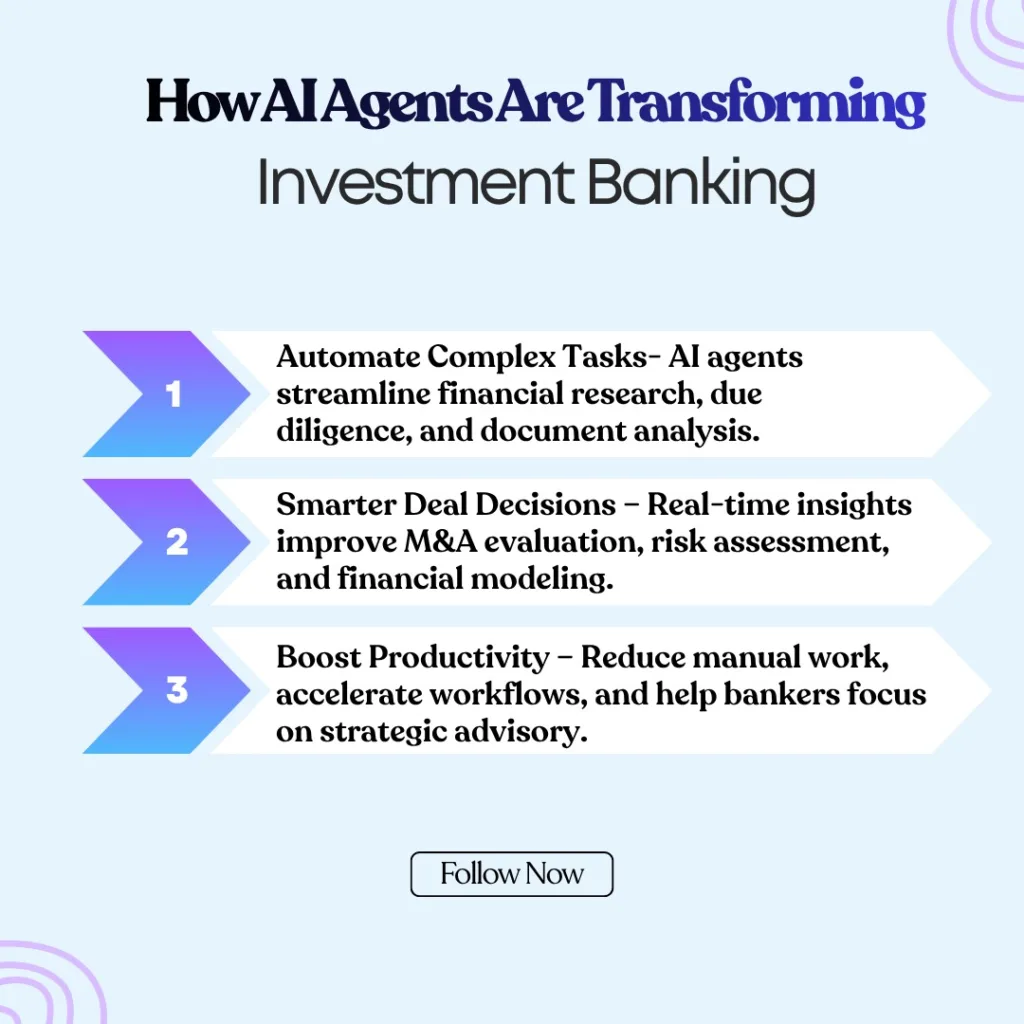
AI agents are fundamentally reshaping investment banking by improving efficiency, accelerating research, and enabling smarter financial decisions. From automated due diligence and intelligent deal sourcing to financial modeling and compliance monitoring, AI continues to transform traditional banking operations.
As technology evolves, investment banks that strategically adopt AI solutions while maintaining strong human oversight will be better equipped to deliver faster transactions, higher-quality advisory services, and stronger long-term business performance.
Frequently Asked Questions (FAQs)
1. How is AI changing investment banking?
AI automates research, financial analysis, compliance monitoring, document review, and deal sourcing, allowing investment bankers to focus on strategic advisory services and client relationships.
2. What are AI agents in investment banking?
AI agents are intelligent software systems that perform financial tasks such as market analysis, valuation support, due diligence, risk monitoring, and workflow automation with minimal human intervention.
3. Can AI replace investment bankers?
No. AI enhances productivity by handling repetitive and data-intensive work, while experienced bankers continue making strategic decisions, negotiating deals, and managing client relationships.
4. What are the biggest benefits of AI in investment banking?
Major benefits include faster deal execution, improved financial analysis, reduced operational costs, stronger compliance, enhanced productivity, and better investment decision-making.
5. What challenges do investment banks face when implementing AI?
Key challenges include data privacy, regulatory compliance, cybersecurity, legacy system integration, AI transparency, governance, and maintaining human oversight over automated decisions.
