


The SEO vs GEO debate is the most consequential discussion in digital marketing today. For two decades, SEO (Search Engine Optimization) was the undisputed king of online visibility. You optimized for Google’s blue links, ranked #1, and earned clicks.
But in 2026, a new challenger has emerged: GEO (Generative Engine Optimization), which optimizes content for AI-generated answers from tools like Google SGE, Perplexity AI, and ChatGPT Search. The SEO vs GEO battle is not about which one wins—it is about how smart marketers allocate resources between two fundamentally different discovery engines.
This article compares SEO vs GEO across every critical dimension: how they work, what content formats they reward, how to measure success, and where to invest your 2026 budget. By the end, you will have a clear framework for balancing traditional SEO with generative engine optimization to maximize total online visibility.
Table of Contents
SEO vs GEO: Head-to-Head Comparison
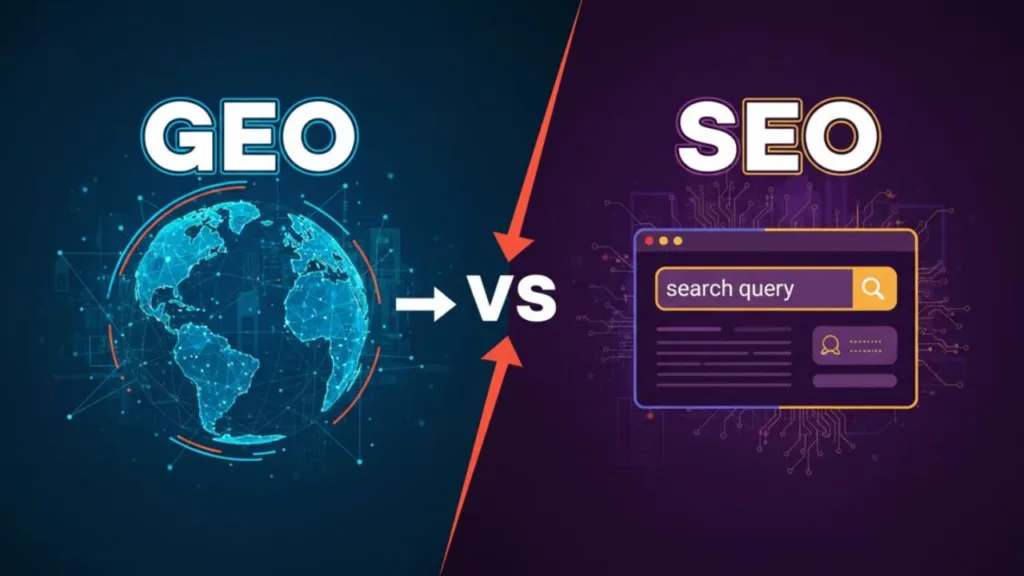
Let’s define the core differences in the SEO vs GEO battle before diving into tactics. Understanding these distinctions is the first step to building a hybrid strategy.
| Dimension | Traditional SEO | GEO (Generative Engine Optimization) |
|---|---|---|
| Goal | Rank #1 in blue links | Get cited in AI-generated answers |
| Primary audience | Google, Bing, Yahoo | Google SGE, Perplexity, ChatGPT Search, Copilot |
| Key metric | Click-through rate (CTR) | Citation frequency and brand mention |
| Content preference | Scannable lists, short paragraphs | Self-contained, attributable facts |
| Time to results | 3-12 months | 30-90 days |
| Zero-click reality | 65% of searches end without clicks | 90% of AI answers never produce clicks |
The SEO vs GEO comparison reveals a fundamental shift. Traditional SEO fights for a click that may never come (zero-click searches exceeded 65% in 2025). GEO fights for a citation that builds brand authority even without a click. Neither approach is obsolete, but ignoring generative engine optimization in 2026 means ceding visibility to competitors.
How Traditional SEO Works (And Where It Fails)
Before we explore why SEO vs GEO matters, let us review traditional SEO’s strengths and weaknesses. Traditional SEO relies on three pillars: keywords (matching search queries), backlinks (building domain authority), and technical structure (site speed, mobile optimization, schema markup). When all three align, your page earns a top organic position.
The problem? Google’s Search Generative Experience (SGE) now answers 40% of all queries directly on the search results page. For informational queries like “how to fix a leaky faucet” or “what is the capital of Peru,” users never see blue links. Your #1 ranking is invisible. This is the core tension in the SEO vs GEO debate: traditional SEO optimizes for a results page that is increasingly hidden.
Additionally, traditional SEO click-through rates have collapsed. In 2020, the #1 organic result earned 3.5% of clicks. In 2026, that number is 1.8%. Meanwhile, the AI-generated answer at the top of the page earns zero clicks by design—users read the answer and leave. If your entire strategy is traditional SEO, you are fighting for a shrinking slice of an already small pie.
How Generative Engine Optimization Changes the Game

In the SEO vs GEO battle, GEO takes a completely different approach. Generative engine optimization optimizes for extractability—how easily an AI model can pull a fact, statistic, or step from your content and present it as part of a conversational answer. The AI does not care about your domain authority or backlink profile. It cares about four things:
- Claim density: How many unique, attributable claims (with sources and dates) per paragraph?
- Self-contained sentences: Can a sentence be understood without reading previous paragraphs?
- Recency: Was your content published or updated in the last 12 months?
- Format clarity: Do you use Q&A blocks, bullet points with attributions, and GEO Markup?
When you implement generative engine optimization, you stop writing for human skimmers and start writing for AI extractors. For example, instead of writing “Social media engagement is dropping,” you write “According to a 2025 Pew Research study, social media engagement dropped 14% year-over-year on Facebook and 22% on X (formerly Twitter).” The second sentence is citeable. The first is not.
This distinction is the heart of SEO vs GEO. Traditional SEO rewards broad topical coverage. Generative engine optimization rewards narrow, data-rich, attributable claims.
When to Use SEO vs GEO (And When to Use Both)
The SEO vs GEO decision depends on your content type and user intent. Here is a practical framework.
Use traditional SEO when:
- You run an e-commerce site (users still click product pages)
- Your target query has commercial intent (“buy running shoes,” “hire plumber”)
- You need direct conversions (newsletter signups, demo bookings)
- Your audience is over 45 years old (less likely to use AI search)
Use generative engine optimization when:
- Your content answers informational queries (“how to,” “what is,” “why does”)
- You target younger audiences (under 35, heavy AI search users)
- You want brand authority even without clicks
- Your competitors already dominate traditional SEO rankings
Use both when:
- You publish long-form, research-driven content (white papers, industry reports)
- You target “best of” or “comparison” queries (AI summaries and traditional results coexist)
- You have the budget for separate strategies
The winning approach to SEO vs GEO is not choosing one over the other. It is allocating 60% of your organic budget to traditional SEO for commercial queries and 40% to generative engine optimization for informational queries. Rebalance as AI search adoption grows.
How to Measure SEO vs GEO Performance
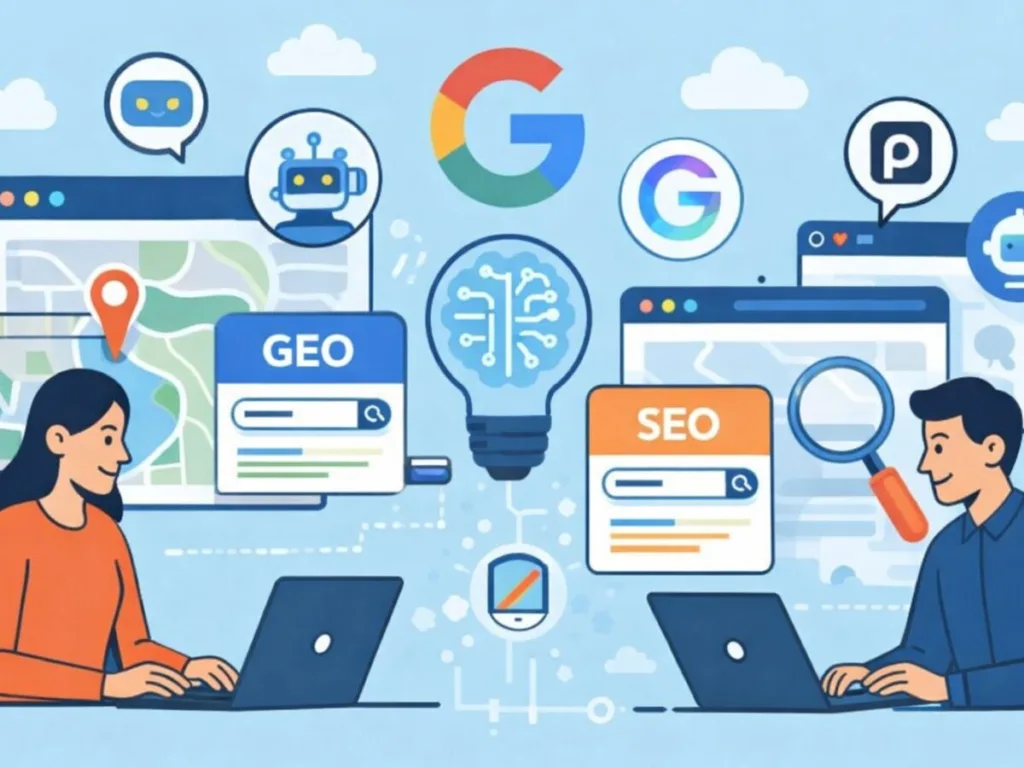
You cannot optimize what you do not measure. In the SEO vs GEO battle, the metrics are completely different.
For traditional SEO, track:
- Keyword rankings (positions 1-10)
- Organic click-through rate (CTR)
- Domain authority (Moz or Ahrefs score)
- Backlink growth
For generative engine optimization, track:
- Citation frequency (how often your domain appears in AI answers)
- Answer presence (does the AI mention your brand by name?)
- Citation accuracy (is the AI correctly representing your claim?)
- Referral clicks from AI answers (users who click cited sources)
Tools for generative engine optimization include GEOmetric, CitationTracker, and PromptPulse (starting at $49/month). Traditional SEO tools include Semrush, Ahrefs, and Moz. A complete SEO vs GEO measurement stack requires both categories.
Case Study: SEO vs GEO in Action
A B2B software company selling project management tools ran a six-month SEO vs GEO experiment. They split their content budget equally: 50% to traditional SEO (blog posts optimized for keywords like “best project management software”) and 50% to generative engine optimization (FAQ-style content optimized for AI extraction).
Results after six months:
- Traditional SEO: 12% increase in organic traffic, 8% increase in demo requests
- Generative engine optimization: 340% increase in citation frequency (appearing in AI answers), 22% increase in branded search volume (users searching for their company name after seeing AI citations)
The SEO vs GEO experiment showed that GEO drove more brand awareness (22% lift) while SEO drove more direct conversions (8% lift). The optimal strategy combined both: use SEO for bottom-of-funnel conversions and GEO for top-of-funnel authority.
Common Mistakes in SEO vs GEO Strategy
Avoid these three errors in the SEO vs GEO battle.
Mistake #1: Abandoning traditional SEO entirely. Some marketers overreact to zero-click searches and stop optimizing for Google. This is a mistake because commercial and local queries still generate clicks. Traditional SEO remains profitable for e-commerce and service businesses.
Mistake #2: Treating GEO as a one-time project. Generative engine optimization requires continuous refreshing of statistics, dates, and claims. AI engines penalize stale content aggressively. Update your GEO-optimized pages quarterly.
Mistake #3: Ignoring citation accuracy. When an AI misquotes your content, it damages your brand authority. Monitor and correct via GEO Markup or by updating the source page.
The Future of SEO vs GEO
By 2028, experts predict that generative engine optimization will command 40-50% of organic search budgets, up from 15% in 2026. Traditional SEO will not disappear, but it will shift toward transactional and local queries where AI answers are less useful. The SEO vs GEO debate will evolve into “how to integrate both seamlessly.”
Early adopters of generative engine optimization are already seeing compounding returns: each citation builds authority, which leads to more citations. Start now with one informational pillar page. Rewrite it using self-contained, attributable claims. Add FAQ blocks with specific dates and sources. Measure citation frequency after 60 days. You will see the future of search before your competitors do.
Final Verdict
SEO vs GEO is not a war with a single winner. It is a strategic allocation problem. Use traditional SEO for commercial queries where clicks convert to revenue. Use generative engine optimization for informational queries where brand authority matters. Measure both separately. Rebalance quarterly based on AI search adoption in your industry. The brands that master both will dominate online visibility in 2026 and beyond.
Frequently Asked Questions (FAQs)
Q1: Can I ignore GEO and just focus on traditional SEO in 2026?
You can, but you will lose visibility on informational queries. Over 40% of Google searches now return AI-generated answers before any blue links. If your target keywords are informational (“how to,” “what is,” “why does”), ignoring generative engine optimization means your content will never be seen. For commercial queries (“buy,” “hire,” “pricing”), traditional SEO remains effective. Audit your keyword portfolio before deciding.
Q2: How much budget should I allocate to SEO vs GEO?
A 60/40 split (SEO/GEO) is a safe starting point for most B2B content marketers. Shift to 50/50 if your audience is under 35 or heavily uses Perplexity and ChatGPT Search. Shift to 80/20 (SEO/GEO) if you run an e-commerce site with mostly commercial queries. Re-evaluate quarterly as AI search adoption grows.
Q3: Do the same tools measure both SEO vs GEO performance?
No. Traditional SEO tools (Semrush, Ahrefs, Moz) do not measure citation frequency in AI answers. You need separate tools for generative engine optimization, such as GEOmetric, CitationTracker, or PromptPulse. Budget $50-$200/month for GEO measurement. Some enterprise platforms now offer combined dashboards, but they cost $500+/month.
Q4: Which is harder to learn: SEO or GEO?
Traditional SEO is harder to learn because it involves technical factors (site speed, schema markup, backlink building) that take years to master. Generative engine optimization is conceptually simpler: write self-contained, attributable, data-rich sentences. However, GEO requires a different mindset—you must stop writing for human skimmers and start writing for AI extractors. Most content writers learn GEO fundamentals in 2-3 weeks.
