


Retrieval-Augmented Generation (RAG) is an AI approach where a model first retrieves relevant external information, like documents or databases, and then uses it to generate accurate responses. It’s important because it makes AI more reliable, up-to-date, and context-aware, especially for enterprise applications that require precise, verifiable, and domain-specific answers.
Large language models are powerful, but on their own they have a structural limitation. They generate answers based on patterns learned during training, not by looking up the latest or most authoritative information at the moment a question is asked. That gap becomes a serious problem in enterprise AI.
A model may sound confident, yet still give an outdated, incomplete, or fabricated response when asked about a product update, an internal policy, a technical document, or a regulatory requirement.
Key Takeaways: The Future of Context-Aware Enterprise AI
Before you deploy your next enterprise AI application, keep these essential insights about Retrieval-Augmented Generation (RAG) in mind:
- Shifts AI from Memory to Research: RAG transforms an LLM from a “closed-book exam taker” relying on outdated training memory into an “open-book researcher” accessing real-time corporate files.
- Eliminates Knowledge Cutoffs: By querying external knowledge bases at the exact moment a prompt is entered, RAG ensures your AI applications always have access to live pricing sheets, current SOPs, and fresh product updates.
- Drastically Lowers Hallucination Risks: Grounding model responses strictly within verified document chunks prevents the AI from confidently manufacturing false or incomplete facts.
- Massive Cost and Time Savings: Updating a RAG system requires simply reindexing a data chunk or updating a database connector—completely bypassing the massive computational expenses and data science overhead of retraining an entire model.
- Guarantees Auditability and Governance: Unlike a standard “black box” model, a functional RAG pipeline offers absolute source traceability with direct inline citations and document linking, satisfying strict enterprise compliance standards (like GDPR, HIPAA, or SOC 2).
Also read- NLP Applications in Healthcare, Finance, and E-commerce
What is Retrieval-Augmented Generation (RAG)?
Retrieval-Augmented Generation (RAG) is an advanced cybersecurity and data architecture framework that optimizes the output of a Large Language Model (LLM) by pulling context from authoritative, external knowledge bases before generating a response.
In short, it turns a standard AI model from a closed-book exam-taker into an open-book researcher by separating knowledge storage from language reasoning.
Breaking Down the Architecture
Traditional AI applications force a model to answer queries using only the static data it internalized during its initial training phase. RAG completely disrupts this model by introducing a dynamic, real-time data look-up process:
- Dynamic Data Access: Enterprise information changes constantly across distributed platforms like CRM systems, ERP tools, and cloud databases. RAG allows the AI to fetch this live data at the exact moment a user submits a query.
- Grounded Context: Instead of guessing or “hallucinating” an answer based on outdated memory, the retrieved documents are fed directly into the model alongside the original prompt as explicit evidence.
- Separation of Concerns: The external database handles the storage and updating of facts, while the LLM focuses purely on what it does best: interpreting, translating, and synthesizing information into human-like prose.
By anchoring AI interactions in real-time corporate telemetry, RAG ensures your customer-facing or internal enterprise AI applications deliver responses that are not only conversational but completely aligned with real, verifiable data.
How a RAG System Works Step by Step
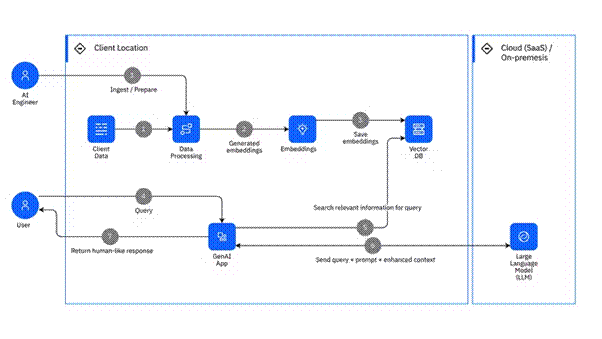
A standard Retrieval-Augmented Generation (RAG) pipeline bridges the gap between raw corporate data and an AI model. Instead of relying purely on static, pre-trained knowledge, the system executes a precise, six-step architectural workflow to generate accurate answers.
Step 1: The User Submits a Query
The process begins when a user asks a natural language question within an application. Common enterprise examples include:
- “What is the approval workflow for purchase requisitions?”
- “How does SAP handle invoice matching exceptions?”
- “What changed in the latest product release?”
In advanced enterprise setups, the system analyzes this initial prompt for intent detection, entity extraction, query rewriting, and automated access control checks to ensure data privacy.
Step 2: The Query is Converted Into a Retrieval-Ready Form
To search an external knowledge base effectively, the natural language question must be translated into machine-readable format.
- The system utilizes an embedding model to transform the text query into a dense vector representation (a string of numbers capturing semantic meaning).
- This vector is then prepared to be run against a specialized index.
Step 3: Relevant Content is Retrieved From External Sources
The system takes the query vector and runs a semantic search against a vector database (like Pinecone, Chroma, or Redis) containing pre-indexed company documents.
📌 Key Architectural Detail: A RAG system almost never processes entire files at once. During data ingestion, documents are broken down into small, digestible “document chunks” (such as paragraphs, policy clauses, or ticket summaries). The database compares vector distances and retrieves only the top few chunks that match the user’s intent.
Step 4: The System Builds an Augmented Prompt
Once the most relevant text chunks are extracted, the application constructs a highly contextualized instructions package for the Large Language Model. The system engineering dynamically builds an augmented prompt by combining:
- The Original Query: The user’s initial question.
- Retrieved Context: The hyper-relevant document chunks pulled in Step 3.
- System Instructions & Guardrails: Strict rules directing the AI (e.g., “Answer only using the provided sources. If the answer is not present, state that you do not know.”).
- Formatting Rules: Constraints defining how the final output should look and handle inline citations.
Step 5: The LLM Generates a Grounded Response
The augmented prompt is sent to the Large Language Model (LLM) via API. Because the model is now answering with factual evidence right in front of it—rather than guessing from its training data—it creates a grounded response. Depending on user intent, the output can be a structured comparison, a workflow guide, a troubleshooting script, or a summarized ticket reply.
Step 6: The System Returns the Answer With Source Traceability
The final phase solves one of AI’s biggest hurdles: transparency. The application delivers the response to the user alongside source traceability details, including:
- Specific document names and hyperlinks.
- Verifiable inline citations.
- Exact supporting passages used by the model.
This verification loop minimizes AI hallucinations and ensures compliance-level auditing for legal, financial, and healthcare software environments.
Also Read:- How AI Is Transforming Medical Imaging and Diagnostics
Standalone LLMs vs. RAG-Powered AI
Adding this table right beneath your opening introduction (before the “What is Retrieval-Augmented Generation?” section) will immediately show your readers the structural gap you are discussing.
| Capability | Standalone Large Language Model | RAG-Powered AI System |
| Knowledge Base | Static & Frozen: Limited strictly to data available before its fixed training cutoff date. | Dynamic & Live: Accesses real-time data, current updates, and live databases at query time. |
| Source of Truth | Internalized neural patterns and memory weights (prone to guessing). | Authoritative external knowledge bases, internal corporate files, and verified APIs. |
| Risk of Hallucination | High: Confidently fabricates answers when it lacks specific or updated facts. | Minimized: Grounded directly in extracted text chunks and constrained by strict source guardrails. |
| Maintenance Cost | Expensive & Slow: Requires continuous model retraining or fine-tuning cycles to stay relevant. | Cost-Effective & Rapid: Updated instantly by modifying source documents or refreshing index connectors. |
| Data Lineage | Black Box: Cannot tell you exactly where or how it formulated a specific conclusion. | Fully Traceable: Provides clear inline citations, document links, and exact audit trails. |
Why RAG Is So Important for AI Applications
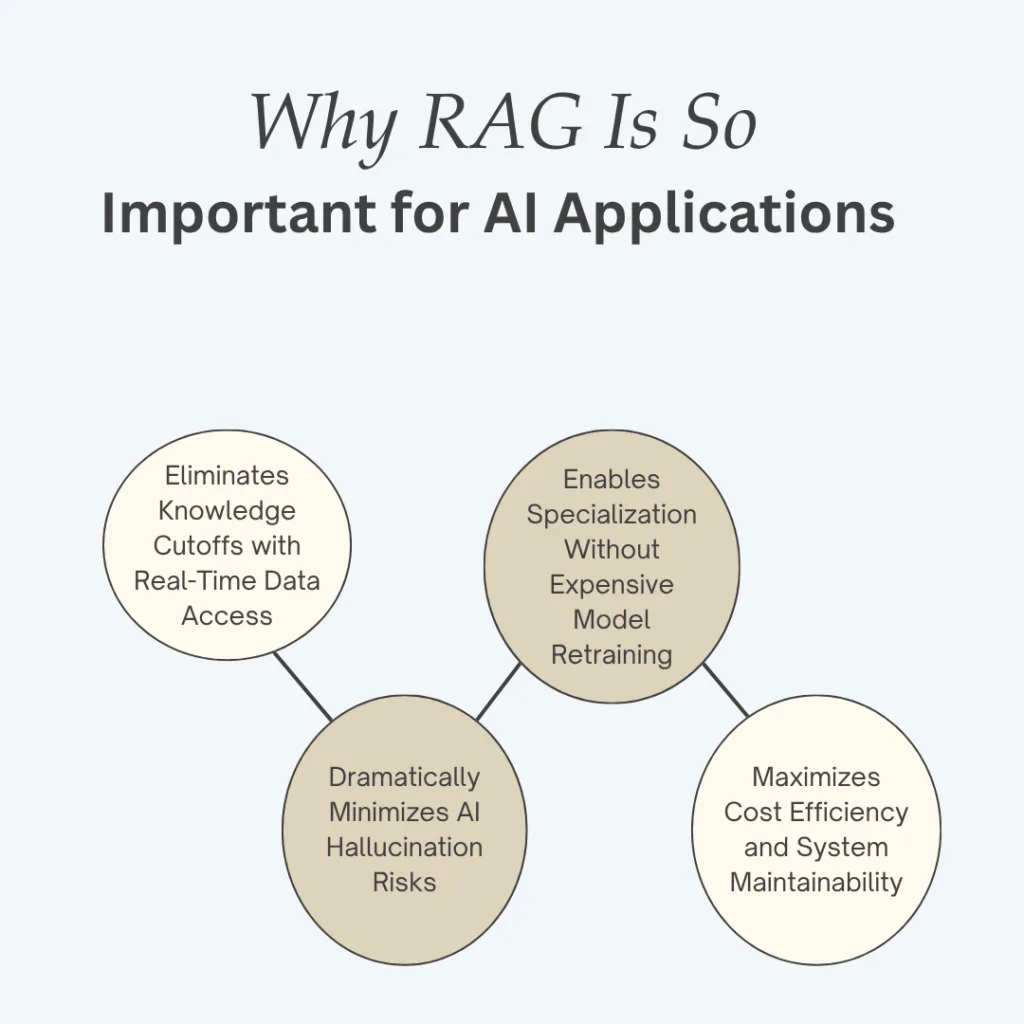
Retrieval-Augmented Generation (RAG) has quickly become the gold standard for enterprise AI because it fundamentally changes how Large Language Models (LLMs) operate in commercial environments. By shifting the AI’s role from a memory-reliant engine to an open-book research assistant, RAG solves five critical limitations of standalone AI models:
1. Eliminates Knowledge Cutoffs with Real-Time Data Access
Standard AI models are frozen in time based on their training cutoff date. A base model cannot naturally know your company’s latest pricing sheet, an updated internal SOP, or this morning’s product release notes. RAG resolves this constraint by dynamically fetching real-time data at query time, ensuring that the AI’s knowledge base never becomes obsolete.
2. Enables Specialization Without Expensive Model Retraining
While public LLMs are broad and generic, enterprise use cases require deep, highly narrow domain expertise. Whether building an automated assistant for SAP workflows, insurance claims processing, or proprietary HR policies, RAG anchors generic models in specialized corporate knowledge. This provides a tailored enterprise experience without the massive compute costs of training a custom model from scratch.
3. Dramatically Minimizes AI Hallucination Risks
One of the biggest hurdles to business AI adoption is hallucination—when a model confidently manufactures false data. While it does not eliminate the risk entirely, RAG dramatically reduces hallucinations. By forcing the LLM to synthesize its answers strictly from retrieved, verifiable evidence, the model is heavily constrained from inventing unsupported claims.
4. Maximizes Cost Efficiency and System Maintainability
Keeping an AI application accurate shouldn’t require data science overhead. Updating a RAG pipeline is simple: you adjust the source document, reindex the content chunk into your vector database, or refresh your API data connectors. This maintenance loop is infinitely faster, cheaper, and more scalable than running continuous model fine-tuning cycles every time a business policy changes.
5. Supports Enterprise Trust, Auditability, and Data Governance
In high-stakes industries like finance, healthcare, and legal tech, an AI being “correct” isn’t enough—its logic must be fully auditable. RAG powers explainable AI by mapping out clear data lineage. Because every generated response is linked directly to an underlying source document or database record, compliance teams can seamlessly maintain strict audit trails and data access governance.
RAG is the Future of Context-Aware Enterprise AI
As AI systems evolve, RAG will become the backbone of intelligent enterprise applications, where models don’t just generate responses, but reason over live, trusted data. This will how organizations interact with knowledge, moving toward systems that are continuously updated, auditable, and decision-ready.
Stay tuned for more such expert insights on AI, enterprise architectures, and digital transformation.
Frequently Ask Question:
1. What does RAG mean in AI?
In AI, RAG stands for Retrieval-Augmented Generation. It is an architectural technique that optimizes the output of a Large Language Model (LLM) by querying an authoritative, external knowledge base (like internal company documents or databases) before generating a response. This ensures the AI provides accurate, up-to-date information without requiring expensive retraining.
What is a RAG pipeline in AI?
A RAG pipeline is the step-by-step workflow that processes a user’s query to generate an augmented response. It typically follows three main stages:
Ingestion & Indexing: Converting raw documents into mathematical representations (vector embeddings) and storing them in a vector database.
Retrieval: Searching the database to find the most relevant document chunks matching the user’s prompt.
Generation: Passing the retrieved information alongside the original prompt to the LLM so it can write a contextual, accurate answer.
3. Can you provide a practical example of Retrieval-Augmented Generation?
A real-world example of RAG is an AI customer support chatbot for an e-commerce company. Instead of relying solely on general knowledge, when a customer asks about a specific return policy, the RAG system dynamically fetches the exact, updated policy document from the company’s private drive and feeds it to the AI. The bot then answers perfectly using that verified text.
4. Why is Retrieval-Augmented Generation important for modern AI applications?
RAG is crucial for enterprise AI because it solves the problem of AI hallucinations by anchoring model responses in factual, verifiable data. It allows businesses to inject private, proprietary, or real-time information into LLMs securely, dramatically reducing errors, maintaining data privacy, and keeping application data current without full-scale model fine-tuning.
