


In the expansive realm of predictive modeling and statistical analysis, Lasso Regression stands tall as a powerful technique for feature selection and regularization. Its ability to shrink coefficients towards zero while simultaneously performing variable selection makes it a cornerstone in machine learning and data science.
Understanding Lasso Regression
1. What is Lasso Regression?
Lasso Regression, short for Least Absolute Shrinkage and Selection Operator, is a linear regression technique that incorporates regularization by adding a penalty term to the ordinary least squares (OLS) objective function. This penalty term, based on the L1-norm of the coefficient vector, encourages sparsity in the coefficient estimates, effectively performing feature selection by driving some coefficients to exact zero.
2. Key Components:
- Dependent Variable (( y )): The target variable to be predicted.
- Independent Variables (( x )): The predictors used to explain the variance in the dependent variable.
- Regularization Parameter (([latex] \lambda [/latex])): Controls the strength of the penalty applied to the coefficients.
- Lasso Penalty Term: The additional term added to the OLS objective function.
3. Mathematical Formulation:
The objective function of Lasso Regression is given by:
[latex] \text{minimize} \left( ||y – X\beta||_2^2 + \lambda ||\beta||_1 \right) [/latex]
Where:
- ( y ) represents the vector of observed values of the dependent variable.
- ( X ) is the matrix of observed values of independent variables.
- ( [latex]\beta[/latex] ) denotes the vector of coefficients.
- ( [latex]\lambda[/latex] ) is the regularization parameter.
4. Lasso Penalty Term:
The lasso penalty term, ( [latex]\lambda ||\beta||_1 [/latex]), penalizes the L1-norm (Manhattan norm) of the coefficient vector. This encourages sparsity in the coefficients by driving some of them to exact zero, effectively performing feature selection and yielding a more interpretable model.
Lasso Regression Cheat Sheet
| Section | Key Concept / Focus | Core Details & Takeaways |
| 1. Definition | Least Absolute Shrinkage and Selection Operator | A linear regression technique that adds an L1-norm penalty to the objective function. It shrinks coefficients toward zero to prevent overfitting. |
| 2. Core Mechanism | Automatic Feature Selection | Unlike other regularization methods, Lasso can drive irrelevant or redundant coefficients to exact zero, completely removing them from the model. |
| 3. Mathematical Goal | Objective Function Optimization | $\text{minimize } ( \|y – X\beta\|_2^2 + \lambda \|\beta\|$ Where $re $\la$ (lambda) controls the penalty strength and $nd $\|\be$ is the Manhattan norm. |
| 4. Industry Applications | Cross-Domain Utility | * Finance: Credit scoring & risk management. * Healthcare: Disease prediction & personalized medicine. * Marketing: Churn prediction & customer segmentation. * Environmental Sci: Pollution & climate modeling. * Genetics: Gene expression & phenotype mapping. |
| 5. Implementation Steps | Workflow Checklist | 1. Data Prep: Handle missing values, scale features (critical for L1), and clean data. 2. Training: Tune $\lambda$ via cross-validation; use solvers like coordinate descent. 3. Evaluation: Track MSE and $R^2$; plot coefficient paths. 4. Interpretation: Rank feature importance based on remaining non-zero coefficients. |
| 6. Best Practices | Golden Rules for Success | * Tune $\lambda$ carefully to perfectly balance bias and variance. * Scale your features before training so the penalty treats all variables equally. * Cross-validate robustly (e.g., k-fold) to ensure stable performance. * Balance performance vs. interpretability depending on your business goals. |
Real-World Applications of Lasso Regression
Because Lasso Regression excels at handling datasets with hundreds or even thousands of variables—while keeping models simple and interpretable—it has become a staple across numerous industries. Here is a deep dive into how different domains leverage this powerful tool.
1. Finance & Risk Management
In the financial sector, data streams are massive, highly correlated, and incredibly noisy. Financial analysts use Lasso Regression to strip away the noise and focus only on the indicators that genuinely impact the bottom line.
- Credit Scoring: When evaluating a borrower’s creditworthiness, banks have access to thousands of data points (transaction history, payment behavior, demographics). Lasso isolates the few critical behaviors that actually predict default risk, ignoring redundant metrics.
- Portfolio Optimization: Investors use Lasso to select a sparse subset of stocks or assets that mimic an index or maximize returns, keeping transaction costs low by reducing the total number of assets to manage.
- Financial Forecasting & Risk Assessment: Lasso helps predict market trends or macroeconomic shifts by filtering out volatile, short-term market noise, ensuring that risk models rely only on stable, high-impact indicators.
2. Healthcare & Predictive Medicine
Modern healthcare relies heavily on high-dimensional data, from patient electronic health records (EHRs) to complex biometric scans. Lasso helps medical researchers find actionable patterns without overfitting their models.
- Disease Prediction & Diagnosis: By analyzing patient history, lifestyle factors, and lab results, Lasso identifies the specific combination of high-risk factors that predict the onset of chronic illnesses like diabetes or heart disease.
- Patient Outcome Analysis: Hospitals use it to predict readmission rates or recovery timelines, allowing them to allocate resources effectively to patients who need them most.
- Medical Imaging: In MRI or CT scan analysis, where datasets consist of millions of pixels (voxels), Lasso regularizes the data to help isolate the specific visual anomalies linked to tumors or tissue damage.
3. Marketing Analytics & Customer Insights
Marketers are flooded with behavioral data from website clicks, social media interactions, and purchase histories. Lasso helps marketing teams understand exactly what drives consumer choices.
- Customer Segmentation & Churn Prediction: Instead of guessing why customers leave, Lasso looks at hundreds of user activities (app open frequency, customer service complaints, login drops) and zeroes in on the top 3 or 4 behaviors that predict a customer is about to churn.
- Market Basket Analysis: It uncovers the genuine relationships between product purchases, allowing retailers to optimize shelf placement and recommendation engines.
- Campaign Optimization: Lasso evaluates the performance of multi-channel marketing campaigns (email, PPC, social ads, TV) to determine which specific channels drive the highest return on investment (ROI), ensuring ad spend isn’t wasted on low-performing avenues.
4. Environmental Science & Climate Modeling
Environmental data is notoriously complex, dealing with interconnected systems like atmospheric pressure, geographic variables, and human activity over decades.
- Pollution Prediction: Environmental agencies use Lasso to predict air quality indices (AQI) or water contamination levels by identifying the primary industrial and weather-related factors responsible for spikes.
- Biodiversity & Habitat Assessment: Ecologists use it to determine which specific environmental stressors (temperature shifts, deforestation, soil acidity) most heavily impact endangered species populations.
- Climate Change Analysis: Lasso aids in building long-term climate models by filtering out seasonal anomalies and pinpointing the structural variables driving global temperature trends.
5. Advanced Genetics & Genomics
Genetics is perhaps the ultimate test for Lasso Regression. A single human genome contains millions of genetic variants, but a specific disease might only be triggered by a handful of them. This is a classic “large $p$, small $n$” problem (thousands of features, few physical samples).
- Phenotype-Genotype Association Studies: It maps out the direct links between a person’s genetic makeup (genotype) and their observable physical traits or disease vulnerabilities (phenotype), laying the foundational groundwork for personalized, precision medicine.
- Gene Expression Analysis: Lasso screens thousands of genes simultaneously to identify the select few that are actively overexpressed or underexpressed in specific cancers.
- SNP (Single Nucleotide Polymorphism) Prediction: Geneticists use Lasso to comb through massive genomic sequences and isolate the specific single-nucleotide mutations responsible for hereditary conditions.
Implementing Lasso Regression
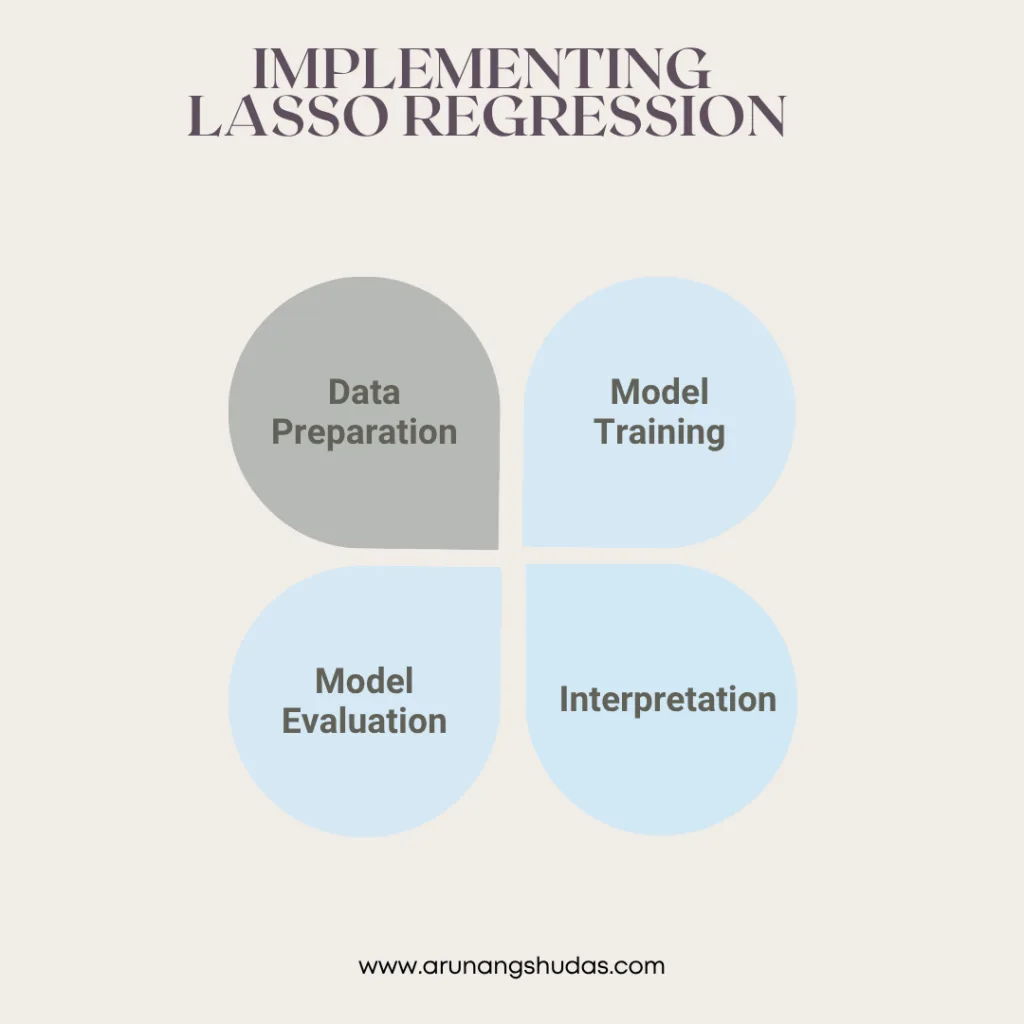
1. Data Preparation:
- Data Cleaning: Handle missing values, outliers, and data inconsistencies.
- Feature Scaling: Standardize or normalize the independent variables to ensure comparability.
- Feature Selection: Identify relevant predictors and eliminate redundant or irrelevant ones.
2. Model Training:
- Parameter Tuning: Select the optimal value of ( [latex]\lambda[/latex] ) through techniques like cross-validation.
- Solver Selection: Choose appropriate optimization algorithms such as coordinate descent or proximal gradient descent.
- Regularization Strength: Experiment with different values of ( [latex]\lambda [/latex]) to balance bias and variance.
3. Model Evaluation:
- Performance Metrics: Assess model performance using metrics like Mean Squared Error (MSE), R-squared, and cross-validated scores.
- Visualization: Plot coefficient paths, residual plots, and feature importance to gain insights into model behavior.
4. Interpretation:
- Coefficient Analysis: Interpret the magnitude and sign of coefficients to understand their impact on the dependent variable.
- Feature Importance: Rank features based on their contribution to the model to identify key predictors.
Best Practices and Considerations
1. Regularization Strength:
- Tune the regularization parameter (([latex] \lambda [/latex])) carefully to balance between bias and variance.
- Conduct sensitivity analysis to understand the impact of different regularization strengths on model performance.
2. Feature Engineering:
- Engage in feature engineering to create informative features and reduce the complexity of the model.
- Explore techniques like polynomial features, interaction terms, and dimensionality reduction.
3. Cross-Validation:
- Utilize cross-validation techniques such as k-fold cross-validation or leave-one-out cross-validation to estimate model performance robustly.
- Ensure that the choice of cross-validation strategy aligns with the dataset size and characteristics.
4. Interpretability vs. Performance:
- Strike a balance between model interpretability and performance based on the specific requirements of the problem.
- Communicate findings effectively by visualizing model outputs and providing intuitive explanations.

Conclusion:
Lasso Regression stands as a formidable technique in the arsenal of predictive modeling, offering a powerful solution to the challenges of multicollinearity, overfitting, and feature selection. Its ability to drive some coefficients to exact zero makes it particularly useful in high-dimensional datasets where feature sparsity is desirable. By understanding its principles, applications, implementation strategies, and best practices, practitioners can harness the full potential of Lasso Regression to extract meaningful insights, make informed decisions, and drive innovation in their respective fields. As with any modeling approach, thoughtful consideration of data quality, feature engineering, regularization strength, and model evaluation is essential to build reliable and actionable predictive models.
Frequently Ask Question:
Q1: What is Lasso Regression and how does it work?
Lasso Regression (Least Absolute Shrinkage and Selection Operator) is a linear regression technique used in machine learning to prevent overfitting and perform automated feature selection. It works by adding a penalty term based on the L1-norm (the absolute values of the coefficients) to the ordinary least squares objective function. This penalty shrinks less important coefficients toward zero.
Q2: How does Lasso Regression perform feature selection?
Unlike Ridge Regression (which shrinks coefficients close to zero but never eliminates them), Lasso can shrink coefficients to exact zero. When a variable’s coefficient drops to zero, it is completely removed from the model. This mathematically isolates the most important predictors, serving as an automated feature selection tool that yields simpler, highly interpretable models.
Q3: What is the role of the lambda ($\lambda$) parameter in Lasso?
The regularization parameter lambda ($\lambda$) controls the strength of the penalty applied to the model.
A $\lambda$ equal to zero removes the penalty entirely, turning the model into standard Ordinary Least Squares (OLS) regression.
As $\lambda$ increases, the penalty grows stronger, pushing more coefficients to zero, increasing bias, and decreasing variance. Data scientists use cross-validation to find the optimal $\lambda$ that balances these trade-offs.
Q4: When should I use Lasso Regression over Ridge Regression?
You should choose Lasso Regression when you suspect that your dataset has a high number of features, but only a small subset of them actually impact the target variable (high sparsity). Lasso is ideal for creating highly interpretable models by discarding irrelevant data. Conversely, choose Ridge Regression if you believe most features contribute to the outcome and you want to reduce multicollinearity without throwing variables away.
