



Network security combines a range of technologies, processes, and tools into a comprehensive strategy to ensure the confidentiality, integrity, and availability of computer networks.
No matter the size, industry, or type of infrastructure, every organization needs strong network security to defend against the constantly evolving landscape of network security threats.
This is part of a broader series on cybersecurity.
Common Network Security Threats and Attacks
Understanding network security threats is essential for protecting modern IT infrastructure. Cybercriminals use a variety of attack methods to steal sensitive information, disrupt business operations, and gain unauthorized access to networks. Below are some of the most common network security threats that organizations should be aware of and defend against.
Malware
Malware is one of the most common network security threats, referring to malicious software designed to compromise computers, servers, and networks. It includes ransomware, spyware, Trojans, worms, and viruses, each created for a specific purpose. Attackers use malware to steal sensitive data, encrypt files for ransom, disrupt business operations, or gain unauthorized access to systems. Keeping software updated, using antivirus solutions, and monitoring network activity can significantly reduce the risk of malware attacks.
Phishing
Phishing is a social engineering attack in which cybercriminals impersonate trusted organizations through emails, text messages, or fake websites to trick users into revealing sensitive information. As one of the leading network security threats, phishing attacks often result in stolen login credentials, financial fraud, or malware infections. Employee awareness training and multi-factor authentication (MFA) are effective ways to reduce phishing risks.
Bot Attacks
Bots are automated software programs that perform repetitive online tasks without human intervention. While some bots are legitimate, malicious bots are used to launch credential stuffing attacks, scrape sensitive information, distribute spam, or overwhelm websites with fake traffic. Modern bot attacks have become increasingly sophisticated, making them a significant network security threat for businesses, websites, and APIs.
Read More – network security threat
Distributed Denial-of-Service (DDoS) Attacks
A Distributed Denial-of-Service (DDoS) attack floods a server, website, or network with massive amounts of traffic from multiple compromised devices. This prevents legitimate users from accessing services and can cause prolonged downtime, financial losses, and reputational damage. DDoS attacks remain one of the most disruptive network security threats affecting organizations worldwide.
Advanced Persistent Threats (APTs)
Advanced Persistent Threats (APTs) are highly targeted cyberattacks in which attackers gain unauthorized access to a network and remain undetected for extended periods. Their primary goal is to steal confidential information, monitor activities, or disrupt critical systems. Because APTs are carefully planned and executed, they are considered one of the most dangerous network security threats for enterprises and government organizations.
Drive-by Download Attacks
A drive-by download occurs when malicious software is automatically downloaded onto a device without the user’s knowledge. These attacks exploit vulnerabilities in web browsers, operating systems, or outdated applications, often requiring no clicks or user interaction. Regular software updates and secure browsing practices help protect against this stealthy network security threat.
DNS Attacks
DNS attacks exploit vulnerabilities within the Domain Name System (DNS) to redirect users to malicious websites, intercept sensitive information, or disrupt online services. Attackers may manipulate DNS records, hijack DNS traffic, or exploit unsecured DNS communications to launch phishing campaigns or distribute malware. Implementing DNS security measures such as DNSSEC can reduce the risk of these network security threats.
Misconfiguration Exploits
Misconfiguration exploits occur when servers, cloud environments, applications, or network devices are improperly configured. Weak passwords, unnecessary open ports, outdated software, excessive user permissions, and missing security patches create opportunities for attackers to gain unauthorized access. Regular security audits, timely patch management, and secure configuration practices are essential for preventing these network security threats and protecting organizational assets.s.
Signs Your Network May Be Under Attack
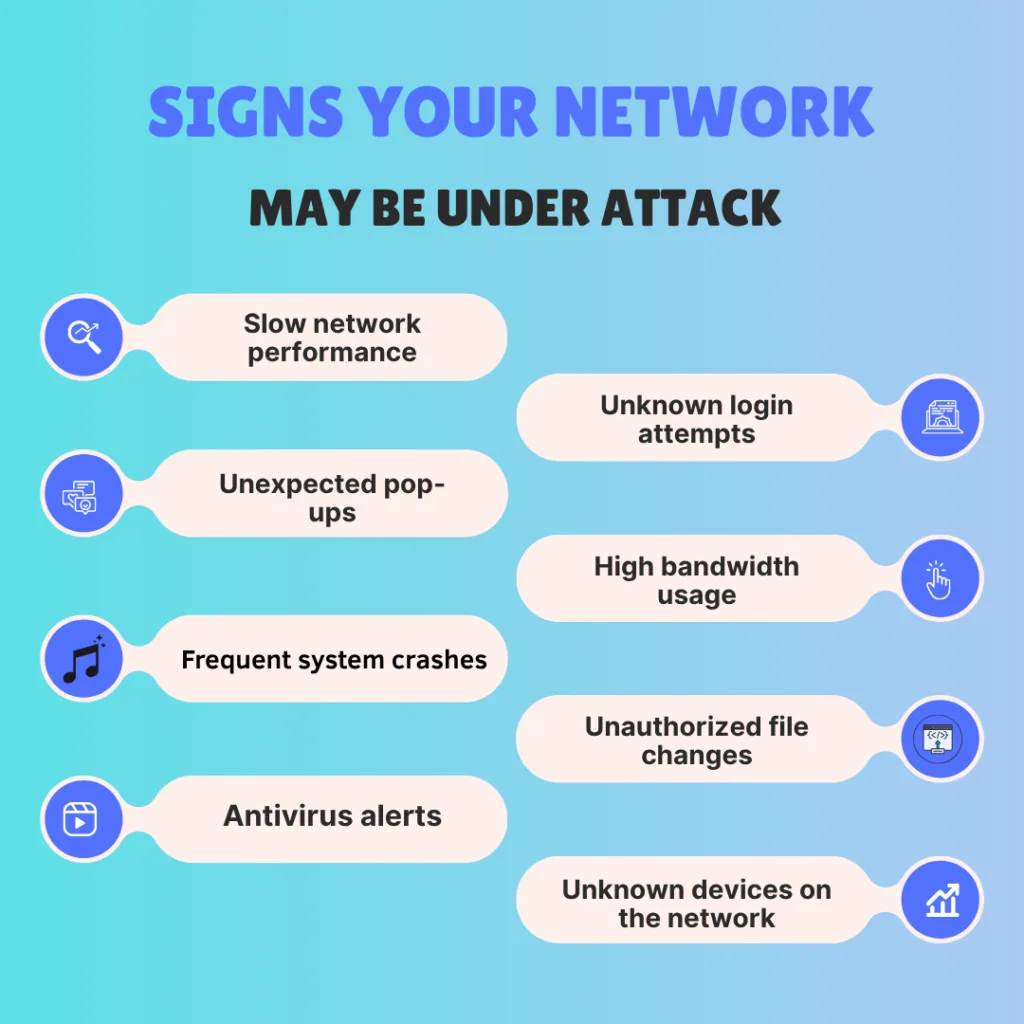
- Slow network performance
- Unknown login attempts
- Unexpected pop-ups
- High bandwidth usage
- Frequent system crashes
- Unauthorized file changes
- Antivirus alerts
- Unknown devices on the network
Network Security Threats Best Practices
Protecting your organization from Network Security Threats requires a proactive and layered approach to cybersecurity. As cyberattacks become more sophisticated, relying on a single security solution is no longer enough. Organizations should regularly identify vulnerabilities, monitor network activity, strengthen access controls, and prepare for potential security incidents. Effective network security best practices can help prevent unauthorized access, detect suspicious activity early, protect sensitive information, and minimize the impact of cyberattacks.
A strong security strategy should combine regular network audits, secure network configurations, real-time security monitoring, reliable data backups, and employee security awareness. Businesses should also keep operating systems, applications, and network devices updated with the latest security patches to reduce exploitable vulnerabilities. By continuously reviewing and improving their security controls, organizations can stay ahead of evolving Network Security Threats and build a more resilient network infrastructure.
The following four best practices can help organizations strengthen their network security and reduce the risk of data breaches, malware infections, unauthorized access, and other cyber incidents.
Why Network Security Threats Are Increasing
The cybersecurity landscape is changing rapidly as businesses adopt new technologies and connect more devices to the internet. While digital transformation improves efficiency, it can also create additional security risks.
Several factors contribute to the growing number of Network Security Threats:
Remote and Hybrid Work
Remote employees often access company resources from different networks and devices. Poorly secured home networks, unmanaged devices, and weak authentication can create additional attack opportunities.
Cloud Adoption
Cloud services provide flexibility and scalability, but improperly configured cloud resources can expose sensitive data and applications to unauthorized users.
Internet of Things (IoT)
Smart devices, cameras, sensors, and other IoT systems can become attractive targets when they use outdated software, weak passwords, or insecure configurations.
Increasingly Sophisticated Attacks
Cybercriminals are using automation, botnets, social engineering, and other advanced techniques to launch attacks at greater scale and speed.
Human Error
Weak passwords, accidental data sharing, poor security practices, and failure to recognize phishing attempts can create opportunities for attackers.
Audit the Network and Security Controls
Regular network and security audits are one of the most effective ways to identify and reduce Network Security Threats before they can affect your organization. By continuously evaluating your security infrastructure, businesses can detect vulnerabilities, strengthen defenses, and improve their overall cybersecurity posture.
A comprehensive network security audit should include:
- Identifying vulnerabilities that require immediate remediation.
- Detecting unused or outdated applications.
- Reviewing and optimizing firewall configurations.
- Assessing servers, applications, software, and network devices.
- Verifying security controls and access policies.
- Checking the reliability of backup systems.
- Reviewing disaster recovery procedures.
- Ensuring operating systems and applications have current security patches.
Regular audits help organizations stay ahead of evolving threats while reducing the risk of data breaches, cyberattacks, and costly downtime.
Use Network Address Translation (NAT)
Network Address Translation (NAT) is an important network technology that can provide an additional layer of protection against Network Security Threats. NAT translates private internal IP addresses into public IP addresses, allowing multiple devices to share an internet connection while keeping internal addressing hidden from external networks.
When combined with firewalls, NAT can make it more difficult for external attackers to directly identify and access individual devices inside a private network.
NAT can help organizations:
- Hide internal IP addresses.
- Reduce direct exposure of internal devices.
- Allow multiple devices to share a public IP address.
- Work alongside firewall-based access controls.
- Reduce the publicly visible attack surface.
However, NAT should not be treated as a replacement for a firewall or other security controls. A layered security strategy that includes firewalls, authentication, monitoring, and regular updates provides stronger protection.
Read More – Access controls for backup systems.
Implement Centralized Logging and Real-Time Log Monitoring
Centralized logging and real-time log monitoring are essential for detecting Network Security Threats before they cause significant damage. Organizations should monitor login attempts, system events, network traffic, and user activity to identify suspicious behavior as early as possible.
Centralized logs allow security teams to:
Maintain a record of security events.
Identify unusual login attempts.
Detect suspicious network activity.
Investigate security incidents.
Recognize repeated attack patterns.
Improve incident response.
Develop a Robust Backup and Recovery Strategy
A robust backup and recovery strategy is one of the most effective defenses against Network Security Threats. Organizations should prepare for potential cyber incidents before they occur rather than waiting until critical data or systems have already been compromised.
A well-designed recovery strategy helps minimize downtime, reduce financial losses, and maintain business continuity after ransomware attacks, data breaches, hardware failures, or other disruptions.
Regularly backing up critical business data and testing recovery procedures are essential security practices. Organizations should consider using secure, automated, and offsite backups to ensure that important information remains recoverable even if primary systems are compromised.
A strong backup strategy should include:
- Regular automated backups.
- Secure offsite or cloud backups.
- Access controls for backup systems.
- Encryption for sensitive backup data.
- Regular recovery testing.
- Multiple backup copies.
- A documented disaster recovery plan.
Testing backups is particularly important because an organization cannot rely on a backup strategy unless it has verified that the data can actually be restored.

Conclusion
Network Security Threats continue to evolve as organizations become more connected and dependent on digital systems. Malware, phishing, bot attacks, DDoS attacks, APTs, drive-by downloads, DNS attacks, and misconfiguration exploits can expose sensitive information, disrupt operations, and create significant financial and reputational risks.
The best way to reduce these risks is to adopt a proactive, layered approach to network security. Regular security audits can identify vulnerabilities, NAT can provide an additional layer of network protection, centralized logging can help detect suspicious activity, and a reliable backup and recovery strategy can minimize the impact of security incidents.
Frequently Ask Questions : (FAQS)
What are network security threats?
Network security threats are attacks or activities that can compromise a network, steal sensitive data, disrupt operations, or gain unauthorized access to systems.
What are the most common network security threats?
Common network security threats include malware, phishing, bot attacks, DDoS attacks, Advanced Persistent Threats (APTs), DNS attacks, and misconfiguration exploits.
How can network security threats be prevented?
Organizations can prevent network security threats by using firewalls, Multi-Factor Authentication (MFA), regular security audits, real-time monitoring, software updates, and secure backups.
Why is network security important?
Network security protects sensitive data, devices, applications, and systems from unauthorized access, cyberattacks, data breaches, and operational disruptions.
What is the best way to protect a network?
The best approach is to use multiple security measures, including firewalls, access controls, network monitoring, regular audits, employee training, and a reliable backup and recovery strategy.
