


APIs are the backbone of modern web and mobile applications, allowing them to communicate seamlessly with backend services. Traditionally, REST (Representational State Transfer) has been the go-to approach for designing APIs, but in recent years, GraphQL has gained immense popularity as a more flexible and efficient alternative.
GraphQL, developed by Facebook in 2012 and open-sourced in 2015, is a query language that enables clients to request only the data they need, reducing over-fetching and under-fetching issues common in REST APIs. If you’re still relying solely on REST, you might be missing out on the advantages GraphQL brings to the table.
| Feature | REST API | GraphQL |
| Data Fetching | Prone to over-fetching and under-fetching | Fetches exact fields requested by the client |
| Endpoints | Multiple dedicated endpoints (/users, /posts) | Single dynamic endpoint (typically /graphql) |
| Schema & Typing | Relies on manual docs or tools like OpenAPI/Swagger | Strongly typed schema with native auto-documentation |
| Network Requests | Often requires multiple round trips for nested data | Consolidates complex relational data into a single query |
| Real-Time Data | Requires external protocols (e.g., raw WebSockets) | Built-in real-time support via native subscriptions |
| Versioning | Rigid versioning paths (/api/v1, /api/v2) | Field-level deprecation without versioning endpoints |
| Caching | Native HTTP caching (CDNs, browser cache) | Handled primarily on the client or via normalized caches |
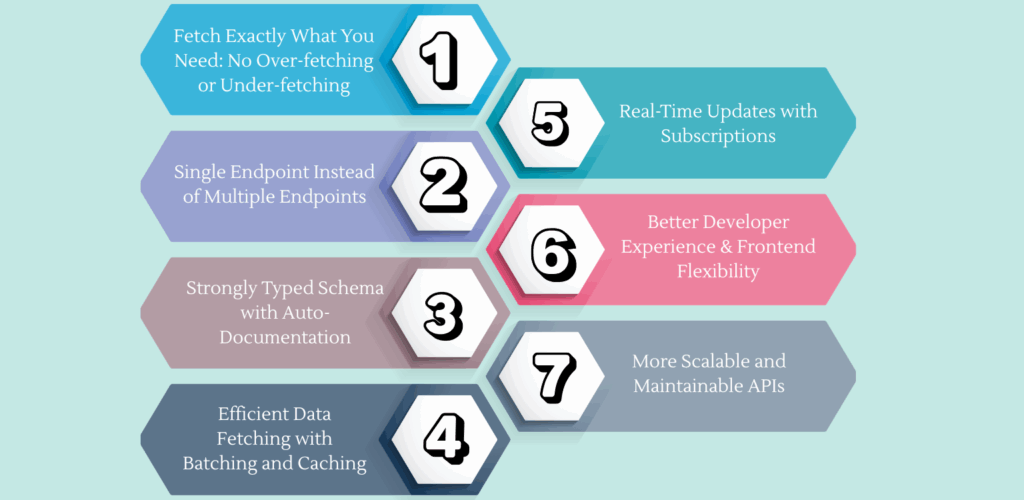
1. Fetch Exactly What You Need: No Over-fetching or Under-fetching
One of the biggest drawbacks of REST APIs is over-fetching and under-fetching.
- Over-fetching happens when an endpoint returns more data than needed.
- Under-fetching occurs when an endpoint doesn’t provide enough data, forcing multiple requests to get all necessary information.
For example, in a REST API for a blog platform:
- A
GET /postsendpoint might return all posts with full details, even if the client only needs thetitleandauthor name. - A
GET /post/{id}endpoint may provide the post details but not the comments, requiring an additionalGET /post/{id}/commentscall.
With GraphQL, the client specifies exactly what fields it needs in a single request:
This eliminates both over-fetching and under-fetching, optimizing data transfer and improving performance, especially for mobile applications with limited bandwidth.
2. Single Endpoint Instead of Multiple Endpoints
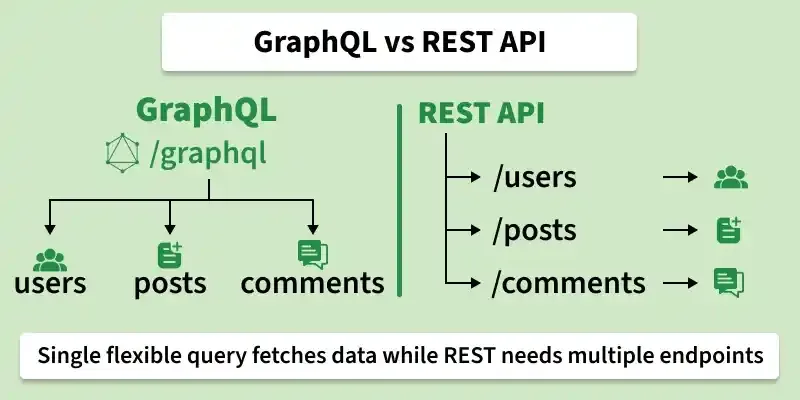
REST APIs typically have multiple endpoints for different types of data:
/users→ Fetch all users/users/{id}→ Fetch a specific user/posts/{id}/comments→ Fetch comments for a post
This results in endpoint sprawl, making API maintenance and versioning cumbersome.
GraphQL, on the other hand, operates through a single endpoint, usually /graphql, where all queries are handled dynamically.
This means:
- No need to create multiple endpoints for different data needs.
- The client decides what data to fetch with a structured query.
A single GraphQL endpoint simplifies API design, reduces backend complexity, and provides more flexibility in handling data requests.
3. Strongly Typed Schema with Auto-Documentation
GraphQL uses a strongly typed schema that defines the structure of API data.
A GraphQL schema might look like this:
This schema acts as self-documenting API documentation, eliminating the need for manually written API docs like Swagger (for REST APIs). Developers can explore the schema using tools like GraphiQL or Playground, making API discovery easier.
With REST, you often rely on external documentation, which can become outdated or incomplete. GraphQL ensures that the schema is always up to date.
4. Efficient Data Fetching with Batching and Caching
In REST APIs, if a page needs data from multiple resources, it results in multiple network requests, which can slow down performance.
GraphQL reduces network overhead by allowing batch requests in a single query:
This retrieves the user, their posts, and associated comments all at once, reducing network latency.
Additionally, GraphQL can leverage persistent caching at the client level (e.g., Apollo Client and Relay) to optimize repeated queries, whereas REST APIs typically rely on server-side caching (e.g., Redis, CDN).
5. Real-Time Updates with Subscriptions
REST APIs rely on polling (repeated requests) to check for updates, which is inefficient.
GraphQL introduces subscriptions, allowing real-time updates when data changes.
For example, a GraphQL subscription for live chat messages:
When a new message arrives, the server pushes data to clients instantly, making GraphQL perfect for real-time applications like:
- Chat apps
- Live sports updates
- Stock market tracking
- Collaborative tools (e.g., Google Docs)
REST lacks this built-in capability, requiring third-party solutions like WebSockets or Firebase to achieve similar real-time behavior.
6. Better Developer Experience & Frontend Flexibility
GraphQL significantly improves developer experience in several ways:
- Easier API evolution → No need for versioning (
v1,v2, etc.). Clients just request new fields when needed. - Faster development → Frontend teams can independently query the data they need without waiting for backend changes.
- Better debugging → Tools like GraphQL Playground provide real-time query validation, error hints, and query execution.
Frontend developers love GraphQL because it allows them to shape the API response based on UI needs. Instead of backend teams defining rigid endpoints, frontend developers can query only the fields they need.
This decouples frontend and backend development, leading to faster iteration cycles and improved team productivity.
7. More Scalable and Maintainable APIs
GraphQL makes API design more scalable compared to REST by:
- Reducing the number of endpoints
- Allowing incremental schema changes instead of breaking API versions
- Supporting microservices by aggregating data from multiple sources into a single query
For example, if a GraphQL server pulls data from multiple microservices:
The GraphQL server fetches user data from the User Service and orders from the Order Service, aggregating the response in a single API call.
This is more efficient than a REST-based microservices setup, where multiple services must be queried separately.
Conclusion: Is GraphQL Better Than REST?
Both GraphQL and REST have their strengths, but GraphQL is a game-changer for modern applications, offering:
→ Efficient data fetching (no over-fetching or under-fetching)
→ Single endpoint for all queries
→ Self-documenting API schema
→ Real-time capabilities with subscriptions
→ Better developer experience and frontend flexibility
→ Scalability for microservices
That said, REST is still widely used and better suited for simple APIs, caching-heavy systems, and legacy applications. However, for applications requiring high flexibility, real-time updates, and optimized performance, GraphQL is the way forward.
You may also like:
1) 5 Common Mistakes in Backend Optimization
2) 7 Tips for Boosting Your API Performance
3) How to Identify Bottlenecks in Your Backend
4) 8 Tools for Developing Scalable Backend Solutions
5) 5 Key Components of a Scalable Backend System
6) 6 Common Mistakes in Backend Architecture Design
7) 7 Essential Tips for Scalable Backend Architecture
8) Token-Based Authentication: Choosing Between JWT and Paseto for Modern Applications
9) API Rate Limiting and Abuse Prevention Strategies in Node.js for High-Traffic APIs
10) Can You Answer This Senior-Level JavaScript Promise Interview Question?
11) 5 Reasons JWT May Not Be the Best Choice
12) 7 Productivity Hacks I Stole From a Principal Software Engineer
13) 7 Common Mistakes in package.json Configuration
Read more blogs from Here
Share your experiences in the comments, and let’s discuss how to tackle them!
Follow me on Linkedin
Frequently Ask Question:
Does GraphQL completely replace the need for REST?
No. REST remains ideal for simple CRUD applications, static resource delivery, and services heavily reliant on native HTTP-level caching.
How does GraphQL handle caching if everything uses a single POST endpoint?
Because standard HTTP caching relies on unique URLs and GET methods, GraphQL relies on client-side normalized caches (e.g., Apollo Client, Relay) or specialized persisted queries and edge gateway caches.
Is GraphQL secure against malicious or deeply nested queries?
Open-ended queries can expose backends to denial-of-service attacks. Production GraphQL APIs mitigate this by implementing query depth limiting, cost analysis, and rate limiting.
Can GraphQL work on top of an existing REST architecture?
Yes. GraphQL is frequently deployed as an API gateway or aggregation layer that sits between the frontend client and existing downstream REST services or microservices.
