


In the fast-paced world of technology, software development methodologies must rapidly evolve to keep pace with shifting requirements, volatile market demands, and rising user expectations. Enter Adaptive Software Development (ASD)—a framework specifically designed to thrive in high-change, high-uncertainty environments.
Unlike traditional, rigid frameworks like the Waterfall model (which relies on sequential, unalterable phases), ASD views fluidity as a feature, not a bug. It encourages cross-functional teams to organically pivot as they uncover deep technical insights and real-world user data during the lifecycle of a project.
The Core Lifecycle of ASD: Beyond the Traditional Lifecycle
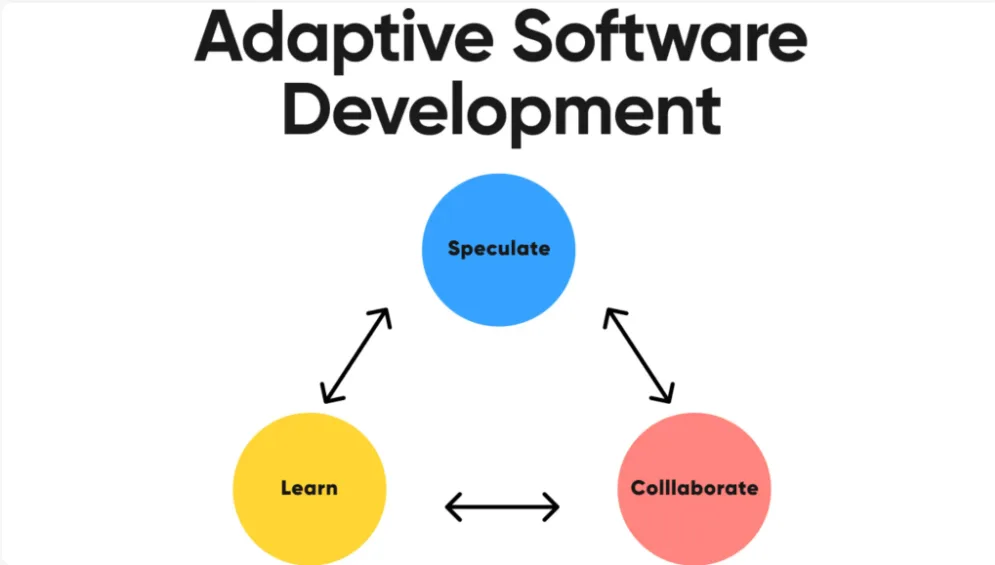
To understand why ASD works, it helps to look at its non-linear, cyclical nature. Instead of the rigid Plan-Design-Build sequence, ASD operates on a continuous three-phase loop: Speculate, Collaborate, and Learn.
   [ Speculate ]  --> Defines the adaptive vision & boundaries
         |
         v
  [ Collaborate ] --> High-bandwidth teamwork & concurrent engineering
         |
         v
    [ Learn ]     --> Quality reviews, retrospectives, & customer feedback
         |
         +----------> Loops back to refine the next speculation cycle
6 Pillars of Adaptive Software Development
1. Speculation Over Rigid Planning
In traditional software engineering, projects kick off with exhaustive, deterministic planning phase aiming to map out every single dependency, feature requirement, and deployment deadline. However, in highly volatile technical environments, uncertainty reigns supreme. ASD swaps out rigid planning for speculation.
Speculation acknowledges a fundamental truth: at the start of a complex project, you know the least about it. Instead of guessing at micro-details, teams define a broad vision and guardrails.
Read more blog : Best AI Healthcare Software Development Companies for 2026
- Embrace Uncertainty: Treat unknowns as natural project variables rather than risks to be feared.
- Macro over Micro: Focus on establishing a clear product vector (direction) rather than locking down fixed feature checklists.
- Dynamic Evolution: Allow the technical roadmaps to naturally adapt as the team gathers concrete data.
Key Takeaway: Start with a razor-sharp, adaptable objective. Trust the systematic process of discovery over fixed documentation.
2. High-Bandwidth Collaboration Over Command-and-Control
Collaboration is the absolute operational engine of ASD. Software development is ultimately a complex cognitive team sport. It requires seamless alignment not just among developers, but across a multi-disciplinary network of QA testers, UI/UX designers, product owners, and business stakeholders.
ASD actively dismantles traditional management structures in favor of autonomous, self-organizing teams.
- Radical Transparency: Use open communication channels to foster shared contextual awareness.
- Short Feedback Loops: Loop in stakeholders early and often to prevent “building the wrong thing perfectly.”
- Cross-Functional Synergy: Assemble diverse perspectives to solve complex architectural problems faster.
Key Takeaway: Break down organizational silos, communicate with high frequency, and actively leverage your team’s collective intelligence.
3. Continuous Learning Through Iterations
ASD thrives on iterative development—breaking a massive project down into smaller, time-boxed delivery cycles. Each iteration is an opportunity to deploy functional code, gather immediate empirical feedback, and refine the product based on real-world usage.
Continuous learning acts as an organization’s ultimate safety net:
| Benefit | Strategic Impact |
| Mitigated Risk | Small, incremental changes stop isolated errors from cascading into system-wide architectural failures. |
| Stakeholder Trust | Frequently shipping working software maintains high stakeholder engagement and visible ROI. |
| Compounded Quality | Integrating continuous testing and regular reviews catches edge-case bugs early when they are cheapest to fix. |
Key Takeaway: Treat every single development iteration as a critical stepping stone toward a more refined, resilient end-product.
4. Actively Embracing Change as a Competitive Advantage
Traditional project management models often view late-stage change requests as scope creep or structural disruption. ASD flips this script entirely, viewing change as a powerful vehicle for competitive differentiation. In today’s market, the velocity at which you can pivot defines your market survival.
- Late-Stage Flexibility: Welcome adjustments to requirements, even deep in the development lifecycle, if they add true business value.
- User-Driven Pivots: Use telemetry, behavioral analytics, and direct customer feedback to guide subsequent iterations.
- Market Responsiveness: Remain hyper-responsive to emerging tech stacks, competitor moves, and macro shifts.
Read more blog : The Future of AI Agents in Indian Software Development
Key Takeaway: Change isn’t the enemy blocking your progress—your team’s internal resistance to it is.
5. An Obsessive Focus on Value-Driven Results
Instead of obsessing over arbitrary process metrics—like meeting a theoretical deadline mapped out months ago—ASD strictly prioritizes value delivery. Success is explicitly measured by product outcomes and business impact, not blind adherence to an outdated project plan.
- Ship Functional Software: Prioritize the deployment of high-quality, working code over vanity documentation.
- Combat Perfectionism: Avoid the trap of “analysis paralysis” that halts momentum; iterate to perfection rather than delaying launch.
- Strategic Alignment: Regularly audit features to ensure engineering output directly maps to core business objectives.
Key Takeaway: Keep your eyes squarely on the prize—delivering tangible, high-impact value to the end-user.
6. Cultivating Adaptation as a Core Culture
True adaptability cannot simply be mandated by a framework; it must be woven into the cultural fabric of the engineering organization. Teams practicing ASD cultivate a shared growth mindset—an organizational culture where experimentation is celebrated, and mistakes are viewed strictly as data points for improvement.
- Psychological Safety: Empower team members to run calculated technical experiments without fear of failure.
- Blameless Retrospectives: Hold recurring, honest review sessions to dissect what went wrong, what went right, and how to optimize workflows.
- Tooling Agility: Maintain total openness to adopting new automation platforms, frameworks, and workflows that boost throughput.
Key Takeaway: Make adaptation an organizational way of life, not just a set of rules in a project handbook.
Final Thoughts: Building for a Non-Linear World
Ultimately, Adaptive Software Development isn’t just a tactical methodology for writing code—it is a strategic philosophy for building the right products in an inherently unpredictable world. By intentionally shifting focus toward speculation, deep collaboration, iterative learning, and cultural agility, modern engineering teams can confidently navigate technical complexity and ship software that delivers lasting user value.
You may also like:
1) How do you optimize a website’s performance?
2) Load Testing with Artillery: Prepare Your Node.js Application for Peak Traffic
3) Top 10 Questions in Software Development Interviews and How to Answer Them
4) Senior-Level JavaScript Promise Interview Question
5) What is Database Indexing, and Why is It Important?
6) Can AI Transform the Trading Landscape?
7) What is the purpose of a deployment pipeline?
8) Token-Based Authentication: Choosing Between JWT and Paseto for Modern Applications
9) API Rate Limiting and Abuse Prevention Strategies in Node.js for High-Traffic APIs
Read more blogs from Here
Share your experiences in the comments, and let’s discuss how to tackle them!
Follow me on Linkedin
Frequently Ask Question :
1. What is Adaptive Software Development (ASD)?
Adaptive Software Development (ASD) is an agile software development methodology designed for projects with evolving requirements and high levels of uncertainty. It focuses on continuous learning, collaboration, and adaptability through the Speculate, Collaborate, and Learn cycle.
2. How does Adaptive Software Development differ from the Waterfall model?
Unlike the Waterfall model, which follows a linear and predefined process, Adaptive Software Development embraces change throughout the project lifecycle. ASD allows teams to adjust requirements, priorities, and solutions based on feedback and new insights.
3. What are the main phases of Adaptive Software Development?
The ASD lifecycle consists of three core phases:
Speculate – Define goals, vision, and project direction.
Collaborate – Encourage teamwork and cross-functional problem-solving.
Learn – Gather feedback, review outcomes, and improve future iterations.
4. What are the benefits of using Adaptive Software Development?
Adaptive Software Development helps organizations improve flexibility, respond quickly to market changes, enhance team collaboration, reduce project risks, and deliver greater value to users through continuous iteration and learning.
5. When should a business choose Adaptive Software Development?
ASD is ideal for complex projects where requirements are likely to change, customer feedback is critical, and innovation is a priority. It works particularly well for startups, enterprise software projects, digital transformation initiatives, and rapidly evolving technology environments.
