



In the realm of deep learning and computer vision, few names resonate as profoundly as AlexNet. Developed by Alex Krizhevsky, Ilya Sutskever, and Geoffrey Hinton, AlexNet marked a watershed moment in the field of artificial intelligence, particularly in image recognition tasks. Its groundbreaking architecture and remarkable performance in the ImageNet Large Scale Visual Recognition Challenge (ILSVRC) 2012 not only propelled deep learning into the mainstream but also laid the foundation for subsequent advancements in convolutional neural networks (CNNs).
When Alex Krizhevsky, Ilya Sutskever, and Geoffrey Hinton published AlexNet in 2012, they did not just win a competition—they triggered the modern deep learning revolution. At a time when hand-crafted feature extractors (like SIFT and HOG) dominated computer vision, AlexNet proved that deep convolutional neural networks (CNNs), trained end-to-end on massive GPUs, could dramatically outperform classical machine learning algorithms.
This guide provides a comprehensive breakdown of AlexNet’s architecture, core innovations, performance impact, and lasting legacy.
1. The Genesis of AlexNet
Developed at the University of Toronto, AlexNet was submitted to the 2012 ImageNet Large Scale Visual Recognition Challenge (ILSVRC). Before 2012, computer vision research was stalled by minor incremental accuracy gains. Deep learning was widely viewed as computationally impractical and prone to severe overfitting.
AlexNet shattered this dynamic. By combining parallel GPU acceleration, strategic regularizations, and non-linear activation functions, the architecture demonstrated that deep neural networks could learn complex visual hierarchies directly from raw pixel data.
2. Architectural Overview
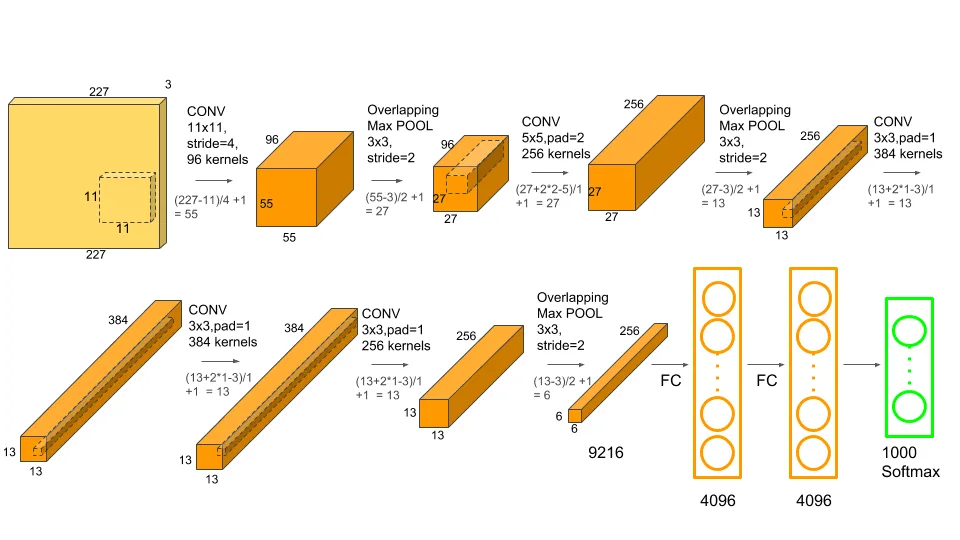
AlexNet consists of 8 trainable layers—comprising 5 convolutional layers for feature extraction and 3 fully connected (dense) layers for final classification.
Input (224x224x3) ➔ Conv1 ➔ Conv2 ➔ Conv3 ➔ Conv4 ➔ Conv5 ➔ FC6 ➔ FC7 ➔ FC8 (Softmax)
A. Convolutional Layers (Feature Extraction)
- The first five layers extract hierarchical features from input images ($224 \times 224 \times 3$ RGB).
- Early Layers (Conv1–Conv2): Capture low-level features such as edges, visual gradients, and basic color blobs using large kernel sizes ($11 \times 11$ and $5 \times 5$).
- Deeper Layers (Conv3–Conv5): Extract high-level semantic representations, such as complex patterns, object parts, and structural shapes.
B. Max-Pooling Layers (Spatial Downsampling)
- Interspersed after Conv1, Conv2, and Conv5.
- Utilizes overlapping max-pooling ($3 \times 3$ filters with a stride of 2) to reduce spatial dimensions, lower computational complexity, and introduce basic translation invariance.
C. Fully Connected Layers (Classification)
- The output of Conv5 is flattened into a dense vector and fed into FC6 (4,096 units) and FC7 (4,096 units).
- FC8 (1,000 units) uses a Softmax activation function to generate a probability distribution across the 1,000 ImageNet object classes.
3. Key Technical Innovations
AlexNet introduced several breakthrough engineering techniques that have since become foundational standards across deep learning:
- ReLU (Rectified Linear Unit) Activation: Replaced traditional $tanh$ and $sigmoid$ functions with $\text{ReLU}(x) = \max(0, x)$. This eliminated the vanishing gradient problem in positive domains, accelerating training convergence speed by nearly $6\times$.
- Dropout Regularization: Introduced in the fully connected layers (FC6 and FC7) with a rate of $0.5$. By randomly deactivating 50% of neurons during each training iteration, the network prevented co-adaptation of node weights and drastically reduced overfitting.
- Data Augmentation: To train millions of parameters without overfitting on finite data, images were dynamically cropped ($224 \times 224$ patches from $256 \times 256$ images), horizontally flipped, and subjected to RGB intensity modifications (PCA color jittering).
- Multi-GPU Parallelization: AlexNet’s 60 million parameters exceeded the 3 GB VRAM capacity of a single NVIDIA GTX 580 GPU at the time. The authors split the network across two GPUs, enabling parallel feature map processing with targeted inter-GPU cross-connections.
4. Architectural Summary Table
| Layer | Type | Filter Size / Stride | Output Shape | Primary Function |
| Input | Image Input | — | $224 \times 224 \times 3$ | Raw RGB pixel input |
| Conv 1 | Convolution + ReLU | $11 \times 11$, Stride 4 | $55 \times 55 \times 96$ | Low-level edge & blob detection |
| Pool 1 | Max Pooling | $3 \times 3$, Stride 2 | $27 \times 27 \times 96$ | Spatial downsampling (Overlapping) |
| Conv 2 | Convolution + ReLU | $5 \times 5$, Stride 1 | $27 \times 27 \times 256$ | Mid-level texture & pattern extraction |
| Pool 2 | Max Pooling | $3 \times 3$, Stride 2 | $13 \times 13 \times 256$ | Spatial downsampling |
| Conv 3 | Convolution + ReLU | $3 \times 3$, Stride 1 | $13 \times 13 \times 384$ | Complex feature combination |
| Conv 4 | Convolution + ReLU | $3 \times 3$, Stride 1 | $13 \times 13 \times 384$ | High-level semantic representation |
| Conv 5 | Convolution + ReLU | $3 \times 3$, Stride 1 | $13 \times 13 \times 256$ | Object part extraction |
| Pool 3 | Max Pooling | $3 \times 3$, Stride 2 | $6 \times 6 \times 256$ | Final spatial pooling |
| FC 6 | Fully Connected + Dropout | — | $4096$ | Dense feature aggregation |
| FC 7 | Fully Connected + Dropout | — | $4096$ | High-level classification vector |
| FC 8 | Output (Softmax) | — | $1000$ | Class probability generation |
5. ILSVRC 2012 Impact & Historic Legacy
AlexNet’s performance at the 2012 ImageNet competition was a watershed moment for artificial intelligence:
- Landslide Victory: AlexNet achieved a top-5 error rate of 15.3%, outperforming the second-place entry (a classical shallow machine learning pipeline at 26.2%) by an unprecedented margin of 10.9%.
- AI Renaissance: This decisive victory forced mainstream computer vision research to abandon hand-crafted features in favor of deep neural networks.
- Foundation for Modern CNNs: AlexNet directly paved the way for deeper, more sophisticated computer vision architectures, including ZFNet, VGGNet, GoogLeNet (Inception), and ResNet.
Read more blog : The Foundation of Convolutional Neural Networks
6. Challenges and Limitations
Despite its historic impact, AlexNet exhibits structural drawbacks when evaluated by modern standards:
- Hardware Vulnerabilities: Compared to contemporary architectures, AlexNet lacks specialized structural safeguards against adversarial noise attacks and requires significant optimization for real-time edge computing deployment.
- High Parameter Volume: The architecture contains approximately 60 million parameters, over 80% of which are concentrated in the parameter-heavy fully connected layers (FC6, FC7, FC8).
- Large Kernel Sizes: The use of $11 \times 11$ filters in Conv1 creates an unnecessarily large parameter footprint and high computational cost compared to modern stacks of smaller $3 \times 3$ filters (popularized by VGG).
Conclusion
AlexNet stands as a monument to human ingenuity and technological advancement. Its revolutionary architecture, innovative techniques, and unparalleled performance in the ILSVRC 2012 heralded a seismic shift in the field of artificial intelligence. By demonstrating the transformative power of deep learning in image recognition, AlexNet not only reshaped our understanding of machine intelligence but also paved the way for a future where AI permeates every facet of our lives. As we continue to unravel the mysteries of neural networks and push the boundaries of AI, let us not forget the indelible imprint of AlexNet on the annals of history.
Frequently Ask Question:
1. What is AlexNet and why is it important in deep learning?
AlexNet is a landmark 8-layer deep convolutional neural network (CNN) developed by Alex Krizhevsky, Ilya Sutskever, and Geoffrey Hinton. It won the 2012 ImageNet (ILSVRC) competition with a groundbreaking top-5 error rate of 15.3%, beating classical machine learning models by over 10%. This decisive victory proved the power of GPU-trained deep learning, sparking the modern artificial intelligence revolution in computer vision.
2. How many layers does AlexNet have in its architecture?
The AlexNet architecture consists of 8 trainable layers:
5 Convolutional Layers (Conv1 through Conv5) for hierarchical feature extraction (edges, textures, and object parts).
3 Fully Connected (Dense) Layers (FC6, FC7, and FC8) for aggregating features and generating final class probabilities using Softmax across 1,000 object categories.
3. What key innovations were introduced by AlexNet?
AlexNet introduced four major technical breakthroughs that became standard practices in deep neural networks:
ReLU Activation: Accelerated training convergence speed by nearly $6\times$ compared to $tanh$ or $sigmoid$ functions.
Dropout Regularization: Randomly deactivated 50% of neurons in fully connected layers to prevent overfitting.
Data Augmentation: Used random cropping, horizontal flipping, and PCA color jittering to expand training data.
GPU Parallelization: Split network training across two NVIDIA GPUs to handle its 60 million parameters.
4. What are the main limitations of the AlexNet architecture?
While historic, AlexNet has key limitations compared to modern neural networks:
High Parameter Count: It contains ~60 million parameters, with over 80% concentrated in heavy fully connected layers (FC6–FC8).
Large Kernel Sizes: Early layers use large $11 \times 11$ and $5 \times 5$ filters, which are computationally expensive compared to stacked $3 \times 3$ filters used in newer architectures like VGGNet and ResNet.
High Memory Footprint: Its parameter size makes it less efficient for deployment on resource-constrained mobile or edge devices.
