



Let’s be honest for a second. We all love big numbers. More traffic. More followers. More downloads. They are positive, attractive in reports and create presentations. However, here is the unpleasant fact: not every KPIs is equal. There are some that come in handy and there are those that are simply noise.
But what KPI will most probably be a vanity measure? To respond to that, we must initially get to know what Vanity Metrics really is and why they quietly undermine sound decision-making.
Understanding the Basics of KPIs and Metrics
What Is a KPI and Why It Matters
A Key Performance Indicator (KPI) is the strategic compass of your business. It doesn’t just record data; it signals whether you are successfully navigating toward your core business objectives or drifting off course.
The Golden Rule of KPIs: If a number doesn’t influence your actions or decisions tomorrow, it isn’t a KPI—it is simply a data point.
High-impact KPIs:
- Ensure Focus: They keep teams aligned on what truly moves the needle.
- Drive Decisions: They provide the “why” behind a strategy shift.
- Shape Strategy: They highlight where resources should be allocated.
Metrics vs KPIs: Clearing the Confusion
The terms are often used interchangeably, but there is a critical distinction: All KPIs are metrics, but not all metrics are fit to be KPIs.
| Feature | Metrics | KPIs |
| Definition | Standard measurements of business activity. | Priority measures tied to specific goals. |
| Function | Tracks “what” is happening (General). | Tracks “how well” you are doing (Strategic). |
| Actionability | Informative, but doesn’t always require a response. | Triggers a specific strategic action if the trend changes. |
| Example | Total website visits. | Conversion rate from organic search. |
The problem for most businesses begins when “feel-good” metrics are promoted to KPIs without a reality check. When you measure everything, you focus on nothing.
Where Vanity Metrics Enter the Picture
This is the “danger zone” of data reporting. Vanity Metrics are data points that look impressive on a dashboard but are not indicative of actual business health or performance.
- The Trap: They swell egos and provide a false sense of success.
- The Reality: They offer zero insight into revenue growth, customer retention, or long-term sustainability.
To build a truly data-driven culture, you must look past the “noise” of vanity and focus on the “signal” of actionable KPIs.
Vanity Metrics Explained in Simple Terms
Vanity Metrics Definition
The simplest definition of a Vanity Metric is a data point that makes you look good but doesn’t help you make better decisions. They provide a surface-level illusion of success without reflecting the actual health of your business.
The Litmus Test: If a number goes up and you still don’t know what your next business move should be, it’s a vanity metric.
What Is a Vanity Metric in Real Business Scenarios
In the real world, vanity metrics often act as “progress in disguise.” Consider these common traps:
- The Traffic Trap: Celebrating 100,000 website visitors while your sales remain stagnant.
- The Follower Illusion: Gaining 10,000 new social media followers without generating a single new lead.
- The Download Delusion: Boasting about high app downloads when daily active usage is dropping.
In these cases, the numbers are growing, but the business isn’t.
Why Vanity Metrics Look Attractive but Mislead
Vanity metrics are popular because they are easy to track, easy to explain, and easy to celebrate. They provide instant gratification for stakeholders and marketing teams.
However, they are misleading for three core reasons:
The “Cover” Fallacy: Judging your business by vanity metrics is like judging a book by its cover; it tells you about the packaging, but nothing about the story inside.
- Lack of Context: They show you how many people saw you, but not how many people valued you.
- No Correlation to Revenue: A “like” or a “view” does not pay the bills.
Which KPI Is Most Likely to Be a Vanity Metric?
Let’s get straight to the core of the question.
Some KPIs look impressive on the surface but fail to reflect real business performance. Below are the most common examples of vanity metrics that businesses often mistake for meaningful growth indicators.
1. Website Traffic (The Most Common Vanity Metric)
Website traffic is often considered a top KPI—but in reality, it can be misleading.
- High traffic does not guarantee conversions
- Visitors may not engage with your content
- Users may leave without taking any action
Without conversions, engagement, or returning users, traffic is just digital footfall—not real growth.
2. Social Media Followers and Likes
Followers, likes, and shares are classic vanity metrics.
- They measure attention, not intent
- A large audience does not mean higher revenue
- Engagement matters more than numbers
A smaller, highly engaged audience is far more valuable than a large inactive one.
3. App Downloads Without Active Usage
App downloads often look like a sign of growth—but they can be deceptive.
- Downloads show initial interest
- But inactive users add no real value
- Growth without usage does not impact revenue
If users don’t actively use the app after downloading, this KPI becomes vanity-driven.
4. Email Subscribers With No Engagement
A large email list may look impressive, but it doesn’t always translate into results.
- Low open rates = low interest
- No clicks = no conversions
- Size does not equal performance
In email marketing, engagement always matters more than list size.
Vanity Metrics vs Actionable Metrics
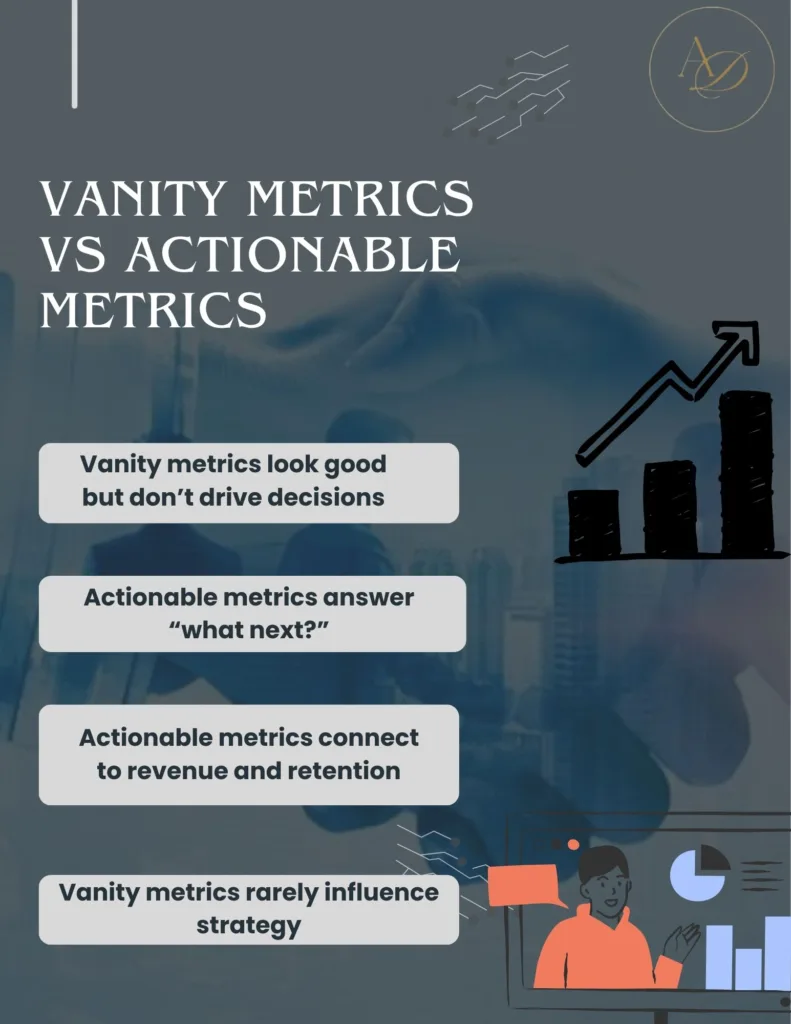
Vanity Metrics vs Actionable Metrics
Understanding the difference between vanity metrics and actionable metrics is essential for making smarter business decisions. While both involve data, their impact is completely different.
What Are Vanity Metrics?
Vanity metrics are numbers that look impressive but don’t help you improve performance or make decisions.
Examples include:
- Website traffic
- Social media followers
- App downloads
- Email subscribers
These metrics focus on appearance, not impact.
What Are Actionable Metrics?
Actionable metrics are data points that directly influence decisions and business outcomes.
Examples include:
- Conversion rate
- Customer retention rate
- Revenue per user
- Customer lifetime value (CLV)
Key Differences Between Vanity and Actionable Metrics
| Vanity Metrics | Actionable Metrics |
|---|---|
| Look impressive in reports | Drive real business decisions |
| Focus on quantity | Focus on quality |
| No direct link to revenue | Directly impact growth and revenue |
| Easy to track | Require deeper analysis |
| Example: Page views | Example: Conversion rate |
Questions to Ask Before Trusting Any KPI
When anyone trusts any KPI, they should ask questions about its intention. Inquire whether the metric affects team behavior or decision making. Inquire about whether it is in line with the general business objectives and whether the adjustment in the metric would result in significant action. In case the response is vague or negative, the KPI probably should be renegotiated.
Vanity Metrics in Marketing
Marketing teams often rely on metrics that are easy to track and visually impressive, but not always meaningful. These numbers may look good in reports, yet they don’t accurately reflect performance or return on investment (ROI).
This is why marketing is one of the most common areas where vanity metrics dominate reporting.
Impressions, Reach, and Views
Impressions, reach, and views indicate how many people have seen your content—but they don’t reveal what actually happened next.
- High reach does not guarantee engagement
- Views do not indicate interest or intent
- Large audiences may still result in zero conversions
A campaign can reach thousands of users and still fail to generate leads or sales.
Key Insight:
If reach is high but engagement is low, it often signals:
- Weak messaging
- Poor audience targeting
On their own, these metrics can be misleading and should not be treated as performance indicators.
Clicks Without Conversions
Clicks often create the illusion of success, but they don’t always translate into real results.
- High click-through rate (CTR) ≠ business growth
- Users may click but not take action
- Poor landing pages can break the conversion journey
If clicks don’t lead to conversions, they offer little value to the business.
Common Issues Behind This:
- Mismatch between ad and landing page
- Weak user experience
- Irrelevant traffic
Tracking clicks without measuring outcomes turns them into vanity metrics instead of actionable insights.
Why Marketers Fall Into the Vanity Trap
In order to market effectively, marketing dashboards tend to have those metrics that are easy to report about and are also pleasing to the eyes. The pressure exerted by the stakeholders to demonstrate growth and visibility also promotes the application of vanity metrics. As time goes by, such emphasis on these superficial figures may make the teams lose track of maximizing campaigns to produce real revenue and customer value.
Vanity Metrics in Sales and Revenue
Vanity metrics can significantly impact sales teams—especially when activity-based numbers are mistaken for real performance indicators.
While these metrics may reflect effort, they don’t always translate into actual results like revenue or growth.
In sales, outcomes matter more than activity.
Leads Generated vs Qualified Leads
Generating a high number of leads may look impressive, but it doesn’t guarantee success.
- Large lead volume ≠ higher conversions
- Unqualified leads rarely turn into customers
- Sales teams waste time on low-quality prospects
Qualified leads are more valuable because they match your target audience and buying intent.
Key Insight:
Focusing on lead quality over quantity improves:
- Conversion rates
- Sales efficiency
- Revenue performance
Tracking Sales KPIs That Truly Matter
To measure real sales performance, businesses should focus on actionable KPIs, such as:
- Conversion rate
- Deal velocity (how quickly deals close)
- Average deal size
- Revenue per customer
These metrics provide deeper insights into:
- Sales effectiveness
- Bottlenecks in the pipeline
- Opportunities for growth
Unlike vanity metrics, these KPIs directly influence business decisions.
Pipeline Size vs Closed Deals
A large sales pipeline can be misleading if deals are not closing.
- Big pipeline ≠ guaranteed revenue
- Low-probability deals inflate numbers
- Creates a false sense of progress
Closed deals are the true measure of sales success because they reflect actual revenue.
Key Insight:
- Pipeline shows potential
- Closed deals show results
Always prioritize revenue-driven outcomes over inflated activity metrics.
Vanity Metrics in Product and SaaS Businesses
In product and SaaS businesses, growth is often measured through expansion metrics, but this can be misleading. Focusing only on growth numbers may hide deeper issues related to user engagement, satisfaction, and retention.
Real success in SaaS is not just about acquiring users—it’s about keeping them.
Registered Users vs Active Users
Registered users show initial interest, but they don’t reflect real product value.
- High sign-ups ≠ product success
- Users may register but never return
- Low activity indicates poor engagement
Active users are a more accurate measure of product health and usability.
Key Insight:
If registered users are increasing but active users are declining, it signals:
- Weak onboarding
- Poor user experience
- Lack of product value
Feature Usage vs Feature Adoption
There is a big difference between trying a feature and actually using it regularly.
- Feature usage = one-time interaction
- Feature adoption = consistent, meaningful use
Adoption shows that users are finding real value in your product.
Why It Matters:
- Drives customer satisfaction
- Improves retention
- Supports long-term growth
Focus on adoption, not just usage.
Retention as the Real Growth Indicator
Retention is one of the most important KPIs in SaaS.
- Measures long-term user engagement
- Reflects product value
- Directly impacts revenue
Unlike vanity metrics, retention cannot be artificially inflated—it shows true product success.
Key Insight:
High retention means:
- Users find value in your product
- Customers are satisfied
- Business growth is sustainable
OKR vs KPI: Where Vanity Metrics Hide
What is the difference between OKR and KPI?
- OKR (Objectives and Key Results): Defines goals and desired outcomes
- KPI (Key Performance Indicator): Measures performance and progress
OKRs set direction, while KPIs track performance.
Read more blog : OKR vs KPI: A Framework for Effective Quarterly Goal Setting
How do vanity metrics hide in OKRs and KPIs?
Vanity metrics appear when businesses focus on outputs instead of outcomes.
Examples of vanity-focused goals:
- Increase website traffic
- Grow social media followers
- Boost app downloads
These look impressive but don’t guarantee business growth.
Why misalignment between OKRs and KPIs creates vanity metrics
When OKRs and KPIs are not aligned:
- Teams focus on numbers, not results
- Success is measured by volume, not impact
- Decision-making becomes weak
This leads to false progress instead of real growth.
Examples: Vanity Metrics vs Outcome-Based Metrics
| Vanity Metric (Output) | Actionable Metric (Outcome) |
|---|---|
| App downloads | Active users |
| Website traffic | Conversion rate |
| Followers | Engagement rate |
| Email subscribers | Open & click rate |
How to avoid vanity metrics in OKRs and KPIs
Follow these simple steps:
- Focus on outcomes, not outputs
- Align KPIs with business goals
- Track metrics that impact revenue, retention, or engagement
- Review KPIs regularly
If a metric doesn’t drive action, it’s a vanity metric.
How to Identify and Avoid Vanity Metrics
To identify and avoid vanity metrics, focus on metrics that directly impact business goals like revenue, retention, and conversions. If a metric does not lead to action or decision-making, it is likely a vanity metric.
Common signs of vanity metrics:
- Do not impact revenue or business growth
- Look impressive but lack context
- Do not lead to actionable insights
- Show activity, not outcomes
- Cannot guide future strategy
Connecting Metrics to Business Goals : Each of the KPIs must be linked to a business objective. When they are not easily explained through that connection, then the metric might be of no value to track.
Measuring Impact, Not Popularity : Attention is depicted by popular metrics, whereas results are depicted by impact metrics. It is impact and not visibility that makes businesses grow.
Creating a KPI Review Framework : Regular reviews of KPI can be used to remove obsolete or misleading measurements. This makes sure dashboards are action-oriented.
Replacing Vanity Metrics With Meaningful KPIs
The use of performance measurement and decision-making is reinforced through the replacement of vanity metrics.
Revenue-Driven Metrics : Such indicators as revenue per user, churn rate, and customer lifetime value give a more realistic picture of the health and growth of business.
Customer-Centric Metrics : Measures of customer satisfaction and retention provide insight into the trust, loyalty and long-term value.
Behavior-Based Metrics : Behavior metrics are indicators that demonstrate what users actually do and this makes them much more reliable than surface ones.

The Future of KPI Tracking
The future of KPI tracking is shifting from data-heavy reporting to impact-driven decision-making. Businesses are moving away from vanity metrics and focusing on fewer, more meaningful KPIs that directly influence growth.
Data Maturity and Smarter Dashboards : As companies grow, they move to fewer and more impactful metrics that give coherent feedback as opposed to data-heavy reports.
From Reporting Numbers to Driving Decisions : Strategic decisions should not be made only through documents but using KPIs. They are, first, action-oriented.
Culture Shift Toward Impact Metrics : Performance measurement is in the future of impact-based measurements, which cover actual results rather than the vanity-based impression.
How Arunangshu Das Guides Businesses to Move Beyond Vanity Metrics
Arunangshu Das focuses on helping businesses replace vanity metrics with outcome-driven KPIs. His approach emphasizes aligning every metric with clear business goals, such as revenue, retention, or customer value. Instead of tracking numbers that only look good on dashboards, he encourages teams to measure metrics that influence decisions and actions. By simplifying dashboards and reviewing KPIs regularly, Arunangshu Das helps organizations build a data-driven culture focused on real impact rather than superficial growth.
Conclusion
But which KPI is the one that is most likely to be a vanity measure? The response is easy, any KPI who appears good but never a decision-maker. The most significant list is usually made of the traffic of the websites, social followers, and downloads, but the context is essential. When a metric does not have a direct correlation with results it is vanity masquerading as a metric. The actual growth is an assessment of what really moves the business.
Frequently Asked Questions
1. Are vanity metrics always useless?
Not necessarily—but they should never be treated as core KPIs. Vanity metrics can provide context, but they don’t reflect real business impact.
2. Can vanity metrics still be tracked?
Yes, but only as secondary indicators. They can offer surface-level insights, not drive decisions.
3. What is the biggest danger of vanity metrics?
They can create a false sense of success, leading to poor decisions and misaligned priorities.
4. How often should KPIs be reviewed?
At least quarterly to ensure they remain relevant and aligned with business goals.
5. What’s the best alternative to vanity metrics?
Focus on actionable KPIs—metrics tied directly to outcomes, user behavior, and business performance.
