


The debate of the century is no longer about whether machines can think, but whether they can feel and create. From DALL·E’s digital masterpieces to ChatGPT’s poetic verses, artificial intelligence is reshaping the creative landscape. But does faster generation mean better innovation?
This overview explores the synergy and friction between Artificial Intelligence and Human Cognition, offering a deep dive into the future of art, design, and storytelling.
How We Evaluate: Our Creative AI Rating Methodology
To provide an authoritative perspective on AI’s impact on creativity, we evaluate AI tools and human-AI collaboration based on these 6 rigorous criteria:
- Technical Precision: The ability of the AI to follow complex prompts and maintain structural integrity.
- Emotional Resonance: Does the output evoke a genuine human response or feel “hollow”?
- Originality Score: How much the tool relies on existing patterns vs. creating something novel.
- Ethical Compliance: Transparency in training data and respect for intellectual property.
- User Experience (UX): Ease of use for creators (e.g., tools like QuillBot AI or ChatGPT Go).
- Expert Validation: Insights from industry leaders like Arunangshu Das on real-world application.
The Rise of AI in Creative Fields
The last ten years have seen the introduction of algorithms such as DALL·E, Midjourney, and ChatGPT that demonstrated that algorithms can create music, poetry, and graphics. The term artificial intelligence to take the place of creativity is no longer unbelievable. AI systems are trained on huge datasets, and the analysis of patterns (style, structure, and tone) generates work that is remarkably unique, or at least seems to be so.
Take artificial intelligence written novels or AI-generated movie trailers. These are outputs that usually astound their creators. Deep-learning and generative-adversarial networks enable AI to recreate brushstrokes of a famous painter or create new visual aesthetics altogether. The pace and magnitude in which machines generate creative material is unparalleled, and it is generating excitement and nervousness the world over.
Human vs AI Innovation
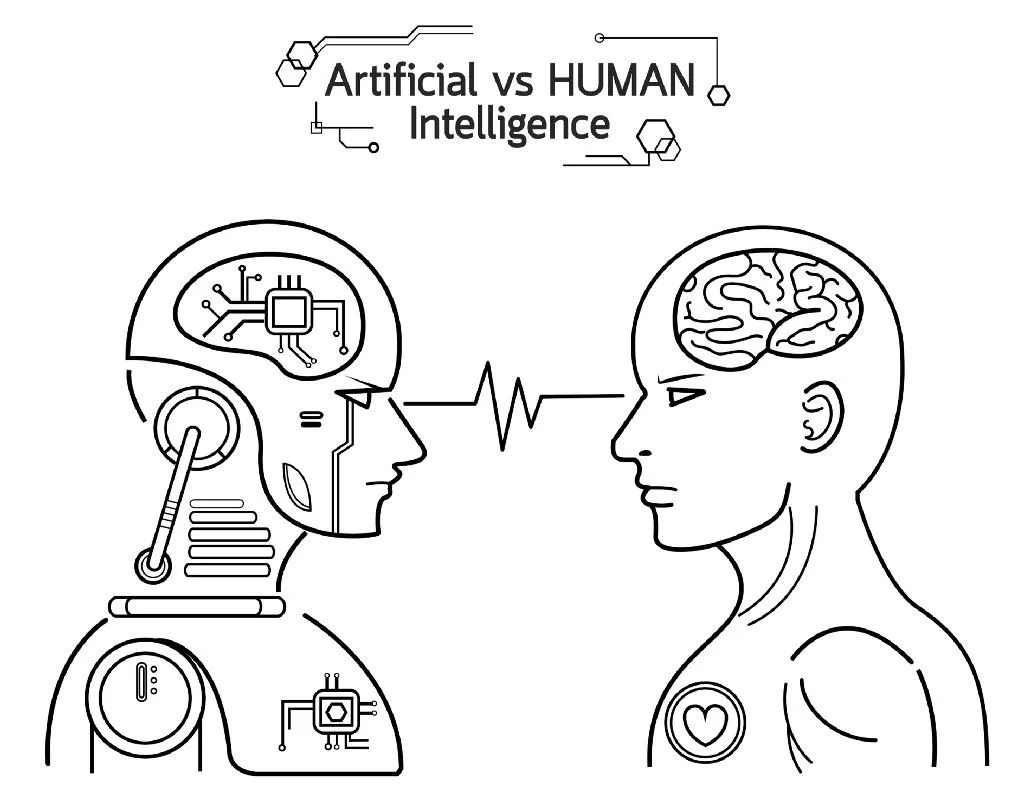
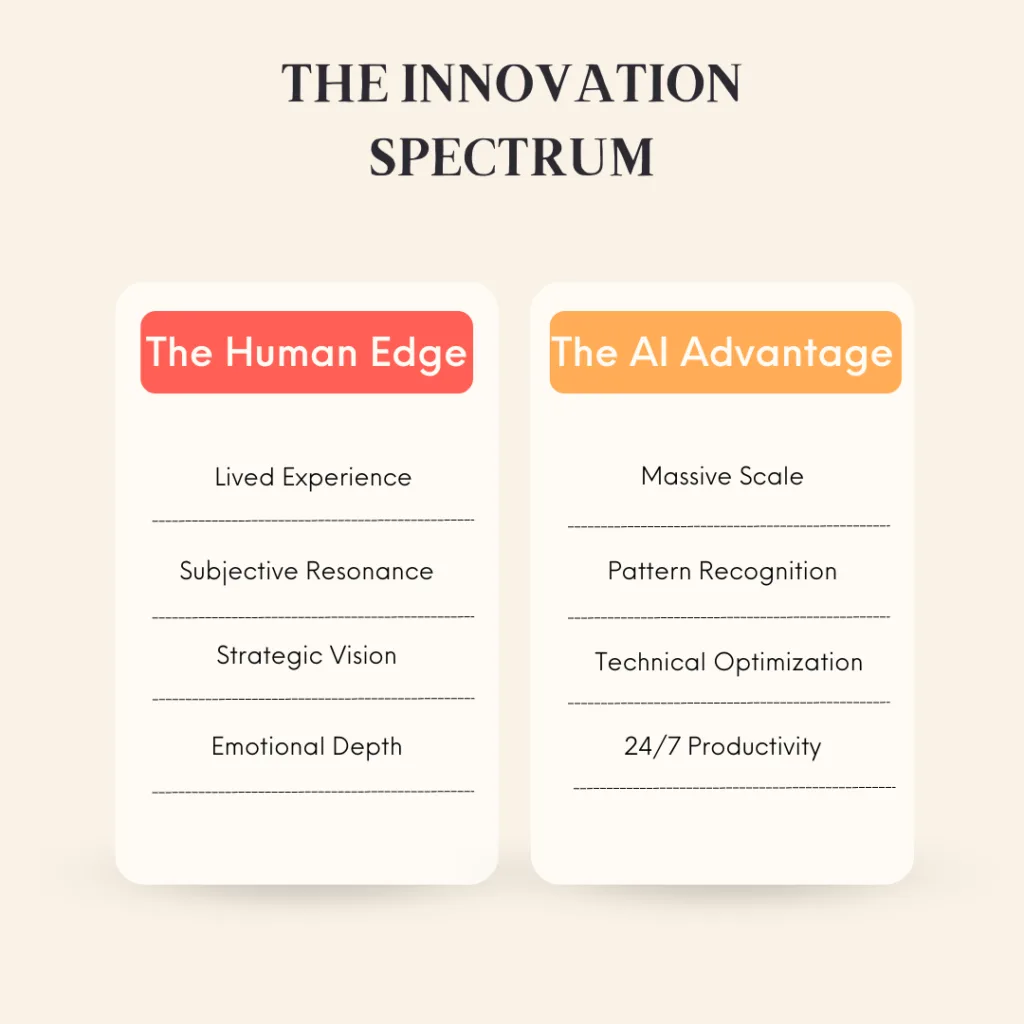
The human vs AI innovation is not as easy as the one who will create faster despite all these advances. Pattern recognition is not the only kind of innovation. Humans utilize lived experience, cultural subtlety, and emotional richness aspects, which are not fully simulated by the algorithms. Whereas AI can produce thousands of logo options within a few seconds, it cannot experience the pleasure of inspiration or disappointment of failure that sometimes results in the breakthrough concept.
Innovative discoveries are often created out of luck and anecdotal accounts. An artist may pour his or her sorrow into a work of art; a musician may recycle his childhood recollections into a haunting tune. Such subjective things are something that are distinctly human and give our work that kind of resonance that data-driven models can never replicate.
The Future of Creative Jobs with AI
To writers, designers, filmmakers and musicians, the future of creative employment involving AI is promising and frightening. First, AI can be used to automate routine tasks, such as editing, formatting, or writing rough drafts, so that human beings can spend their time on high-level ideation. On the other it jeopardizes positions that were formerly secured by the human touch.
Advertising firms are currently testing their campaign ideas with the help of AI. Procedural generation is used by video game studios to create large worlds with little human involvement. Even journalism, which has always been regarded as a stronghold of human narration, is implementing AI to provide news updates. The most important aspect of professionals will be adjustment: getting used to the fact that AI is a tool that can be used instead of a competitor.
Also Read:- Expanding Your Dataset: Powerful Data Augmentation Techniques for Machine Learning
At a Glance: Human Creativity vs. AI Capabilities
To better understand where the boundary lies, here is a comparison of how both entities approach the creative process:
| Feature | Human Creativity | AI Generative Ability |
| Source of Inspiration | Lived experiences, emotions, and cultural heritage. | Massive datasets and mathematical patterns. |
| Speed & Volume | Slow, deliberate, and limited by physical stamina. | Near-instantaneous; can generate thousands of iterations. |
| Emotional Depth | High; driven by a desire to communicate meaning. | None; replicates the appearance of emotion statistically. |
| Originality | Can create entirely new paradigms out of “thin air.” | Iterates on existing data (cannot create outside its training). |
| Primary Strength | Subjective Resonance (Moving the soul). | Technical Efficiency (Optimizing the workflow). |
| Best Used For | High-level strategy, storytelling, and fine art. | Drafting, formatting, and rapid prototyping. |
AI-Generated Art vs Human Art
The conflict between AI-generated and human art is an example of how complicated this new era is. The art of AI may be aesthetically beautiful and technically accurate. AI pieces have won the competitions, and the question of authenticity has been raised. However, according to the arguments of many art lovers, the works of machines are not intentional. They might blind the eye, but do they affect the soul?
Galleries and collectors are starting to consider AI art as art forms worthy of valuing since they are novel and challenge the definition of art. In the meantime, other human artists still use AI as a partner and feed the prompts and filter the output to generate a hybrid artwork, which combines algorithmic output with human eyes.
AI Impact on Creative Industries
In the creativity industries, there can be no doubt about the effect of AI. Machine learning is applied to predict the success of films in the box-office. Fashion companies use AI to make predictions and customize designs. AI helps music producers to create beats and even interpret the emotions of the audience to create the most engagement.
Although these applications make the process more effective, and allow unlocking new sources of revenue, it also leads to questions of ownership and originality. Who owns the copyright to AI-created symphony, the programmer, the user, or the algorithm? The dilemmas are yet to be reflected in legal systems across the world.
Artificial Intelligence and Human Cognition
The discussion of Artificial Intelligence and Human Cognition explains why AI creative potential attracts the attention of scholars. Imaginative human activity is based on a system of neural activities memory, emotion, intuition. The neural networks used to replicate some of these mechanisms by AI do so statistically rather than in an experiential way.
Cognition entails being conscious, having a sense of self and the capacity to attach meaning. AI lacks these qualities. It never dreams or wonders its mission or reflects on death, which in human art and narration, are the sources of inspiration. Therefore, even though AI may be able to replicate creativity, it does not duplicate the mental or emotional terrain.
ChatGPT Go Lands in India & QuillBot AI Review
The last changes reveal the increasing availability of AI. Through ChatGPT Go Lands in India entrepreneurs, students, and content creators will have the opportunity to use conversational AI to perform customer care, brainstorming, and other tasks. On the same note, such tools as QuillBot AI Review demonstrate the way the AI can be used to improve the writing process, including grammar correction and style recommendations.
The platforms enable people to create quality content within a very short period of time, and they also emphasize the importance of responsible usage and judgment. The use of AI alone in the absence of human supervision may cause mistakes, bias, and monotony of thought.
Collaboration: The New Creative Paradigm
Rather than making the debate a fight, a number of thought leaders propose synergy. Through human intuition as well as precision of the machine we are able to discover fresh expressions. AI can be applied to simulate the environmental impacts that architects can use to make their designs more sustainable. Moviemakers can also play around with AI-based special effects to see non-existent worlds.
It is probable that the most successful creative professionals will be the ones that adopt this partnership and see AI as the opportunity to expand and not as an opponent to be taken seriously.
Ethical and Cultural Considerations
With the introduction of AI into the creative realm, the ethical issues become more acute. Whereas, deep fake technology, as an example, is able to affect voices and faces, the privacy and trust are at stake. Another sensitive topic is cultural heritage: when sacred indigenous art is fed into an algorithm, the question of consent and appropriation emerges.
The collaboration between policymakers, artists, and technologists is the key to creating rules that would safeguard human dignity and creativity and promote innovation.
Guidance from Arunangshu Das
The changing environment can be confusing, and it is through professional mentors that one can find some clarity. Arunangshu Das has become a reliable source of information when it comes to people and organizations searching for the creative potential of AI. His workshops, personal consultations, and thought-provoking materials help creators learn how to use AI tools without losing their originality. You might be a startup looking to apply generative design to your advantage or an artist exploring new art forms;, whatever you are, what Arunangshu has to say in his strategic advice will make sure technology will not dilute your originality.
Conclusion
The future isn’t AI vs. Human, it is AI + Human. Machines will always dominate pattern-based tasks, but humans provide the emotional depth that gives art meaning. By staying ethical and seeking expert guidance from mentors like Arunangshu Das, we can ensure that technology enriches rather than replaces the human imagination.
FAQs: What People Are Asking About AI and Creativity
Can AI ever replace human artists entirely?
While AI can replicate styles and generate content faster, it lacks consciousness and emotional intent. It is more likely to replace “routine” creative tasks rather than the “soul” of high-level art.
How is ChatGPT Go changing the creative landscape in India?
ChatGPT Go Lands in India has democratized access to high-level brainstorming and customer care, allowing local entrepreneurs and students to compete on a global scale with AI-boosted productivity.
Is AI-generated art considered “real” art?
This depends on the definition of art. If art requires human intent and emotion, AI falls short. However, as a new medium, AI art is gaining value in galleries for its technical novelty.
What is the best AI tool for academic and creative writing?
Based on recent QuillBot AI Reviews, it remains a top choice for grammar and style refinement, while ChatGPT is preferred for ideation and structure.
