



RESTful APIs (Representational State Transfer) Application Programming Interfaces have become the foundation of modern web and mobile application development. They enable different software systems to communicate efficiently, exchange data securely, and integrate seamlessly across platforms. From e-commerce websites and banking applications to social media platforms and cloud services, RESTful APIs power countless digital experiences that users rely on every day.
Built on standard HTTP protocols, RESTful APIs are known for their simplicity, scalability, flexibility, and performance. They allow developers to create applications that are easier to maintain, faster to deploy, and capable of supporting millions of users. Whether you’re developing a web application, mobile app, or microservices-based architecture, understanding the core principles and features of RESTful APIs is essential for building reliable and high-performing systems.
In this guide, we’ll explore the 5 key features of RESTful APIs, explain why they are important, and see how they help developers create secure, scalable, and efficient applications. Whether you’re a beginner learning API development or an experienced developer looking to strengthen your knowledge, this article will provide valuable insights into one of the most widely used API architectures in modern software development.
1. Statelessness: Keeping RESTful APIs Simple and Scalable
One of the most important features of RESTful APIs is statelessness.
A stateless API means every client request contains all the information required for the server to process it. The server does not remember previous requests or maintain session information.
Benefits of Stateless REST APIs
- Improves scalability by allowing servers to process requests independently.
- Makes load balancing easier across multiple servers.
- Enhances reliability because there is no session dependency.
- Simplifies caching and improves performance.
Example
GET /weather?city=DubaiResponse
{
  "city": "Dubai",
  "temperature": "35°C",
  "condition": "Sunny"
}
Even if the same request is sent later, the server treats it as a completely new request.
2. Resource-Based Architecture
Everything in a RESTful API is treated as a resource, identified by a unique URL.
Instead of creating different endpoints for every action, REST uses standard HTTP methods to interact with resources.
Common HTTP Methods
| HTTP Method | Purpose | Example |
|---|---|---|
| GET | Retrieve data | GET /books |
| POST | Create a resource | POST /books |
| PUT | Replace a resource | PUT /books/10 |
| PATCH | Update part of a resource | PATCH /books/10 |
| DELETE | Delete a resource | DELETE /books/10 |
Read More Blog : Building Robust APIs: Essential REST API Design Principles for Developers
Example
GET /booksReturns all books.
GET /books/123Returns details of Book ID 123.
This consistent structure makes RESTful APIs easier to understand and maintain.
3. HATEOAS (Hypermedia as the Engine of Application State)
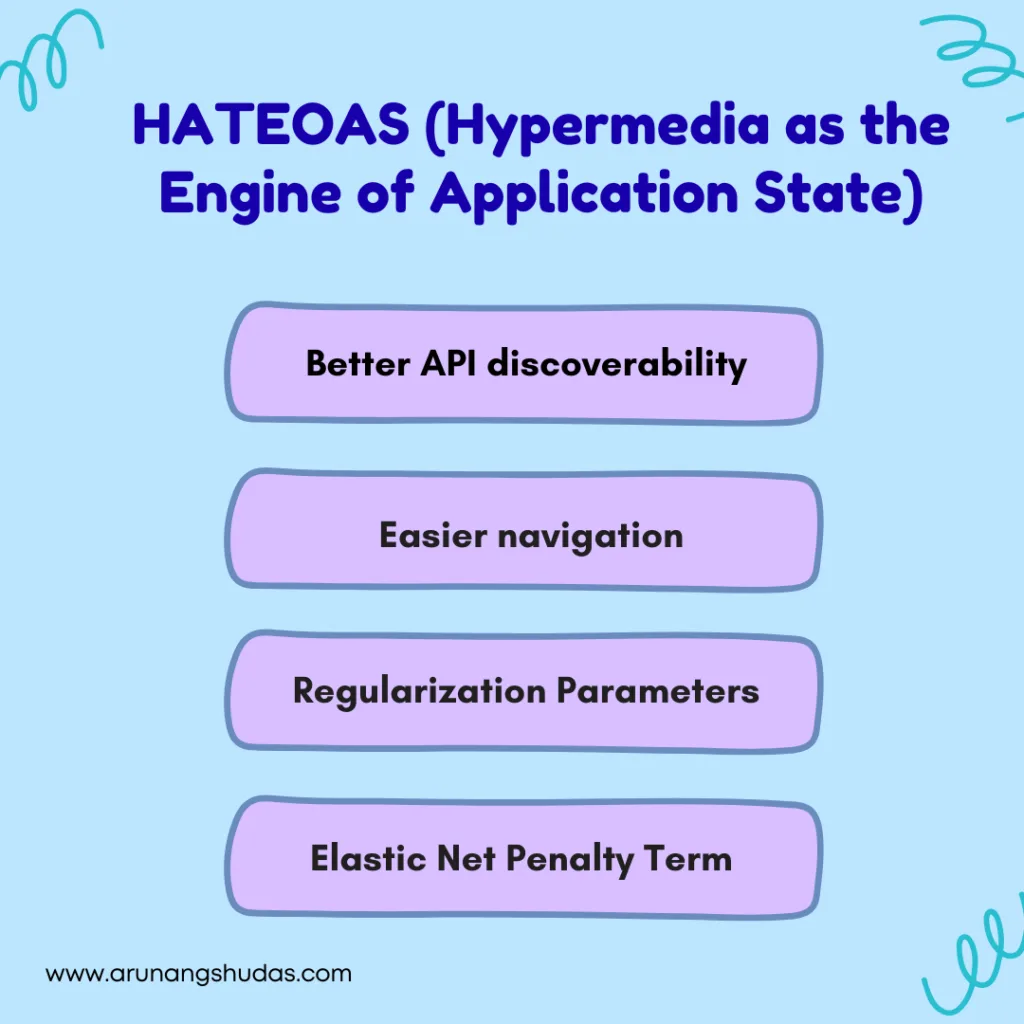
HATEOAS enables REST APIs to include links to related resources inside API responses.
Instead of hardcoding URLs, clients can navigate dynamically through hyperlinks.
Benefits
- Better API discoverability
- Easier navigation
- Reduced dependency on fixed URLs
- Future-proof API architecture
4. Standard HTTP Status Codes
RESTful APIs use standard HTTP status codes to indicate whether a request was successful or failed.
These status codes help developers debug applications quickly.
Common REST API Status Codes
| Status Code | Meaning |
|---|---|
| 200 OK | Request successful |
| 201 Created | Resource created |
| 204 No Content | Request successful with no response body |
| 400 Bad Request | Invalid request |
| 401 Unauthorized | Authentication required |
| 403 Forbidden | Access denied |
| 404 Not Found | Resource doesn’t exist |
| 500 Internal Server Error | Server-side issue |
Read More Blog : Building Robust APIs: Essential REST API Design Principles for Developers
Example
GET /books/99999Response
{
  "error":"Book not found"
}
Status Code
404 Not FoundUsing proper HTTP status codes improves API usability and developer experience.
Example
{
  "id":5,
  "name":"John Doe",
  "email":"john@example.com",
  "links":[
    {
      "rel":"self",
      "href":"/users/5"
    },
    {
      "rel":"orders",
      "href":"/users/5/orders"
    }
  ]
}
The client automatically knows where to fetch the user’s orders.
5. Caching for Better API Performance
Caching reduces unnecessary API requests and improves application speed.
A well-designed RESTful API should support caching whenever possible.
Types of API Caching
- Client-side caching
- Browser caching
- Server-side caching
- CDN caching
Example
Cache-Control: public, max-age=3600This tells the browser to cache the response for one hour.
If the resource hasn’t changed:
304 Not ModifiedThe client reuses cached data instead of downloading it again.
Benefits include:
- Faster response times
- Lower server load
- Reduced bandwidth usage
- Improved user experience
RESTful APIs vs SOAP APIs
| Feature | RESTful APIs | SOAP APIs |
|---|---|---|
| Architecture | REST | SOAP Protocol |
| Data Format | JSON, XML | XML Only |
| Performance | Fast and Lightweight | Slower |
| Scalability | High | Moderate |
| Stateless | Yes | Can be Stateful |
| Caching | Supported | Limited |
| Learning Curve | Easy | Complex |
| Best Use Cases | Web & Mobile Apps | Enterprise Systems |
Best Practices for Designing RESTful APIs
- Use meaningful endpoint names.
- Always use HTTPS.
- Follow proper HTTP methods.
- Return appropriate HTTP status codes.
- Implement authentication using OAuth or JWT.
- Version your APIs.
- Document APIs using Swagger/OpenAPI.
- Enable caching where appropriate.
- Validate user input.
- Return consistent JSON responses.
Benefits of RESTful APIs
Using RESTful APIs provides several advantages:
Simplified maintenance proving performance.
Faster application development
Better scalability
Platform independence
Improved performance
Easy integration
Reduced development costs
Enhanced security with HTTPS and authentication
Key Takeaways
→ Statelessness makes REST APIs scalable and reliable.
→ Resource-Based Structure keeps APIs intuitive and organized.
→ HTTP Status Codes improve error handling and debugging.
→ HATEOAS enhances API discoverability and flexibility.
→ Caching boosts performance and reduces server load.
By designing APIs with these principles in mind, developers can build powerful applications that stand the test of time.

Conclusion :
RESTful APIs have become the industry standard for building scalable, reliable, and high-performance web services. Their stateless architecture, resource-oriented design, standardized HTTP methods, caching capabilities, and support for hypermedia make them an excellent choice for modern application development.
Whether you’re building enterprise software, mobile apps, cloud platforms, or microservices, understanding these 5 key features of RESTful APIs will help you design better APIs that are secure, maintainable, and future-ready.
Frequently Ask Questions :
What is a RESTful API?
A RESTful API is an API that follows REST architectural principles to enable communication between applications using standard HTTP methods like GET, POST, PUT, PATCH, and DELETE.
Why are RESTful APIs popular?
RESTful APIs are popular because they are lightweight, scalable, fast, platform-independent, and easy to integrate with web and mobile applications.
What are the five key features of RESTful APIs?
The five key features include: Statelessness Resource-Based Architecture HTTP Status Codes HATEOAS Caching
What is the difference between REST and RESTful APIs?
REST is an architectural style, while a RESTful API is an API that follows REST principles and constraints.
Which data format do RESTful APIs commonly use?
RESTful APIs primarily use JSON because it is lightweight, easy to read, and supported by almost every programming language.
You may also like:
1) 5 Common Mistakes in Backend Optimization
2) 7 Tips for Boosting Your API Performance
3) How to Identify Bottlenecks in Your Backend
4) 8 Tools for Developing Scalable Backend Solutions
5) 5 Key Components of a Scalable Backend System
6) 6 Common Mistakes in Backend Architecture Design
7) 7 Essential Tips for Scalable Backend Architecture
8) Token-Based Authentication: Choosing Between JWT and Paseto for Modern Applications
9) API Rate Limiting and Abuse Prevention Strategies in Node.js for High-Traffic APIs
10) Can You Answer This Senior-Level JavaScript Promise Interview Question?
11) 5 Reasons JWT May Not Be the Best Choice
12) 7 Productivity Hacks I Stole From a Principal Software Engineer
13) 7 Common Mistakes in package.json Configuration
Share your experiences in the comments, and let’s discuss how to tackle them!
Follow me on Linkedin
