


In the volatile landscape of modern software engineering, rigidity is a liability. Market trends shift overnight, user requirements evolve in real-time, and tech stacks advance at breakneck speed. For Project Managers, relying on traditional, linear development models in this dynamic environment often leads to a familiar cycle: missed milestones, scope creep, and blown budgets.
To break this cycle, forward-thinking teams rely on Adaptive Software Development (ASD)—a high-flexibility framework designed to turn unpredictability into a competitive advantage through continuous learning and rapid iteration.
If you’re a project manager trying to navigate the chaos of modern development, this guide is for you.
What Is Adaptive Software Development (ASD)?
Adaptive Software Development (ASD) is an agile framework built on the premise that modern software development is an evolutionary learning process rather than a static, predictable task. Where traditional models (like Waterfall) demand rigid adherence to a pre-defined scope, ASD embraces change, prioritizing continuous feedback and cross-functional collaboration.
The 3 Core Pillars of ASD
Unlike linear models, the ASD lifecycle is a continuous loop. Instead of the traditional “Plan-Design-Build” phase, ASD operates on three iterative pillars:
- 1. Speculate (Planning for Uncertainty): Rather than locking in a rigid, line-by-line project plan, PMs define a high-level roadmap and project boundaries. You define the goals and constraints, leaving the technical execution path open to evolution.
- 2. Collaborate (Shared Responsibility): ASD shifts the focus from managing tasks to managing people and communication. It requires active, ongoing alignment between developers, stakeholders, and end-users to navigate complex changes.
- 3. Learn (The Feedback Loop): Every iteration ends with rigorous testing, review, and focus groups. Teams don’t just check off completed tasks; they actively analyze real-world results to steer the next cycle.
Why Project Managers Should Embrace ASD
Project managers are constantly balancing a triad of constraints: speed, quality, and stakeholder expectations. When unexpected bottlenecks or market shifts hit, traditional frameworks break down.
Adaptive Software Development removes the friction of change management by embedding agility directly into the project lifecycle. Here is how ASD transforms daily project operations:
1. High-Flexibility Scope Control
Traditional project management treats scope changes as a risk; ASD treats them as an asset. By shifting from a rigid upfront plan to dynamic, continuous forecasting, you can pivot resources and absorb changing technical requirements without derailing your entire timeline or blowing your budget.
2. Proactive Stakeholder Alignment
Because collaboration is hardcoded into the methodology, ASD replaces stressful, late-stage reveals with predictable, regular touchpoints. Engaging stakeholders and end-users early in each cycle captures critical feedback loops when changes are cheap to implement, virtually eliminating costly late-stage rework.
3. Accelerated Time-to-Market
ASD replaces high-risk, “big-bang” deployments with shorter, iterative delivery cycles. By shipping functional micro-increments or minimum viable features early, you generate immediate business value, secure real-world user data, and establish a faster feedback loop to guide the next sprint.
4. Micro-Targeted Risk Mitigation
Large, monolithic project plans carry massive failure domains. ASD minimizes project risk by decoupling deliverables into self-contained iterations. If a technical challenge or integration failure occurs, the blast radius is isolated to a single cycle—allowing you to course-correct instantly without threatening the broader product roadmap.
How to Implement ASD: A 5-Step Project Management Blueprint
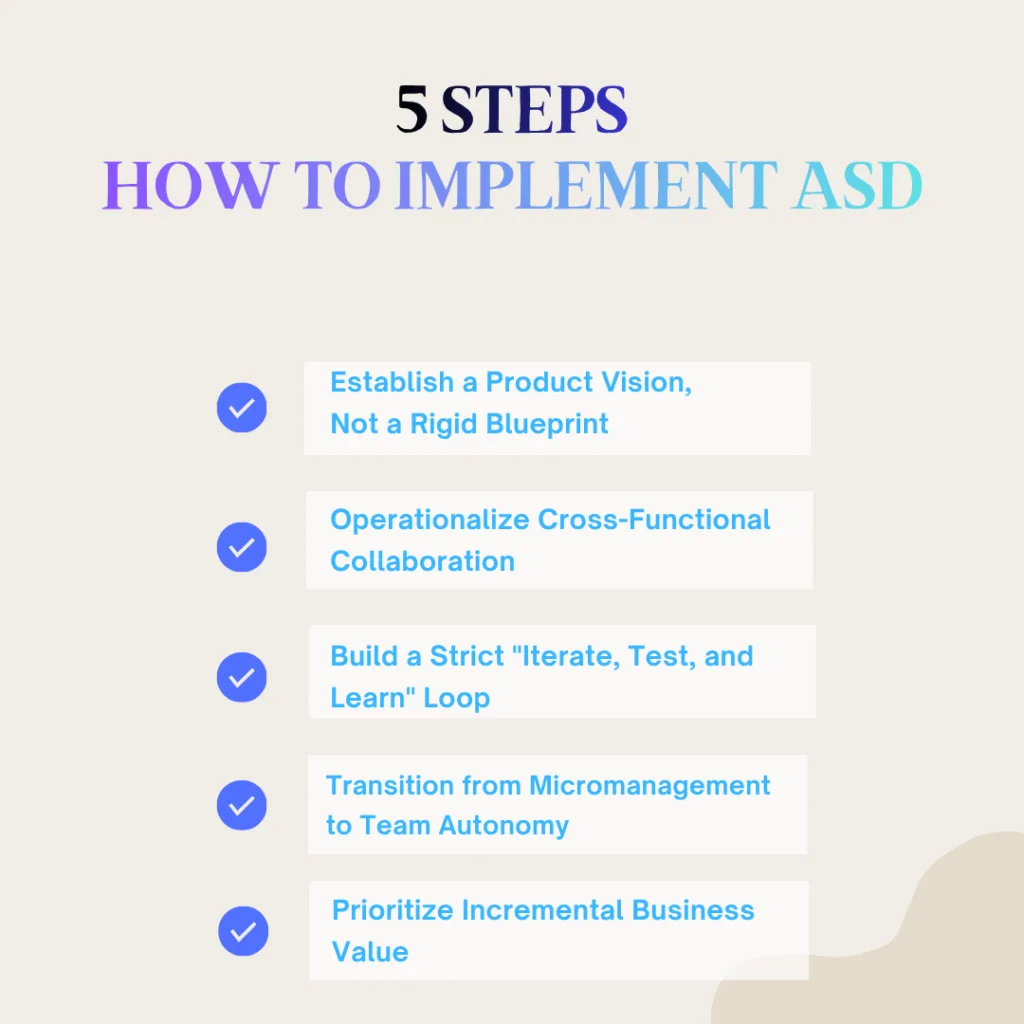
Transitioning to an Adaptive Software Development model requires moving away from rigid command-and-control structures toward dynamic orchestration. Use these five steps to deploy ASD within your engineering teams:
1. Establish a Product Vision, Not a Rigid Blueprint
Ditch the comprehensive, hundred-line Gantt chart. Instead, align your stakeholders around a well-defined product vision and a high-level roadmap. Detail the core project boundaries and high-priority milestones, but leave the technical execution path flexible enough to absorb shifting user requirements.
2. Operationalize Cross-Functional Collaboration
Break down operational silos by building a unified ecosystem where developers, designers, product owners, and end-users communicate synchronously. Move away from isolated weekly status updates; instead, use continuous feedback loops and integrated communication channels to spark innovation and surface hidden technical friction early.
3. Build a Strict “Iterate, Test, and Learn” Loop
Structure your roadmap into short, fixed-duration development cycles. Every single iteration must conclude with a rigorous review phase containing two components: automated/user testing and a stakeholder feedback loop. Treat the data gathered during this phase as the primary driver for planning your next cycle.
4. Transition from Micromanagement to Team Autonomy
Because ASD thrives on speed, centralized decision-making creates crippling bottlenecks. Empower your development team with the autonomy to solve technical blockers and make architectural pivots independently. Your role as a PM shifts from monitoring micro-tasks to unblocking roads and safeguarding the broader product direction.
5. Prioritize Incremental Business Value
Evaluate the success of an iteration by one metric: the delivery of working, high-value software features. Prioritize the product backlog ruthlessly so that every cycle ships a tangible increment that users can interact with. This maintains stakeholder buy-in and ensures the team’s effort directly impacts ROI.
Challenges and How to Overcome Them
Adopting ASD isn’t always smooth sailing. Here are some common challenges and tips to address them:
- Resistance to Change: Teams and stakeholders may cling to traditional methods. Overcome this by emphasizing the benefits of adaptability and showcasing early wins.
- Unclear Roles: In a collaborative environment, roles can blur. Clearly define responsibilities while maintaining flexibility.
- Scope Creep: While ASD is flexible, it’s crucial to manage changes effectively. Use a prioritization framework like MoSCoW (Must-have, Should-have, Could-have, Won’t-have).
ASD vs. Scrum vs. Waterfall: Project Management Execution Matrix
| Evaluation Vector | Adaptive Software Development (ASD) | Scrum | Traditional Waterfall |
| Core Philosophy | Emergence & Learning: Accepts that complex systems are inherently unpredictable. | Structured Agility: Manages predictability through rigid, short-term cadences. | Linear Predictability: Assumes requirements are fixed and completely discoverable upfront. |
| Planning Paradigm | Speculate: High-level product vision and flexible macro-roadmaps; details evolve. | Sprint Backlog: Fixed, prioritized scope locked in for 1 to 4-week cycles. | Gantt Chart Blueprint: Comprehensive, multi-month breakdown baseline. |
| Primary Metric | Learning Velocity: Value of insights gained and rapid adaptation frequency. | Team Velocity: Number of story points delivered per sprint. | Milestone Adherence: Compliance to original timeline, budget, and scope. |
| Blast Radius of Failure | Isolated to Cycle: Decoupled iterations keep risks micro-targeted. | Isolated to Sprint: Blockers affect current sprint goals only. | System-Wide Risk: Errors caught during late-stage testing can derail the entire budget. |
| Stakeholder Engagement | Continuous Co-creation: Real-time feedback loop deeply embedded in every phase. | Ceremony-Driven: Formal inspection during Sprint Reviews. | Gate-Based: Heavy involvement at kickoff and final handoff only. |
| Best Suited For… | High-uncertainty R&D, cutting-edge AI integrations, and volatile market entries. | Standard cross-functional product development with evolving backlogs. | Fixed-scope compliance software, construction-adjacent tech, or hardware integrations. |
Success Stories of ASD in Action
Example 1: E-Commerce Platform Upgrade
An e-commerce company needed to revamp its platform to handle seasonal demand. Using ASD, the project team released incremental updates, such as improved search functionality and faster checkout, before the holiday season. Real-time user feedback helped them optimize features, resulting in a 20% increase in sales.
Example 2: Healthcare App Development
A healthcare startup used ASD to develop a telemedicine app. Early iterations focused on core features like video consultations, with additional features like prescription management added later. This iterative approach helped the startup attract investors and users quickly.
Conclusion: Shifting from Control to Adaptation
In a volatile software landscape, the traditional project management obsession with absolute control is a recipe for missed deadlines and burned-out teams. Trying to force a dynamic, evolving software product into a rigid, upfront blueprint ignores the reality of modern tech: change is inevitable.
Adaptive Software Development (ASD) offers a proven path forward. By replacing rigid planning with strategic speculation, breaking down silos for radical collaboration, and building non-negotiable learning loops, ASD allows PMs to mitigate risk where it matters most. It shifts your role from a task-monitoring referee to a strategic orchestrator who drives real, incremental business value.
Don’t wait for your next monolithic plan to hit a roadblock. Start small: pick one upcoming feature cycle, establish a flexible roadmap, empower your development team, and let the data from real-world feedback loops guide your next move.
You may also like:
1) How do you optimize a website’s performance?
2) Load Testing with Artillery: Prepare Your Node.js Application for Peak Traffic
3) Top 10 Questions in Software Development Interviews and How to Answer Them
4) Senior-Level JavaScript Promise Interview Question
5) What is Database Indexing, and Why is It Important?
6) Can AI Transform the Trading Landscape?
7) What is the purpose of a deployment pipeline?
8) Token-Based Authentication: Choosing Between JWT and Paseto for Modern Applications
9) API Rate Limiting and Abuse Prevention Strategies in Node.js for High-Traffic APIs
Read more blogs from Here
Share your experiences in the comments, and let’s discuss how to tackle them!
Follow me on Linkedin
Frequently Ask Question:
What is the main difference between ASD and Waterfall?
Waterfall relies on a rigid, linear blueprint where scope is locked upfront. ASD is an evolutionary framework that replaces strict planning with fluid forecasting, allowing project managers to pivot scope based on real-world feedback.
How does ASD handle project risk?
ASD minimizes risk by isolating deliverables into short, self-contained development cycles. This keeps the “blast radius” of technical bugs or shifting requirements micro-targeted, preventing a single failure from derailing the entire budget.
What are the three phases of the ASD lifecycle?
The ASD lifecycle operates on a continuous loop of three pillars:
Speculate: Defining a flexible product vision instead of a rigid blueprint.
Collaborate: Driving synchronous communication across all stakeholders.
Learn: Using rigorous testing and user reviews to guide the next cycle.
When should a Project Manager choose ASD over Scrum?
Choose Scrum if your project needs structured, predictable sprint cadences. Choose ASD when you are dealing with extreme technical uncertainty (like AI integrations or new market entries) where the biggest risk is requirement volatility rather than delivery speed.
