


Introduction
Natural Language Processing (NLP) and Artificial Intelligence (AI) have fundamentally reshaped the way humans interact with machines. As we witness rapid technological advancements, these fields are increasingly converging, creating more seamless, accurate, and intuitive communication methods between humans and machines. This article explores how the merging of NLP and AI is enhancing human-machine communication, its applications, and the potential it holds for the future.
Understanding NLP and AI: Core Concepts
To appreciate how these technologies converge, it is essential to understand the distinct role each field plays in the modern digital ecosystem.
What is Natural Language Processing (NLP)?
Natural Language Processing (NLP) is a specialized branch of artificial intelligence and computer science that bridges the gap between human communication and machine understanding.
Unlike structured programming code, human language is messy—filled with idioms, regional dialects, context, and emotional nuance. NLP relies on advanced algorithms and computational linguistics to break down, interpret, and generate human language in a way that is contextually accurate and meaningful.
Core Components of NLP
- Syntax Analysis: Evaluating sentence structure and grammatical rules.
- Semantic Analysis: Decoding the literal meaning of words and phrases.
- Pragmatic Analysis: Interpreting the real-world context and situational intent.
- Sentiment Analysis: Detecting the underlying emotion or attitude behind the text.
What is Artificial Intelligence (AI)?
Artificial Intelligence (AI) is an umbrella term for technologies that simulate human cognitive functions. Rather than just executing rigid commands, AI systems perceive their environments, analyze data patterns, make independent decisions, and learn from continuous feedback loops.
The Two Core Classifications of AI
- Narrow AI (Weak AI): Systems engineered and optimized for a highly specific task—such as Google’s search algorithms, virtual assistants, or language translators.
- General AI (Strong AI): A theoretical form of AI possessing human-level intellect, capable of executing any cognitive task a human can.
Modern AI scales these capabilities using diverse methodologies, most notably Machine Learning (ML) and Deep Learning (DL), which allow algorithms to self-improve without explicit reprogramming.
NLP vs. Artificial Intelligence
Here is a quick-reference breakdown of how NLP and AI differentiate and intersect:
| Feature | Natural Language Processing (NLP) | Artificial Intelligence (AI) |
| Core Definition | A specialized domain focused exclusively on machine-human language interaction. | An overarching field dedicated to building systems that simulate human intelligence. |
| Scope | Narrow and specific (Text, Speech, and Linguistics). | Broad and comprehensive (Vision, Robotics, Logic, Data Analysis, and NLP). |
| Primary Goal | To make human language readable, understandable, and actionable for computers. | To enable machines to problem-solve, learn, reason, and make autonomous decisions. |
| Real-World Examples | Chatbots, grammar checkers, translation apps, and voice assistants. | Autonomous vehicles, predictive analytics engines, and facial recognition software. |
| Relationship | A core subset of the larger AI ecosystem. | The superset that encompasses NLP, Machine Learning, and Robotics. |
The Role of AI in Advancing NLP
While NLP and AI have always been deeply interconnected, recent breakthroughs in artificial intelligence have fundamentally transformed how machines process human language. By moving away from rigid, rule-based programming, AI advancements have unlocked unprecedented fluidity, contextual awareness, and precision in NLP capabilities.
1. The Engine of Modern NLP: Machine Learning & Deep Learning
Traditional NLP relied on manual linguistic rules, which easily broke down when faced with slang or complex sentence structures. Today, Machine Learning (ML) and Deep Learning (DL) serve as the structural backbone of modern language processing.
- Machine Learning (ML): Instead of being told how to interpret a phrase, ML models are trained on massive datasets. By analyzing millions of text examples, they independently learn to recognize patterns and improve their accuracy in tasks like language translation and intent classification.
- Deep Learning (DL): As a sophisticated subset of ML, deep learning utilizes multi-layered artificial neural networks designed to process data in a manner inspired by the human brain.
The Impact on Context
Deep learning has elevated NLP from simple keyword matching to cognitive comprehension. Multi-layer neural networks allow systems to decode complex linguistic layers, enabling machines to detect:
- Subtle contextual shifts
- Sarcasm and irony
- Regional idioms and cultural humor
This evolution is what makes interactions with modern AI feel fluid and human-like rather than robotic.
2. The Evolution of Advanced Language Models
The marriage of deep learning and NLP birthed a new era of architecture: Large Language Models (LLMs). Driven by advanced neural frameworks like the Transformer architecture, models such as OpenAI’s GPT series and Google’s BERT/Gemini ecosystems have redefined textual generation and analysis.
- Massive Scale Pre-training: These models ingest planetary-scale datasets during their initial training phase. This allows them to master syntax, semantics, and world knowledge, predicting the next logically accurate word or phrase with incredible precision.
- The Power of Transfer Learning: One of AI’s greatest gifts to NLP is transfer learning. Instead of building a new model from scratch for every specific business use case, developers can take a highly sophisticated, pre-trained base model and fine-tune it with minimal data.
The Bottom Line: This architectural shift has supercharged everything from enterprise chatbots and virtual assistants to automated copywriting tools, allowing them to participate in deeply complex, multi-turn conversations without losing track of the context.
Applications of NLP and AI Convergence
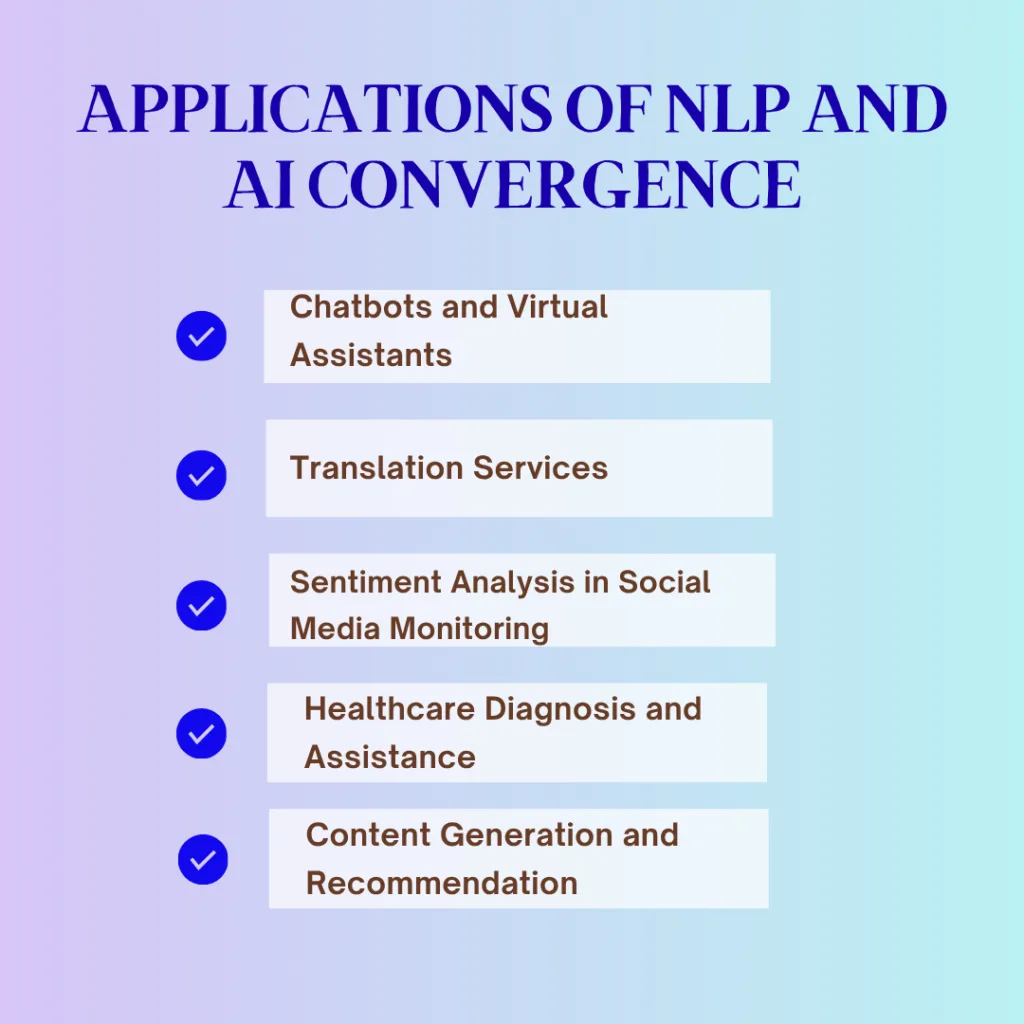
The integration of NLP and AI has opened doors to numerous applications, enhancing communication across various industries. Here are some of the most impactful applications:
1. Chatbots and Virtual Assistants
Chatbots and virtual assistants, like Siri, Alexa, and Google Assistant, have become commonplace in homes and workplaces. Through NLP and AI, these systems can understand user commands, answer questions, and perform tasks. NLP enables them to interpret user input accurately, while AI allows them to learn from interactions and improve over time.
In customer service, AI-driven chatbots are revolutionizing user experiences by providing instant support, resolving common queries, and even handling complaints, allowing human agents to focus on complex issues.
2. Translation Services
Language translation has been one of the most significant achievements in NLP. Tools like Google Translate use AI-powered NLP to provide accurate translations across hundreds of languages. AI’s neural machine translation models consider context, idioms, and nuances, delivering natural translations that go beyond word-for-word interpretation.
This capability has proven invaluable for businesses expanding globally, travelers, and people communicating across language barriers.
3. Sentiment Analysis in Social Media Monitoring
Sentiment analysis allows businesses to understand customer opinions and emotions by analyzing text data from social media, product reviews, and other user-generated content. By using NLP algorithms, companies can gauge public sentiment on their brand, products, or services and make data-driven decisions.
AI enhances sentiment analysis by detecting sarcasm, irony, and other nuanced tones that are difficult for traditional NLP systems to interpret. This insight enables brands to respond promptly to customer feedback and adjust their strategies based on real-time sentiment analysis.
4. Healthcare Diagnosis and Assistance
In healthcare, NLP and AI are transforming patient care and diagnostics. Medical records, patient notes, and research papers contain valuable information that NLP-powered AI systems can analyze to aid diagnosis and treatment. For instance, IBM’s Watson Health uses NLP to scan medical literature and suggest treatment options based on a patient’s history and symptoms.
These systems can also serve as conversational agents, assisting patients with routine inquiries and offering preliminary guidance, reducing the workload on healthcare professionals.
5. Content Generation and Recommendation
NLP-powered AI systems are becoming invaluable in the media and content industry. Content generation tools, such as OpenAI’s GPT, help create blog posts, marketing copy, and even complex research reports. With minimal human intervention, these systems can generate coherent, high-quality content, saving time for writers and marketers.
Recommendation engines, like those used by Netflix, Amazon, and Spotify, rely on NLP to analyze user preferences and recommend relevant content. These engines consider users’ past interactions, preferences, and even review sentiments to personalize recommendations, enhancing user engagement.
Read more blog : NLP Applications in Healthcare, Finance, and E-commerce
Key Challenges in Merging NLP and AI
Despite the rapid acceleration of AI-driven linguistic models, fusing natural language processing with autonomous intelligence presents severe technical, ethical, and structural hurdles. Solving these challenges is critical for the next generation of deployment.
1. Data Privacy, Governance, and Security
AI-driven NLP models thrive on data, but the collection and processing of massive conversational datasets introduce massive security liabilities.
- The Exposure of Sensitive Data: Applications like healthcare virtual assistants, automated financial advisors, and corporate HR bots regularly process highly sensitive information (e.g., medical records, proprietary source code, or personal identifiable information).
- The Risk of “Data Leakage”: Because deep learning models retain patterns from their training phases, there is a risk of models inadvertently regurgitating confidential user inputs to other users if not properly sandboxed.
- The Solution: Standardizing rigid framework protocols—such as differential privacy, data anonymization, and localized edge-computing—is mandatory to comply with international regulations and maintain user trust.
2. Bias, Toxicity, and Echo Chambers in Training Data
AI systems do not possess innate moral frameworks; they are entirely reflective of the datasets used to train them.
- Inherited Biases: Large language models ingest data from historical archives, forums, and digitization projects across the internet. If the training data contains societal, racial, gender, or economic biases, the AI will internalize and replicate those biases.
- High-Stakes Fallout: In sensitive deployments—such as automated resume screening, legal contract analysis, or judicial risk assessments—biased NLP outputs can lead to systemic discrimination and flawed decision-making.
- The Mitigation Hurdle: Eliminating bias requires aggressive dataset auditing, reinforcement learning from human feedback (RLHF), and establishing diverse engineering teams to catch blind spots.
3. The Unending Complexity of Human Communication
While modern neural networks are exceptional at statistical next-token prediction, they still lack true cognitive comprehension. Human language is infinitely fluid, making total accuracy an elusive target.
The Hallucination Problem: When faced with gaps in understanding or conflicting linguistic data, AI systems frequently “hallucinate”—generating highly confident but factually incorrect or illogical responses. Bridging this gap from statistical mimicry to authentic reasoning remains the core frontier of NLP research.
Linguistic Blind Spots:
- Contextual Ambiguity: Words that change meaning entirely based on subtle situational cues.
- Cultural Nuance & Slang: Regional dialects, evolving internet slang, and generational idioms that bypass standard dictionary definitions.
- Emotional Subtext: Sarcasm, deadpan humor, and multi-layered emotional expressions where the literal words spoken contradict the user’s actual intent.
The Future of NLP and AI Convergence
The trajectory of AI-driven linguistic development points toward a paradigm shift from simple transactional interfaces to deeply integrated, cognitively aware partners. As researchers move beyond basic Transformer architectures, the next frontier of human-machine communication will be defined by three massive evolutionary shifts.
Read more blog : AI Tools Every Marketer Needs in 2026
1. Hyper-Contextual and Empathetic Intelligence
Future NLP models will transition from text predictors to systems that exhibit deep situational and emotional awareness.
- Long-Horizon Context: Next-generation models will possess massive context windows capable of remembering and synthesizing months of multi-turn user interactions without losing track of nuanced details or conversational history.
- Artificial Empathy: By analyzing semantic patterns, pacing, and vocabulary choices, AI will dynamically gauge a user’s emotional state (frustration, anxiety, excitement) and adapt its tone, vocabulary, and response style to provide empathetic, psychologically aligned interactions. This will elevate virtual assistants from sterile tools into supportive, intuitive collaborators.
2. Multi-Modal Fusion: Beyond the Written Word
Human communication relies heavily on non-verbal cues. The future of NLP belongs to truly integrated Multimodal AI Frameworks that process language alongside sensory inputs in real-time.
- Sensory Synchronization: Instead of analyzing text in a vacuum, future systems will simultaneously process voice modulation (tone, pitch, hesitation), facial expressions, micro-expressions, and body language via camera and audio feeds.
- Holistic Interpretation: If a user says “That’s great” with a sarcastic tone or a furrowed brow, a multimodal NLP system will instantly decode the contradiction, understanding the true intent far better than a text-only algorithm ever could.
3. Frictionless, Real-Time Cross-Language Synchronicities
The ultimate goal of globalized NLP is the total elimination of language barriers through instantaneous, zero-latency translation.
- Macro-Impact: This seamless linguistic democratization will fundamentally rewrite the rules of global commerce, international diplomacy, remote workforce collaboration, and cross-cultural travel—making the language a person speaks entirely irrelevant to their ability to connect globally.
- Continuous Neural Translation: Moving beyond sentence-by-sentence translation apps, future AI will offer ambient, continuous, real-time audio translation that preserves the speaker’s original voice, emotional cadence, and unique vocal inflection.
Conclusion
The convergence of NLP and AI is creating a future where human-machine communication is increasingly natural, efficient, and intuitive. From virtual assistants and chatbots to healthcare diagnostics, sentiment analysis, and even the NLP used in healthcare to enhance patient care, the applications of this convergence are already shaping how we interact with technology daily. As challenges such as data privacy, bias, and language complexity are addressed, the potential of NLP and AI to revolutionize human-machine communication continues to grow, promising a more connected and accessible world.
If you found this article insightful and would like to stay updated on the latest trends in AI, NLP, and emerging technologies, feel free to connect with me on LinkedIn. Let’s engage in meaningful discussions, share ideas, and collaborate on future projects.
Frequently Asked Questions (FAQs)
Q1: What is the primary difference between NLP and AI?
Artificial Intelligence (AI) is an overarching field of computer science dedicated to building autonomous systems that simulate human cognitive functions, such as reasoning, learning, and decision-making. Natural Language Processing (NLP) is a specialized subset of AI focused entirely on the interaction between computers and human language. In short, AI is the broad intellectual ecosystem, while NLP is the specific linguistic toolkit that allows machines to read, decode, and generate human speech and text.
Q2: Why do advanced AI models like LLMs still experience “hallucinations”?
Linguistic hallucinations occur because large language models (LLMs) operate on advanced statistical next-token prediction rather than actual cognitive comprehension or real-world logic. When a model encounters gaps in its training data, complex contextual ambiguities, or conflicting information, it mathematically calculates the most probable sequence of words to follow. This results in outputs that are grammatically flawless and highly confident, yet factually incorrect.
Q3: How do Machine Learning (ML) and Deep Learning (DL) improve NLP accuracy?
Traditional NLP relied on rigid, hand-coded grammatical rules that frequently broke down when encountering slang or complex syntax.
Machine Learning (ML) allows NLP models to independently recognize patterns by training on massive, diverse datasets.
Deep Learning (DL) utilizes multi-layered artificial neural networks (such as the Transformer architecture) to process data similarly to a human brain. This multi-layered approach enables the system to look at whole sentences simultaneously, capturing subtle shifts in context, sarcasm, and emotional subtext.
Q4: What are the security risks associated with deploying AI-driven NLP in enterprise settings?
The primary risks are data exposure and data leakage. Enterprise NLP systems (like HR bots or financial assistants) regularly process sensitive, proprietary, or personally identifiable information (PII). Because deep learning models retain patterns from all inputs they receive, there is a risk that confidential data could be inadvertently integrated into the model’s knowledge base and leaked to unauthorized users during a future prompt. Mitigation requires strict data anonymization, sandboxed localized computing, and rigorous differential privacy protocols.
Q5: What is “Multimodal Fusion” and how does it change human-machine interaction?
Multimodal Fusion is an advanced AI framework that processes multiple streams of sensory input—such as text, voice modulation (pitch and pacing), facial expressions, and body language—simultaneously. Unlike traditional text-only NLP, a multimodal system can cross-reference what a user says with how they say it. This allows the AI to accurately detect non-verbal cues like irony, hesitation, or frustration, leading to a much more authentic, intuitive, and human-like interaction.
