

Close Menu
Arunangshu Das Blog
  • SaaS Tools
    • Business Operations SaaS
    • Marketing & Sales SaaS
    • Collaboration & Productivity SaaS
    • Financial & Accounting SaaS
  • Web Hosting
    • Types of Hosting
    • Domain & DNS Management
    • Server Management Tools
    • Website Security & Backup Services
  • Cybersecurity
    • Network Security
    • Endpoint Security
    • Application Security
    • Cloud Security
  • IoT
    • Smart Home & Consumer IoT
    • Industrial IoT
    • Healthcare IoT
    • Agricultural IoT
  • Software Development
    • Frontend Development
    • Backend Development
    • DevOps
    • Adaptive Software Development
    • Expert Interviews
      • Software Developer Interview Questions
      • Devops Interview Questions
    • Industry Insights
      • Case Studies
      • Trends and News
      • Future Technology
  • AI
    • Machine Learning
    • Deep Learning
    • NLP
    • LLM
    • AI Interview Questions
    • All about AI Agent
  • Startup

Subscribe to Updates

Subscribe to our newsletter for updates, insights, tips, and exclusive content!

What's Hot

Can Artificial Intelligence be Dangerous?

March 28, 2024

Why Every Software Development Team Needs a Good Debugger

July 2, 2024

5 Common Web Attacks and How to Prevent Them

February 14, 2025
X (Twitter) Instagram LinkedIn
Arunangshu Das Blog Thursday, June 18
  • Write For Us
  • Blog
  • Stories
  • Gallery
  • Contact Me
  • Newsletter
Facebook X (Twitter) Instagram LinkedIn RSS
Subscribe
  • SaaS Tools
    • Business Operations SaaS
    • Marketing & Sales SaaS
    • Collaboration & Productivity SaaS
    • Financial & Accounting SaaS
  • Web Hosting
    • Types of Hosting
    • Domain & DNS Management
    • Server Management Tools
    • Website Security & Backup Services
  • Cybersecurity
    • Network Security
    • Endpoint Security
    • Application Security
    • Cloud Security
  • IoT
    • Smart Home & Consumer IoT
    • Industrial IoT
    • Healthcare IoT
    • Agricultural IoT
  • Software Development
    • Frontend Development
    • Backend Development
    • DevOps
    • Adaptive Software Development
    • Expert Interviews
      • Software Developer Interview Questions
      • Devops Interview Questions
    • Industry Insights
      • Case Studies
      • Trends and News
      • Future Technology
  • AI
    • Machine Learning
    • Deep Learning
    • NLP
    • LLM
    • AI Interview Questions
    • All about AI Agent
  • Startup
Arunangshu Das Blog
  • Write For Us
  • Blog
  • Stories
  • Gallery
  • Contact Me
  • Newsletter
Home » Artificial Intelligence » Machine Learning » Beyond the Bell Curve: A Deep Dive into the Central Limit Theorem
Machine Learning

Beyond the Bell Curve: A Deep Dive into the Central Limit Theorem

Arunangshu DasBy Arunangshu DasApril 6, 2024Updated:April 28, 2026No Comments5 Mins Read
Facebook Twitter Pinterest Telegram LinkedIn Tumblr Copy Link Email Reddit Threads WhatsApp
Follow Us
Facebook X (Twitter) LinkedIn Instagram
Share
Facebook Twitter LinkedIn Pinterest Email Copy Link Reddit WhatsApp Threads
Beyond the Bell Curve A Deep Dive into the Central Limit Theorem

Statistics is not merely a branch of mathematics but a powerful tool that permeates almost every field of science, from economics to biology, from psychology to engineering. At the heart of many statistical concepts lies the Central Limit Theorem (CLT), a fundamental principle that underpins our understanding of random variables and their distributions.

Unveiling the Central Limit Theorem

Imagine you have a population with a distribution of any shape—it could be uniform, heavily skewed, or completely irregular. If you draw multiple random samples from this population and calculate the mean of each sample, a pattern emerges. As your sample size increases, the distribution of those sample means will naturally form a bell-shaped curve, known as the Normal Distribution.

Understanding the Mechanics

The CLT provides a predictable framework for how sample means behave. It tells us that as the sample size ($n$) increases, the sampling distribution of the mean becomes increasingly normal, regardless of the original population’s shape.

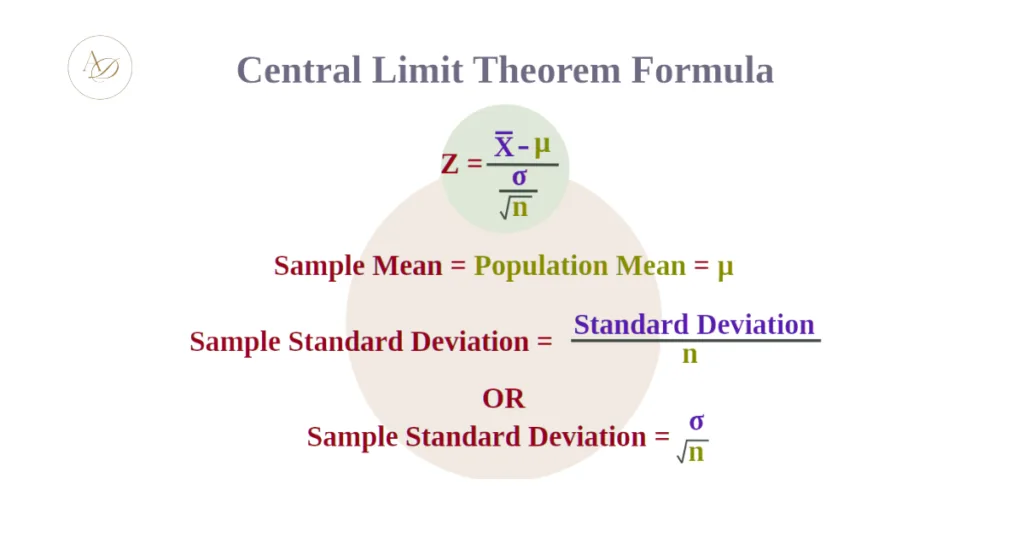
Mathematically, the Central Limit Theorem is expressed as:
Top 5 AI Tools for Generating 3D Animated Characters for Video 1

Where:

  • $\bar{X}$: The sample mean.
  • $\mu$: The population mean.
  • $\sigma$: The population standard deviation.
  • $n$: The sample size.

This formula demonstrates that the sampling distribution will have a mean equal to the population mean ($\mu$), but its spread (standard deviation) will shrink by a factor of $\sqrt{n}$. This refined spread is known as the Standard Error.

CLT at a Glance: Key Components

FeatureDescription
Core ConceptSample means will be normally distributed even if the population is not.
Mean ($\mu$)The mean of the sample means is equal to the population mean.
Standard ErrorCalculated as $\sigma / \sqrt{n}$; it decreases as sample size increases.
Magic NumberUsually $n \geq 30$ is considered sufficient for the theorem to take effect.

Real-World Implications

The Central Limit Theorem holds profound implications for both theoretical statistics and practical applications across various domains. Here are some key implications:

  1. Inference and Estimation: The CLT forms the basis for many statistical inference procedures, such as hypothesis testing and confidence interval estimation. It allows us to make inferences about population parameters based on sample statistics.
  2. Sample Size Determination: Understanding the CLT helps researchers determine the appropriate sample size for their studies. Larger sample sizes tend to produce more reliable estimates of population parameters.
  3. Quality Control: In fields like manufacturing and quality control, the CLT is instrumental in analyzing and monitoring processes. It enables practitioners to assess whether variations in product quality are within acceptable limits.
  4. Economics and Finance: The CLT is central to risk management, asset pricing models, and financial forecasting. It allows analysts to make robust predictions about future outcomes despite the uncertainty inherent in financial markets.
  5. Biostatistics and Epidemiology: In healthcare and epidemiological studies, the CLT facilitates the analysis of medical data, enabling researchers to draw meaningful conclusions about the effectiveness of treatments or the spread of diseases.

Related Articles :

Normal Distribution

Measurement of Dispersion

Limitations and Assumptions

While the Central Limit Theorem is a powerful tool, it’s essential to recognize its limitations and the assumptions underlying its applicability:

  1. Sample Size Requirement: The CLT assumes that the sample size is sufficiently large. While there is no strict rule for what constitutes a “sufficiently large” sample size, a commonly cited guideline is ( n [latex]\geq 30[/latex] ). However, this threshold can vary depending on the shape of the population distribution.
  2. Independence Assumption: The samples drawn must be independent of each other. In practical scenarios, this assumption may be violated if, for example, samples are taken from a time series data set where observations are correlated over time.
  3. Finite Variance: The CLT requires that the population from which the samples are drawn have a finite variance. In cases where the population variance is infinite, the CLT may not hold.

Beyond the Bell Curve A Deep Dive into the Central Limit Theorem 1

Conclusion

In conclusion, the Central Limit Theorem stands as a cornerstone of modern statistics, providing a powerful framework for understanding the behavior of sample means and their distributions. Its implications extend far beyond the realm of theoretical statistics, shaping our ability to make informed decisions and draw meaningful conclusions from data across diverse fields. By grasping the essence of the CLT and its underlying principles, statisticians, researchers, and practitioners unlock a world of analytical possibilities, empowering them to navigate the complexities of uncertainty with confidence and precision.

Frequently Asked Questions (FAQ)

1. Why is the Central Limit Theorem so important?

It allows statisticians to use the properties of the normal distribution to make inferences about a population, even when the population distribution is unknown or non-normal.

2. Does the population have to be normal for CLT to work?

No. That is the “magic” of the CLT—the population can be any shape. Only the distribution of the sample means needs to be normal.

3. What happens if my sample size is less than 30?

If the sample size is small, the CLT might not apply unless the underlying population is already normally distributed. For non-normal populations with small $n$, the results may be biased.

Artificial Intelligence Central Limit Theorem Machine Learning
Follow on Facebook Follow on X (Twitter) Follow on LinkedIn Follow on Instagram
Share. Facebook Twitter Pinterest LinkedIn Telegram Email Copy Link Reddit WhatsApp Threads
Previous ArticleZ-Score
Next Article Gradient Descent Optimizer
Arunangshu Das
  • Website
  • Facebook
  • X (Twitter)

Trust me, I'm a software developer—debugging by day, chilling by night.

Related Posts

SEO vs GEO: The New Battle for Online Visibility

June 18, 2026

What Is GEO (Generative Engine Optimization) and Why It Matters?

June 17, 2026

How Vertical AI SaaS Is Disrupting Every Industry?

June 15, 2026
Add A Comment
Leave A Reply Cancel Reply

You must be logged in to post a comment.

Top Posts

Future Technologies and Their Adaptability Across Programming Languages

July 2, 2024

Why Deep Learning requires GPU?

June 25, 2021

How NLP Works?

March 28, 2024

How NLP used in healthcare?

June 28, 2021
Don't Miss

10 Best Practices for Fine-Tuning AI Models

February 9, 20255 Mins Read

Fine-tuning AI models is both an art and a science. Whether you’re working with large…

How to Choose the Right SaaS Solution for Your Business? 8 Steps to Follow

June 9, 2025

QuillBot AI Review 2025: Best Paraphrasing Tool for Students & Writers?

July 15, 2025

Endpoint Security vs Antivirus: 5 Powerful Differences to know?

July 30, 2025
Stay In Touch
  • Facebook
  • Twitter
  • Pinterest
  • Instagram
  • LinkedIn

Subscribe to Updates

Subscribe to our newsletter for updates, insights, and exclusive content every week!

About Us

I am Arunangshu Das, a Software Developer passionate about creating efficient, scalable applications. With expertise in various programming languages and frameworks, I enjoy solving complex problems, optimizing performance, and contributing to innovative projects that drive technological advancement.

Facebook X (Twitter) Instagram LinkedIn RSS
Don't Miss

How to Migrate Your Website to Cloudways Without Downtime? 7 Steps to follow

June 23, 2025

5 Common Web Attacks and How to Prevent Them

February 14, 2025

Implementing Real-Time Data Sync with MongoDB and Node.js

December 23, 2024
Most Popular

AI AssistWorks Review: Features, Pricing & Use Cases

May 22, 2026

Gradient Descent Optimizer

April 8, 2024

10 Best Practices for Securing Your Backend

February 14, 2025
Arunangshu Das Blog
  • About Us
  • Contact Us
  • Write for Us
  • Advertise With Us
  • Privacy Policy
  • Terms & Conditions
  • Disclaimer
  • Article
  • Blog
  • Newsletter
  • Media House
© 2026 Arunangshu Das. Designed by Arunangshu Das.

Type above and press Enter to search. Press Esc to cancel.

Ad Blocker Enabled!
Ad Blocker Enabled!
Our website is made possible by displaying online advertisements to our visitors. Please support us by disabling your Ad Blocker.