


Building a scalable SaaS product in 2026 is not limited to iterative coding. It has now transformed into “vibe coding.” It’s now all about AI-assisted rapid prototyping with the correct balance of robust technical engineering and market validation.
Making a revenue-driving, problem-solving SaaS platform is faster and more accessible than ever. However, the real barrier is not building it; it’s deploying it fast enough in a market full of AI wrappers and niche tools.
Here is the step-by-step framework for building a modern, scalable SaaS from scratch with a mix of the right tools.
Blueprint for Building a Scalable SaaS Product
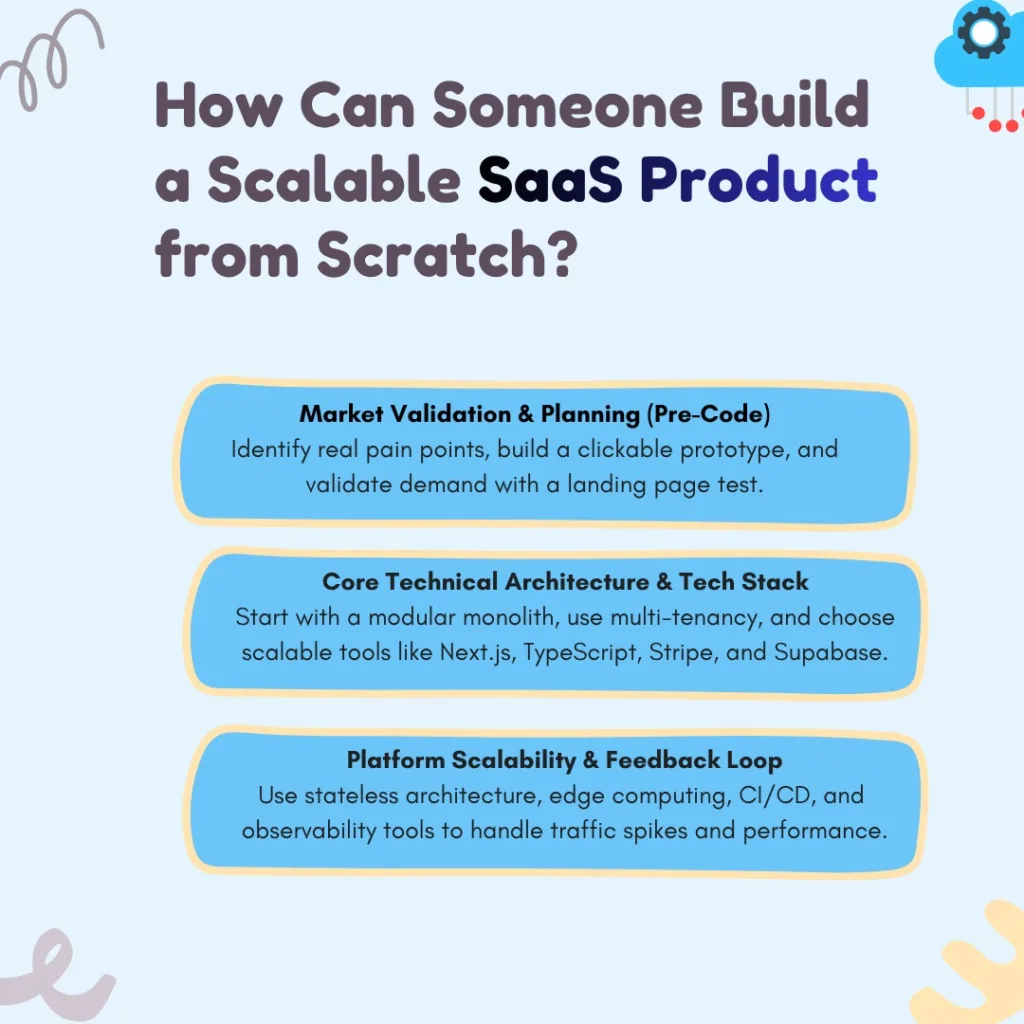
Step 1: Market Validation & Planning (Pre-Code)
Before writing a single line of code, make sure the problem is painful enough that people will pay to solve it. Start by identifying one repetitive, expensive pain point. Speak with at least five potential users and ask where they lose time, money, or visibility in their current workflow.
- Identify the “pain.”
Look for problems that are frequent, annoying, and tied to business outcomes. Good SaaS ideas usually sit at the intersection of urgency and repetition.
- Building a Clickable Prototype
Build an artificial but interactive UI using no-code tools like Framer, Softr, or Typedream. Circulate it within your potential clients & look for their friction points while using it.
- Monetization Strategy
Decide which pricing strategy aids your product roadmap best—is it the freemium model, usage-based pricing, or tiered pricing? This will help build your billing & user management layers.
- The Landing Page Test
A focused landing page can validate demand before the product exists.It’s easy and fast to create a high-converting landing page with the help of tools like Framer or Webflow.
Step 2: Core Technical Architecture
Scalability for a SaaS product is defined by multi-tenancy, a single instance of your software serving multiple customers/tenants. Designing this correctly is important to avoid “refactoring” (rewriting code) later.
- Start with a “modular monolith.”
Start with a single codebase where different features like billing, auth, and core logic are divided into cleanly arranged folders. This enables you to break them into independent services when a heavy data processing engine requires its dedicated server resources.
- Gradually Move to Microservices
Once your traffic starts growing, you can break them into independent services (like auth, payments, notifications) so they can scale separately.
Step 3:Design database isolation carefully
For many SaaS products, PostgreSQL with a shared database and tenant_id column is a strong default. If you want stronger security guarantees, PostgreSQL Row-Level Security (RLS) is especially valuable because it enforces tenant isolation at the database level instead of relying only on application logic.
For products with unstructured or rapidly changing data models, MongoDB may still be useful, but PostgreSQL remains the more natural choice for most multi-tenant SaaS platforms because of its reliability, relational structure, and strong security controls.
Step 4:The 2026 Tech Stack Blueprint
Choosing the right tech stack is the mover’s advantage to enter early in the market.
- Frontend: Next.js as an industry best helps with faster page loads, SEO & complex UI handling. For rapid styling, pairing it with Tailwind CSS is the best choice.
- Backend & API: TypeScript across the entire stack (Node.js/Next.js) reduces bugs by ensuring data types are consistent from the database to the browser.
- The “Unbundling” Strategy: Don’t build what you can buy.
- Authentication: Use Clerk or Auth0. Building a secure login system from scratch is a liability.
- Payments: Stripe is non-negotiable for handling global taxes, subscriptions, and dunning (failed payment recovery).
- Database: Supabase or PlanetScale offers “serverless” databases that grow automatically as your user base expands.
Step 5: Platform Capable of Handling Traffic Spike
A scalable SaaS platform isn’t one that can handle lakhs of users. It’s when it can seamlessly handle 10,000 users in a single minute without crashing.
- Statelessness
It’s the key to ensure the application servers aren’t remembering individual users. Caches like Redis are super helpful in storing all session data. With it, you can add up to 10 extra servers and avoid downtime during sudden traffic spikes.
- Edge Computing
Platforms like Vercel or Cloudflare Workers are super effective in running code based on users’ geographic location. This helps avoid latency and maximum uptime no matter where the customer is located.
- Asynchronous Processing
If a task takes more than 200ms (like generating a PDF or sending a mass email), don’t make the user wait. Push that task to a Message Queue (like Inngest or BullMQ) to be handled in the background.
Step 6: The Feedback Loop
Once the aspired SaaS product’s MVP (Minimum Viable Product) is live, now the job shifts from being a developer to an analyst.
a) Watch churn closely
Remember, getting new users is not the real win; sustaining them is. Tools like Mixpanel or PostHog help analyze where the users are dropping off in their journey. If they are struggling to complete the “onboarding,” your UI needs a revamp.
- CI/CD (Continuous Integration/Deployment)
It’s a safe bet to automate your deployment using GitHub Actions. Wherever a bug is fixed, it would go live automatically after passing through automated tests. Super efficient in rolling out product updates 5–10 times a day without any hassle. It won’t break your existing features.
- Infrastructure as Code (IaC)
It’s super beneficial to document your server setup in code with platforms like Terraform or Pulumi. Super helpful in case your current server provider acts out. This will help you create the entire infrastructure on a new provider with a single command.
- Observability
It’s impossible to fix what you cannot see. Datadog or Prometheus comes in handy for tracking performance, detecting issues, and visualizing key metrics to ensure the system’s reliability.
Conclusion
Building a scalable SaaS is no longer about having the biggest server; it’s about having the smartest architecture. By validating the problem early, choosing a high-velocity tech stack, and leveraging “unbundled” services like Stripe and Clerk, you can focus on the only thing that matters: delivering value to your users.
Scalability is a journey of removing bottlenecks. Start simple, stay modular, and always keep the “tenant” at the center of your code.
FAQs
1. How do you ensure SaaS scalability during sudden traffic spikes?
It’s best to implement load balancing, auto-scaling, and stateless services. On top of that, using cloud-native infrastructure, caching layers, and distributed systems can dynamically help handle traffic spikes without breaking user experience.
2. What role does multi-tenancy play in SaaS scalability?
Multi-tenancy enables efficient resource utilization by serving multiple customers on shared infrastructure. It reduces costs, simplifies deployment, and ensures scalability while maintaining logical data isolation through schema or database-level separation.
3. How important is API-first design in SaaS products?
API-first design ensures seamless integrations, modular development, and faster scaling. It allows SaaS products to connect with third-party tools, support microservices architecture, and enable flexible feature expansion across platforms.
4. When should a SaaS product transition from monolith to microservices?
Transition when scaling bottlenecks, deployment complexity, or team size increases. Microservices improve flexibility, independent scaling, and faster releases but require strong DevOps maturity and system orchestration capabilities.
