


Understanding the Core Concepts
When you think of your startup as a new cafe in a not-so-busy street, then the concept of demand generation against Lead generation will be much easier to comprehend. Demand generation is similar to making people desire coffee even before they can find out about the existence of your cafe. It is all about building awareness, curiosity and trust. Startups create a fanbase of people who are really interested in what they produce through content, storytelling and education.
An effective inbound strategy of marketing significantly contributes to this. Social media content, blogs, webinars, and posts created by the attempt to optimize the search of a specific topic can all assist your brand in appearing on the list in which your audience already spends their time. Rather than pushing sales, demand generation is a pull factor that pulls people in naturally.
In the case of early startups, such a strategy creates long-term value. It does not provide immediate leads, but it establishes a pipeline of individuals who believe in your brand. Such trust will be the basis of scalable growth.
What is Lead Generation?
On the other hand, lead generation is more direct. Like giving a Buy 1 Get 1 Free Coffee until you run out of people that may want your coffee at the moment you want people to buy your coffee. You are getting contact information-emails, phone numbers, or Sign-ups so that you can translate them into customers.
There are also the forms, landing pages, and magnets as examples of free eBooks or templates, or demos. This style emphasizes a lot on quantifiable outcomes and short term victories.
In startups that require rapid traction and increased flow, lead generation to startups may seem the easy choice. However, the trick here is that when people do not trust your brand, the chances of it converting might remain low.
The Key Difference
1. Difference between demand gen and lead gen
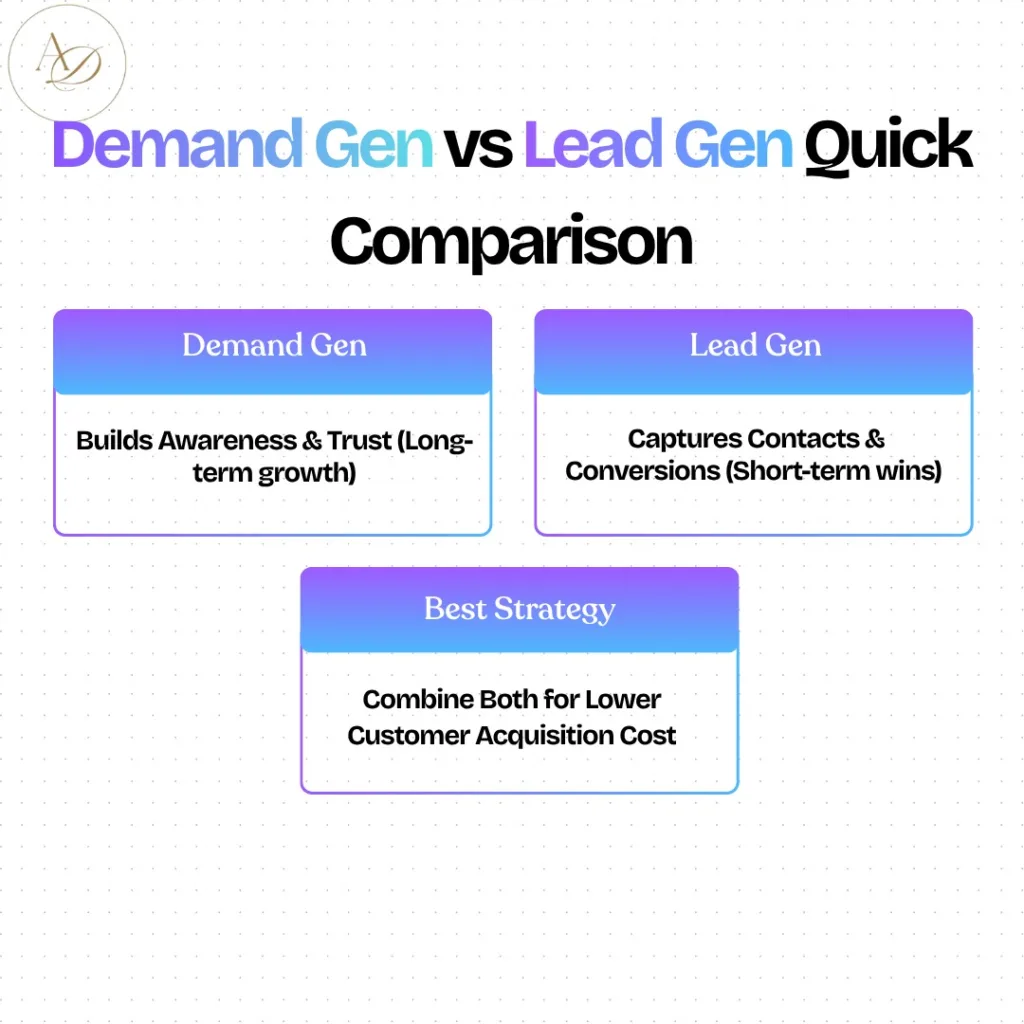
There is a distinction between demand gen and lead gen based on timing and purpose. Demand generation creates awareness in the first stage, and the lead generation takes an interest in what is already there.
- Demand gen = relationship building in the long term.
- Lead Gen = short term conversion emphasis.
2. Demand generation vs lead generation explained simply
Demand generation can be considered planting a seed and lead generation can be considered harvesting crops. Without seeds, there will be nothing to harvest. This is why startups which only specialize in leads tend to have quality difficulties.
Why Early Startups Struggle With This Choice
Startups are usually pressured with little funds available, high expectations and an urgency to grow. Of course, they incline to the strategies that will yield the immediate results.
The truth here, however, is that concentrating on the leads but not creating demand is like being in a market where no one feels hot concentrating on the leads alone but not on creating demand. You could have, but the conversions will be costly and unpredictable.
It is a balance between both strategies that smart founders win.
Role of Customer Acquisition Strategy
Your customer acquisition strategy defines the way you get and convert users. Assuming that it is extremely biased towards advertisements and lead capturing, your Customer Acquisition Cost may soar to the ground.
A. How Customer Acquisition Cost impacts decisions
When startups user paid campaigns solely, they usually experience an increase in costs in the long term. Demand generation can aid in lessening this by creating organic traffic and brand remembrance.
In short words, demand gen reduces your Customer Acquisition Cost whereas lead gen assists you expand at a more rapid pace when demand is already there.
Demand Generation in Action
1. Inbound marketing strategy examples
An effective inbound marketing plan consists of content marketing, SEO, and social interactions. To illustrate, writing blogs to respond to real user queries or producing educational videos will be trusted with time.
SaaS, and other startup companies, frequently depend greatly on this strategy. They train users prior to making sales such that the decision to buy is not dictated.
2. B2b demand generation strategy
A b2b demand generation model aims at developing decision-makers by giving them valuable content. Consider webinars, LinkedIn posts, case studies, and thought leadership.
Rather than following the lead, you will appeal to your brand as the recognized one once consumers are willing.
Lead Generation in Action
1. Lead generation for startups tactics
For startups needing quick traction, lead generation for startups includes paid ads, landing pages, and email capture forms. These tactics work best when paired with strong messaging.
2. Lead magnets examples
Good examples of magnets would be:
- Free trials
- Ebooks or guides
- Discount offers
- Templates or tools
Such incentives give the users the impetus to leave contact details enabling startups to give the customer a boost.
Performance Marketing vs Brand Marketing
Whether to call the performance marketing or a brand marketing would be the ideal subject matter in this discussion. Performance marketing puts emphasis on immediate ROI- clicks, leads and conversions. Similar to the demand generation, brand marketing creates awareness and trust through time.
Startups failing to consider brand building usually experience the increasing costs of ads and the deteriorating returns. In the meantime investors to both have sustainable growth.
Go To Market Strategy Startup Perspective
A start up plan combined with both demand and lead generation is a solid go to market strategy start up plan. In its initial development phase, startups are recommended to channel a little more attention to demand to create awareness. Conversions can be scaled up as traction increases and generation makes these conversions.
It is not about having to pick one– it is a timing and balance thing.
Can You Do Both Together?
The most successful startups are not between demand generation vs lead generation- they are both integrated.
An example is where a blog (demand gen) has a downloadable guide (lead gen). In the process you obtain and translate in a single continuous journey.
Lead Generation Without Paying
Most founders believe there’s never an occasion when generation of leads is not done through advertisements. However, it is possible to generate leads with no payment due to SEO, organic social media, and referrals.
Producing content that is valuable, startups can get organically, as opposed to relying on paid campaigns.
B2B Cold Email and Its Role
B2B Cold Email is still quite a potent tool when properly executed. Rather than generics, value-based and personalised email messages can produce quality.
Cold emails are not as obtrusive when paired up with demand generation; rather, they appear more relevant.
Expert Guidance and Real Growth
Most startups are not able to adopt the appropriate demand and lead generation balance. This is one of the areas when the professional straightforward is invaluable. Professionals such as Arunangshudas assist startups with crafting a clear customer acquisition strategy, optimize campaigns and reduce Customer Acquisition Cost.
Startups can also escape many of the most frequent pitfalls as well as align their go to market strategy startup and scale more quickly with a combination of demand building and conversion focused strategies. You may as well as have someone experienced to guide you through and can turn confusion to clarity and effort to quantifiable growth.
Conclusion
It is not about picking sides when it comes to the topic of demand generation vs lead generation. The foundation is generated through demand generation and government is the resultant action initiated through lead generation.
Those new companies can attain fast successes but long-run failure. The investors in the demand develop sustainable growth and great brand equity. The best way to do it is to combine the two guaranteeing consistent traffic, quality and reduced Customer Acquisition Cost in the long term.
FAQs
1. What is the main difference between demand gen and lead gen?
The distinction between demand gen and lead gen is that demand gen generates awareness, whereas, gen creates interested prospects.
2. What is more suitable when starting up early?
Startups should put an emphasis to demand generation initially and subsequently to generation.
3. Is it possible to lower Customer Acquisition Cost by use of demand gen?
Yes, the demand generation assists in reducing Customer Acquisition Cost by drawing in organic traffic.
4. How effective is B2B Cold Email?
Yea, B2B Cold Email is effective when it has been personalized, and strong value propositions have been established.
5. Which are some good examples of lead magnets?
Some of the most common examples of popular magnets are free trials, ebooks, templates and discounts.
