


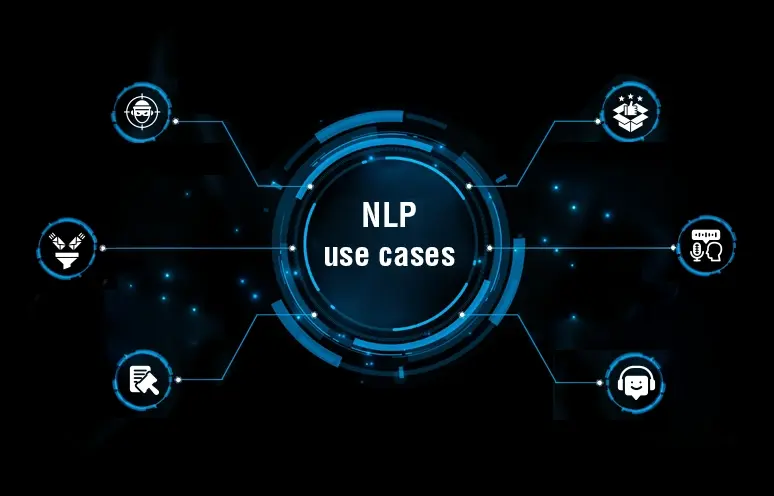
NLP use cases are now fundamental to how industries operate, innovate, and interact with customers. Natural Language Processing (NLP), a critical branch of artificial intelligence (AI), enables machines to understand, interpret, and generate human language.
From streamlining back-office operations to creating personalized front-end experiences, the NLP applications transforming business are both profound and diverse. This article explores the most impactful natural language processing use cases driving efficiency and insight across key sectors today.
Table of Contents
Understanding NLP in AI
Before diving into specific applications, it’s essential to grasp what NLP in AI entails. NLP combines computational linguistics with statistical and machine learning models to bridge the gap between human communication and computer understanding. It moves beyond simple keyword matching to comprehend context, sentiment, and intent.
This capability unlocks a world where machines can read vast document sets in seconds, maintain coherent conversations, and extract actionable meaning from unstructured text data—which constitutes over 80% of all enterprise data. The evolution of deep learning and large language models (LLMs) has dramatically accelerated the sophistication and accuracy of these NLP applications.
Core NLP Use Cases in Business

Several foundational NLP use cases serve as building blocks across industries. These are the functional applications that solve universal business problems.
- Sentiment Analysis & Voice of the Customer: This is one of the most widespread natural language processing use cases. AI models scan social media posts, product reviews, survey responses, and support tickets to determine customer sentiment—positive, negative, or neutral. Brands use this for real-time brand monitoring, measuring campaign success, and identifying pain points in the customer journey.
- Intelligent Chatbots & Virtual Assistants: Gone are the days of clunky, rule-based bots. Modern NLP in AI powers conversational agents that understand nuanced queries, manage context throughout a dialogue, and provide accurate, helpful responses. They handle routine customer inquiries, internal IT helpdesk tickets, and appointment scheduling, freeing human agents for complex issues.
- Machine Translation: While tools like Google Translate are consumer-facing, enterprise NLP applications for translation localize training materials, translate legal documents for global compliance, and enable real-time communication in multinational teams, breaking down language barriers in operational workflows.
- Text Summarization & Information Extraction: NLP models can digest lengthy reports, legal contracts, or research papers and produce concise, coherent summaries. A related use case is Named Entity Recognition (NER), which automatically pulls out key information like names, dates, monetary values, and medical codes from unstructured text, feeding it directly into databases.
Industry-Specific Applications of NLP
The true power of NLP is revealed when these core functions are applied to sector-specific challenges.
1. Healthcare & Life Sciences
The healthcare industry leverages NLP use cases to improve patient outcomes and administrative efficiency.
- Clinical Documentation: NLP transcribes and structures physician notes from patient encounters, auto-populating Electronic Health Records (EHRs). This reduces clinician burnout and improves data accuracy.
- Medical Research & Drug Discovery: AI models analyze millions of academic papers, clinical trial reports, and patient forums to identify potential drug candidates, uncover adverse effect patterns, and accelerate literature reviews.
- Intelligent Triage: Chatbots use symptom checking and patient-reported information to provide preliminary triage advice, directing individuals to the appropriate level of care.
2. Financial Services & Banking
In finance, NLP applications are crucial for risk management, compliance, and customer experience.
- Fraud Detection: By analyzing the language in customer service calls, transaction memos, and email communications, NLP can identify subtle, fraudulent patterns that rule-based systems miss.
- Algorithmic Trading & Market Intelligence: Models analyze news articles, earnings reports, and social media sentiment to gauge market mood and inform trading algorithms in real time.
- Contract Analysis & Compliance: NLP in AI reviews thousands of loan agreements or regulatory documents to ensure compliance, extract key clauses, and assess risk exposure, a process that would take humans months.
3. Retail & E-Commerce
Retailers use natural language processing use cases to personalize the shopping journey and optimize operations.
- Enhanced Search & Product Discovery: NLP goes beyond keywords to understand search intent. A query for “a comfortable dress for a summer wedding” understands concepts of occasion, season, and attribute.
- Review Analysis & Insight Generation: Automatically analyzing customer reviews to highlight frequently praised features or recurring complaints about products, providing direct feedback to merchandising and product development teams.
- Personalized Marketing: Generating personalized product descriptions or marketing email copy tailored to individual user profiles and browsing history.
4. Legal & Professional Services
The legal domain, inundated with documents, is revolutionized by NLP applications.
- E-Discovery & Due Diligence: During litigation or mergers, NLP can sift through millions of emails and documents to find relevant evidence or flag potential liabilities, cutting down manual review time exponentially.
- Legal Document Automation: Generating first drafts of standard legal contracts (like NDAs or leases) by extracting relevant terms from a questionnaire, ensuring consistency and saving billable hours.
5. Media & Content Moderation
Platforms rely on advanced NLP use cases to manage content at scale.
- Automated Content Moderation: Identifying and flagging hate speech, harassment, violent threats, or inappropriate content in user-generated posts, comments, and videos, even when users attempt to evade filters with slang or misspellings.
- Content Recommendation: Understanding the themes and sentiment of articles, videos, or podcasts to recommend the next most relevant piece of content to a user, increasing engagement.
The Future and Challenges of NLP Implementation
The frontier of NLP in AI is moving toward more nuanced understanding, multi-modal systems (combining text with vision and audio), and greater personalization. However, implementing these natural language processing use cases comes with challenges. Bias in training data can lead to unfair or skewed outcomes. Languages with less digital resources (low-resource languages) are harder to model accurately.
Furthermore, ensuring data privacy and security, especially when processing sensitive customer or patient information, is paramount. Successful implementation requires clear problem definition, high-quality and ethical data sourcing, and ongoing human oversight.
Conclusion
The NLP use cases spanning today’s industries demonstrate that language is not just a human tool but a critical data pipeline. NLP applications in sentiment analysis, intelligent automation, and deep document insight are no longer futuristic concepts but present-day competitive necessities.
As NLP in AI continues to evolve, its capacity to unlock the value hidden in human language will only grow, creating more intuitive interfaces, empowering data-driven decisions, and reshaping professional workflows across every sector that depends on communication and information.
Frequently Asked Questions (FAQs)
1. What is the main benefit of using NLP over traditional text analysis methods?
The primary benefit is understanding context and meaning. Traditional methods often rely on simple keyword searches or rule-based patterns, which miss nuance, sarcasm, and intent. NLP in AI uses statistical models to comprehend grammar, sentiment, relationships between entities, and the overall topic, allowing for a much more accurate and insightful analysis of unstructured text data at scale.
2. What’s the difference between NLP and generative AI (like ChatGPT)?
NLP is the broad field of enabling computers to understand human language. It includes many NLP applications like classification, extraction, and sentiment analysis. Generative AI is a subset of NLP focused specifically on creating new, coherent text. Think of NLP as the entire toolbox for language, with generative AI being one powerful tool (like a text-creation wrench) within that box. All generative AI uses NLP, but not all NLP involves generation.
3. What are the key challenges in implementing an NLP project?
Three major challenges are: Data Quality & Bias: NLP models learn from data; if the training data is biased or low-quality, the outputs will be too. Context & Ambiguity: Language is filled with homonyms, sarcasm, and cultural references that can be difficult for models to interpret correctly.
